 Add to Chrome
 Add to Firefox
 Add to Edge
Silu
Papers and Code
NLI:Non-uniform Linear Interpolation Approximation of Nonlinear Operations for Efficient LLMs Inference
Feb 03, 2026
Large Language Models (LLMs) have demonstrated remarkable performance across a wide range of tasks, but their deployment is often constrained by substantial memory footprints and computational costs. While prior work has achieved significant progress in compressing and accelerating linear layers, nonlinear layers-such as SiLU, RMSNorm, and Softmax-still heavily depend on high-precision floating-point operations. In this paper, we propose a calibration-free, dynamic-programming-optimal, and hardware-friendly framework called Non-uniform Linear Interpolation (NLI). NLI is capable of efficiently approximating a variety of nonlinear functions, enabling seamless integration into LLMs and other deep neural networks with almost no loss in accuracy. NLI ingeniously recasts cutpoint selection as a dynamic-programming problem, achieving the globally minimal interpolation error in O(MxN2) time via Bellman's optimality principle. Based on the NLI algorithm, we also design and implement a plug-and-play universal nonlinear computation unit. Hardware experiments demonstrate that the NLI Engine achieves more than 4x improvement in computational efficiency compared to the state-of-the-art designs.

SpikySpace: A Spiking State Space Model for Energy-Efficient Time Series Forecasting
Jan 02, 2026Time-series forecasting often operates under tight power and latency budgets in fields like traffic management, industrial condition monitoring, and on-device sensing. These applications frequently require near real-time responses and low energy consumption on edge devices. Spiking neural networks (SNNs) offer event-driven computation and ultra-low power by exploiting temporal sparsity and multiplication-free computation. Yet existing SNN-based time-series forecasters often inherit complex transformer blocks, thereby losing much of the efficiency benefit. To solve the problem, we propose SpikySpace, a spiking state-space model (SSM) that reduces the quadratic cost in the attention block to linear time via selective scanning. Further, we replace dense SSM updates with sparse spike trains and execute selective scans only on spike events, thereby avoiding dense multiplications while preserving the SSM's structured memory. Because complex operations such as exponentials and divisions are costly on neuromorphic chips, we introduce simplified approximations of SiLU and Softplus to enable a neuromorphic-friendly model architecture. In matched settings, SpikySpace reduces estimated energy consumption by 98.73% and 96.24% compared to two state-of-the-art transformer based approaches, namely iTransformer and iSpikformer, respectively. In standard time series forecasting datasets, SpikySpace delivers competitive accuracy while substantially reducing energy cost and memory traffic. As the first full spiking state-space model, SpikySpace bridges neuromorphic efficiency with modern sequence modeling, marking a practical and scalable path toward efficient time series forecasting systems.
MODE: Efficient Time Series Prediction with Mamba Enhanced by Low-Rank Neural ODEs
Jan 01, 2026Time series prediction plays a pivotal role across diverse domains such as finance, healthcare, energy systems, and environmental modeling. However, existing approaches often struggle to balance efficiency, scalability, and accuracy, particularly when handling long-range dependencies and irregularly sampled data. To address these challenges, we propose MODE, a unified framework that integrates Low-Rank Neural Ordinary Differential Equations (Neural ODEs) with an Enhanced Mamba architecture. As illustrated in our framework, the input sequence is first transformed by a Linear Tokenization Layer and then processed through multiple Mamba Encoder blocks, each equipped with an Enhanced Mamba Layer that employs Causal Convolution, SiLU activation, and a Low-Rank Neural ODE enhancement to efficiently capture temporal dynamics. This low-rank formulation reduces computational overhead while maintaining expressive power. Furthermore, a segmented selective scanning mechanism, inspired by pseudo-ODE dynamics, adaptively focuses on salient subsequences to improve scalability and long-range sequence modeling. Extensive experiments on benchmark datasets demonstrate that MODE surpasses existing baselines in both predictive accuracy and computational efficiency. Overall, our contributions include: (1) a unified and efficient architecture for long-term time series modeling, (2) integration of Mamba's selective scanning with low-rank Neural ODEs for enhanced temporal representation, and (3) substantial improvements in efficiency and scalability enabled by low-rank approximation and dynamic selective scanning.
On the Approximation Power of SiLU Networks: Exponential Rates and Depth Efficiency
Dec 13, 2025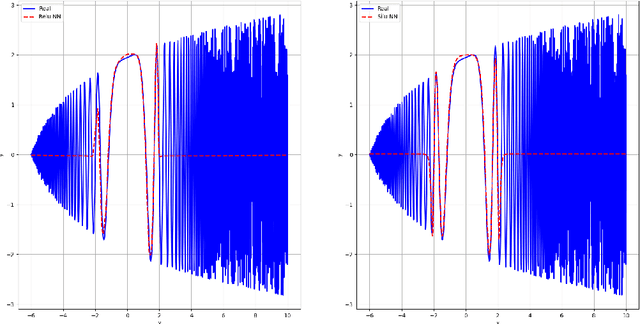

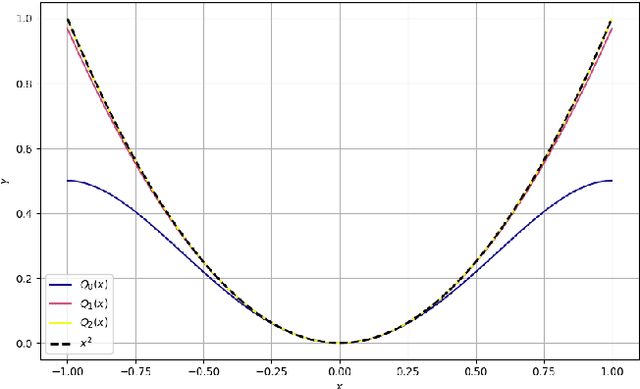
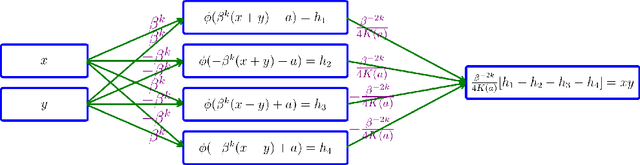
This article establishes a comprehensive theoretical framework demonstrating that SiLU (Sigmoid Linear Unit) activation networks achieve exponential approximation rates for smooth functions with explicit and improved complexity control compared to classical ReLU-based constructions. We develop a novel hierarchical construction beginning with an efficient approximation of the square function $x^2$ more compact in depth and size than comparable ReLU realizations, such as those given by Yarotsky. This construction yields an approximation error decaying as $\mathcal{O}(ω^{-2k})$ using networks of depth $\mathcal{O}(1)$. We then extend this approach through functional composition to establish sharp approximation bounds for deep SiLU networks in approximating Sobolev-class functions, with total depth $\mathcal{O}(1)$ and size $\mathcal{O}(\varepsilon^{-d/n})$.
Stochastic activations
Sep 26, 2025We introduce stochastic activations. This novel strategy randomly selects between several non-linear functions in the feed-forward layer of a large language model. In particular, we choose between SILU or RELU depending on a Bernoulli draw. This strategy circumvents the optimization problem associated with RELU, namely, the constant shape for negative inputs that prevents the gradient flow. We leverage this strategy in two ways: (1) We use stochastic activations during pre-training and fine-tune the model with RELU, which is used at inference time to provide sparse latent vectors. This reduces the inference FLOPs and translates into a significant speedup in the CPU. Interestingly, this leads to much better results than training from scratch with the RELU activation function. (2) We evaluate stochastic activations for generation. This strategy performs reasonably well: it is only slightly inferior to the best deterministic non-linearity, namely SILU combined with temperature scaling. This offers an alternative to existing strategies by providing a controlled way to increase the diversity of the generated text.
eMamba: Efficient Acceleration Framework for Mamba Models in Edge Computing
Aug 14, 2025State Space Model (SSM)-based machine learning architectures have recently gained significant attention for processing sequential data. Mamba, a recent sequence-to-sequence SSM, offers competitive accuracy with superior computational efficiency compared to state-of-the-art transformer models. While this advantage makes Mamba particularly promising for resource-constrained edge devices, no hardware acceleration frameworks are currently optimized for deploying it in such environments. This paper presents eMamba, a comprehensive end-to-end hardware acceleration framework explicitly designed for deploying Mamba models on edge platforms. eMamba maximizes computational efficiency by replacing complex normalization layers with lightweight hardware-aware alternatives and approximating expensive operations, such as SiLU activation and exponentiation, considering the target applications. Then, it performs an approximation-aware neural architecture search (NAS) to tune the learnable parameters used during approximation. Evaluations with Fashion-MNIST, CIFAR-10, and MARS, an open-source human pose estimation dataset, show eMamba achieves comparable accuracy to state-of-the-art techniques using 1.63-19.9$\times$ fewer parameters. In addition, it generalizes well to large-scale natural language tasks, demonstrating stable perplexity across varying sequence lengths on the WikiText2 dataset. We also quantize and implement the entire eMamba pipeline on an AMD ZCU102 FPGA and ASIC using GlobalFoundries (GF) 22 nm technology. Experimental results show 4.95-5.62$\times$ lower latency and 2.22-9.95$\times$ higher throughput, with 4.77$\times$ smaller area, 9.84$\times$ lower power, and 48.6$\times$ lower energy consumption than baseline solutions while maintaining competitive accuracy.
Robust Deep Network Learning of Nonlinear Regression Tasks by Parametric Leaky Exponential Linear Units (LELUs) and a Diffusion Metric
Jul 09, 2025This document proposes a parametric activation function (ac.f.) aimed at improving multidimensional nonlinear data regression. It is a established knowledge that nonlinear ac.f.'s are required for learning nonlinear datasets. This work shows that smoothness and gradient properties of the ac.f. further impact the performance of large neural networks in terms of overfitting and sensitivity to model parameters. Smooth but vanishing-gradient ac.f.'s such as ELU or SiLU have limited performance and non-smooth ac.f.'s such as RELU and Leaky-RELU further impart discontinuity in the trained model. Improved performance is demonstrated with a smooth "Leaky Exponential Linear Unit", with non-zero gradient that can be trained. A novel diffusion-loss metric is also proposed to gauge the performance of the trained models in terms of overfitting.
Gated Rotary-Enhanced Linear Attention for Long-term Sequential Recommendation
Jun 16, 2025In Sequential Recommendation Systems (SRSs), Transformer models show remarkable performance but face computation cost challenges when modeling long-term user behavior sequences due to the quadratic complexity of the dot-product attention mechanism. By approximating the dot-product attention, linear attention provides an efficient option with linear complexity. However, existing linear attention methods face two limitations: 1) they often use learnable position encodings, which incur extra computational costs in long-term sequence scenarios, and 2) they may not consider the user's fine-grained local preferences and confuse these with the actual change of long-term interests. To remedy these drawbacks, we propose a long-term sequential Recommendation model with Gated Rotary Enhanced Linear Attention (RecGRELA). Specifically, we first propose a Rotary-Enhanced Linear Attention (RELA) module to model long-range dependency within the user's historical information using rotary position encodings. We then introduce a local short operation to incorporate local preferences and demonstrate the theoretical insight. We further introduce a SiLU-based Gated mechanism for RELA (GRELA) to help the model determine whether a user's behavior indicates local interest or a genuine shift in long-term preferences. Experimental results on four public datasets demonstrate that our RecGRELA achieves state-of-the-art performance compared to existing SRSs while maintaining low memory overhead.
The Resurrection of the ReLU
May 28, 2025Modeling sophisticated activation functions within deep learning architectures has evolved into a distinct research direction. Functions such as GELU, SELU, and SiLU offer smooth gradients and improved convergence properties, making them popular choices in state-of-the-art models. Despite this trend, the classical ReLU remains appealing due to its simplicity, inherent sparsity, and other advantageous topological characteristics. However, ReLU units are prone to becoming irreversibly inactive - a phenomenon known as the dying ReLU problem - which limits their overall effectiveness. In this work, we introduce surrogate gradient learning for ReLU (SUGAR) as a novel, plug-and-play regularizer for deep architectures. SUGAR preserves the standard ReLU function during the forward pass but replaces its derivative in the backward pass with a smooth surrogate that avoids zeroing out gradients. We demonstrate that SUGAR, when paired with a well-chosen surrogate function, substantially enhances generalization performance over convolutional network architectures such as VGG-16 and ResNet-18, providing sparser activations while effectively resurrecting dead ReLUs. Moreover, we show that even in modern architectures like Conv2NeXt and Swin Transformer - which typically employ GELU - substituting these with SUGAR yields competitive and even slightly superior performance. These findings challenge the prevailing notion that advanced activation functions are necessary for optimal performance. Instead, they suggest that the conventional ReLU, particularly with appropriate gradient handling, can serve as a strong, versatile revived classic across a broad range of deep learning vision models.
Localized Weather Prediction Using Kolmogorov-Arnold Network-Based Models and Deep RNNs
May 27, 2025Weather forecasting is crucial for managing risks and economic planning, particularly in tropical Africa, where extreme events severely impact livelihoods. Yet, existing forecasting methods often struggle with the region's complex, non-linear weather patterns. This study benchmarks deep recurrent neural networks such as $\texttt{LSTM, GRU, BiLSTM, BiGRU}$, and Kolmogorov-Arnold-based models $(\texttt{KAN} and \texttt{TKAN})$ for daily forecasting of temperature, precipitation, and pressure in two tropical cities: Abidjan, Cote d'Ivoire (Ivory Coast) and Kigali (Rwanda). We further introduce two customized variants of $ \texttt{TKAN}$ that replace its original $\texttt{SiLU}$ activation function with $ \texttt{GeLU}$ and \texttt{MiSH}, respectively. Using station-level meteorological data spanning from 2010 to 2024, we evaluate all the models on standard regression metrics. $\texttt{KAN}$ achieves temperature prediction ($R^2=0.9986$ in Abidjan, $0.9998$ in Kigali, $\texttt{MSE} < 0.0014~^\circ C ^2$), while $\texttt{TKAN}$ variants minimize absolute errors for precipitation forecasting in low-rainfall regimes. The customized $\texttt{TKAN}$ models demonstrate improvements over the standard $\texttt{TKAN}$ across both datasets. Classical \texttt{RNNs} remain highly competitive for atmospheric pressure ($R^2 \approx 0.83{-}0.86$), outperforming $\texttt{KAN}$-based models in this task. These results highlight the potential of spline-based neural architectures for efficient and data-efficient forecasting.