 Add to Chrome
 Add to Firefox
 Add to Edge
HYDRA: A Heterogeneous Chiplet DSE Framework for Serving Dynamic Hybrid LLM Workloads
Aug 19, 2026
Hybrid Transformer-Mamba large language models (LLMs) enhance long-context efficiency, but their heterogeneous computation and communication patterns complicate efficient hardware acceleration. Chiplet-based architectures offer a scalable solution by integrating specialized compute and memory units. However, the design space spanning static architectural configurations and dynamic runtime policies is prohibitively large to explore exhaustively. To address this challenge, we present HYDRA, a comprehensive design space exploration framework for hybrid LLM serving on heterogeneous chiplet systems. HYDRA jointly explores chiplet composition, placement, inter-chiplet bandwidth provisioning, dynamic batching, and runtime scheduling. It integrates communication-aware placement, dynamic batching, elastic task scheduling, and a fast Markov-based performance estimator that captures multi-tenant runtime dynamics for efficient and accurate exploration. Across all workloads, HYDRA delivers 1.55x the throughput and 43.7 percent lower time-to-first-token on average, with throughput gains reaching up to 2.3x compared to state-of-the-art baselines. These results highlight that co-designing architecture and runtime policies is critical for efficient large-scale LLM serving on heterogeneous chiplet systems.

Agile perceptive multi-skill locomotion for quadrupedal robots in the wild
Jul 15, 2026Enabling quadrupedal robots to traverse complex terrains-from rugged outdoor environments to urban landscapes-requires seamless integration of multiple motor skills, smooth transitions between gaits, and high-speed perceptive locomotion using only onboard sensors. We present APT-RL (Action Pretrained Transformer-based Reinforcement Learning), a unified framework that enables multi-skill locomotion to achieve high-speed traversal in complex environments through autonomous skill transitions utilizing only onboard perception and computation. Our approach generates large-scale, feature-rich 2D motion datasets through trajectory optimization with simplified dynamics. These datasets enable training of diverse, reusable locomotion skills that transfer effectively to a real quadruped robot operating on complex uneven terrains. The resulting high-quality skills serve as strong priors for efficient learning of complex downstream tasks and extend naturally to 3D environments, enabling smooth, high-speed multi-skill locomotion in deployed policy. Real-world experiments demonstrate the framework's capabilities: the robot performs agile maneuvers through complex indoor obstacles and outdoor wild environments, including dynamic drop-down maneuvers that reach instantaneous peak speeds of up to 6 meters per second. A single onboard policy enables robust traversal of diverse obstacles, including stairs, hurdles, stepping stones, gaps, and fallen branches, demonstrating the versatility and effectiveness of our approach.
Random Is Hard to Beat: Active Selection in online DPO with Modern LLMs
Apr 03, 2026Modern LLMs inherit strong priors from web-scale pretraining, which can limit the headroom of post-training data-selection strategies. While Active Preference Learning (APL) seeks to optimize query efficiency in online Direct Preference Optimization (DPO), the inherent richness of on-policy candidate pools often renders simple Random sampling a surprisingly formidable baseline. We evaluate uncertainty-based APL against Random across harmlessness, helpfulness, and instruction-following settings, utilizing both reward models and LLM-as-a-judge proxies. We find that APL yields negligible improvements in proxy win-rates compared to Random. Crucially, we observe a dissociation where win-rate improves even as general capability -- measured by standard benchmarks -- degrades. APL fails to mitigate this capability collapse or reduce variance significantly better than random sampling. Our findings suggest that in the regime of strong pre-trained priors, the computational overhead of active selection is difficult to justify against the ``cheap diversity'' provided by simple random samples. Our code is available at https://github.com/BootsofLagrangian/random-vs-apl.
STONE Dataset: A Scalable Multi-Modal Surround-View 3D Traversability Dataset for Off-Road Robot Navigation
Mar 12, 2026Reliable off-road navigation requires accurate estimation of traversable regions and robust perception under diverse terrain and sensing conditions. However, existing datasets lack both scalability and multi-modality, which limits progress in 3D traversability prediction. In this work, we introduce STONE, a large-scale multi-modal dataset for off-road navigation. STONE provides (1) trajectory-guided 3D traversability maps generated by a fully automated, annotation-free pipeline, and (2) comprehensive surround-view sensing with synchronized 128-channel LiDAR, six RGB cameras, and three 4D imaging radars. The dataset covers a wide range of environments and conditions, including day and night, grasslands, farmlands, construction sites, and lakes. Our auto-labeling pipeline reconstructs dense terrain surfaces from LiDAR scans, extracts geometric attributes such as slope, elevation, and roughness, and assigns traversability labels beyond the robot's trajectory using a Mahalanobis-distance-based criterion. This design enables scalable, geometry-aware ground-truth construction without manual annotation. Finally, we establish a benchmark for voxel-level 3D traversability prediction and provide strong baselines under both single-modal and multi-modal settings. STONE is available at: https://konyul.github.io/STONE-dataset/
See and Fix the Flaws: Enabling VLMs and Diffusion Models to Comprehend Visual Artifacts via Agentic Data Synthesis
Feb 24, 2026Despite recent advances in diffusion models, AI generated images still often contain visual artifacts that compromise realism. Although more thorough pre-training and bigger models might reduce artifacts, there is no assurance that they can be completely eliminated, which makes artifact mitigation a highly crucial area of study. Previous artifact-aware methodologies depend on human-labeled artifact datasets, which are costly and difficult to scale, underscoring the need for an automated approach to reliably acquire artifact-annotated datasets. In this paper, we propose ArtiAgent, which efficiently creates pairs of real and artifact-injected images. It comprises three agents: a perception agent that recognizes and grounds entities and subentities from real images, a synthesis agent that introduces artifacts via artifact injection tools through novel patch-wise embedding manipulation within a diffusion transformer, and a curation agent that filters the synthesized artifacts and generates both local and global explanations for each instance. Using ArtiAgent, we synthesize 100K images with rich artifact annotations and demonstrate both efficacy and versatility across diverse applications. Code is available at link.
eMamba: Efficient Acceleration Framework for Mamba Models in Edge Computing
Aug 14, 2025State Space Model (SSM)-based machine learning architectures have recently gained significant attention for processing sequential data. Mamba, a recent sequence-to-sequence SSM, offers competitive accuracy with superior computational efficiency compared to state-of-the-art transformer models. While this advantage makes Mamba particularly promising for resource-constrained edge devices, no hardware acceleration frameworks are currently optimized for deploying it in such environments. This paper presents eMamba, a comprehensive end-to-end hardware acceleration framework explicitly designed for deploying Mamba models on edge platforms. eMamba maximizes computational efficiency by replacing complex normalization layers with lightweight hardware-aware alternatives and approximating expensive operations, such as SiLU activation and exponentiation, considering the target applications. Then, it performs an approximation-aware neural architecture search (NAS) to tune the learnable parameters used during approximation. Evaluations with Fashion-MNIST, CIFAR-10, and MARS, an open-source human pose estimation dataset, show eMamba achieves comparable accuracy to state-of-the-art techniques using 1.63-19.9$\times$ fewer parameters. In addition, it generalizes well to large-scale natural language tasks, demonstrating stable perplexity across varying sequence lengths on the WikiText2 dataset. We also quantize and implement the entire eMamba pipeline on an AMD ZCU102 FPGA and ASIC using GlobalFoundries (GF) 22 nm technology. Experimental results show 4.95-5.62$\times$ lower latency and 2.22-9.95$\times$ higher throughput, with 4.77$\times$ smaller area, 9.84$\times$ lower power, and 48.6$\times$ lower energy consumption than baseline solutions while maintaining competitive accuracy.
Enhancing Multi-Exposure High Dynamic Range Imaging with Overlapped Codebook for Improved Representation Learning
Jul 02, 2025High dynamic range (HDR) imaging technique aims to create realistic HDR images from low dynamic range (LDR) inputs. Specifically, Multi-exposure HDR imaging uses multiple LDR frames taken from the same scene to improve reconstruction performance. However, there are often discrepancies in motion among the frames, and different exposure settings for each capture can lead to saturated regions. In this work, we first propose an Overlapped codebook (OLC) scheme, which can improve the capability of the VQGAN framework for learning implicit HDR representations by modeling the common exposure bracket process in the shared codebook structure. Further, we develop a new HDR network that utilizes HDR representations obtained from a pre-trained VQ network and OLC. This allows us to compensate for saturated regions and enhance overall visual quality. We have tested our approach extensively on various datasets and have demonstrated that it outperforms previous methods both qualitatively and quantitatively
Active Learning for Continual Learning: Keeping the Past Alive in the Present
Jan 24, 2025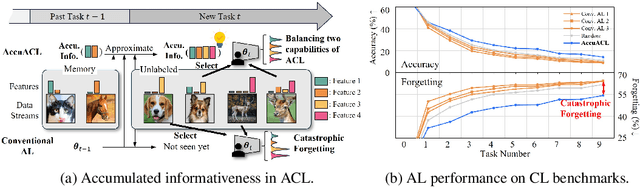
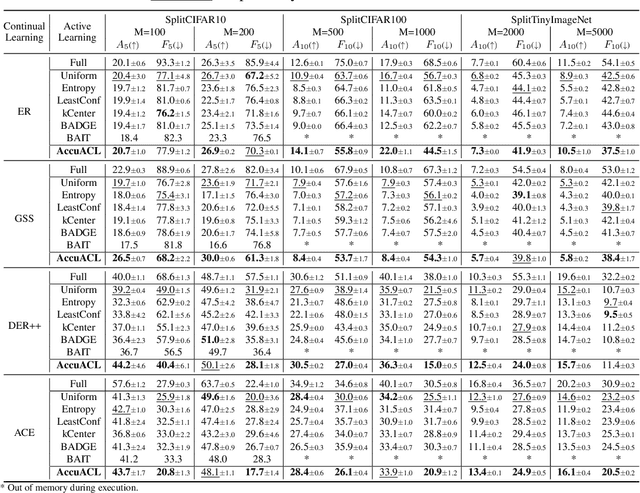

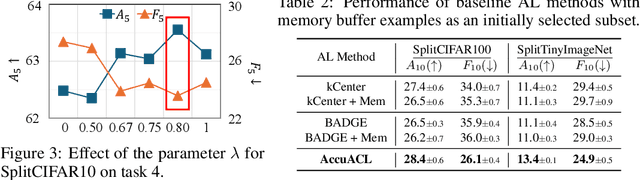
Continual learning (CL) enables deep neural networks to adapt to ever-changing data distributions. In practice, there may be scenarios where annotation is costly, leading to active continual learning (ACL), which performs active learning (AL) for the CL scenarios when reducing the labeling cost by selecting the most informative subset is preferable. However, conventional AL strategies are not suitable for ACL, as they focus solely on learning the new knowledge, leading to catastrophic forgetting of previously learned tasks. Therefore, ACL requires a new AL strategy that can balance the prevention of catastrophic forgetting and the ability to quickly learn new tasks. In this paper, we propose AccuACL, Accumulated informativeness-based Active Continual Learning, by the novel use of the Fisher information matrix as a criterion for sample selection, derived from a theoretical analysis of the Fisher-optimality preservation properties within the framework of ACL, while also addressing the scalability issue of Fisher information-based AL. Extensive experiments demonstrate that AccuACL significantly outperforms AL baselines across various CL algorithms, increasing the average accuracy and forgetting by 23.8% and 17.0%, respectively, in average.
Diffusion-Based Offline RL for Improved Decision-Making in Augmented ARC Task
Oct 15, 2024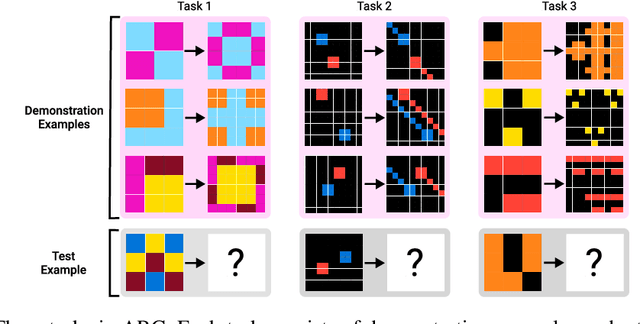
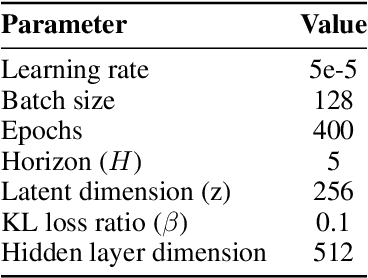
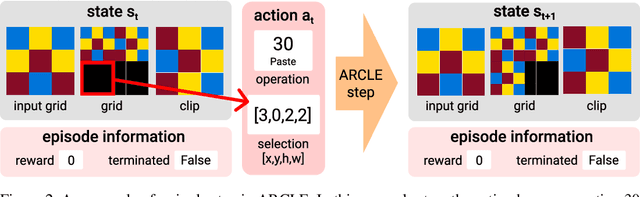
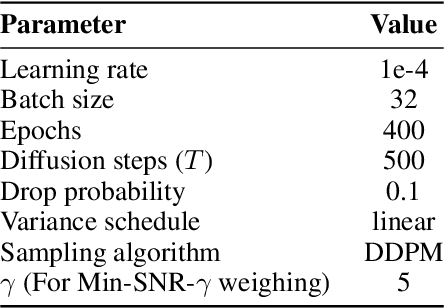
Effective long-term strategies enable AI systems to navigate complex environments by making sequential decisions over extended horizons. Similarly, reinforcement learning (RL) agents optimize decisions across sequences to maximize rewards, even without immediate feedback. To verify that Latent Diffusion-Constrained Q-learning (LDCQ), a prominent diffusion-based offline RL method, demonstrates strong reasoning abilities in multi-step decision-making, we aimed to evaluate its performance on the Abstraction and Reasoning Corpus (ARC). However, applying offline RL methodologies to enhance strategic reasoning in AI for solving tasks in ARC is challenging due to the lack of sufficient experience data in the ARC training set. To address this limitation, we introduce an augmented offline RL dataset for ARC, called Synthesized Offline Learning Data for Abstraction and Reasoning (SOLAR), along with the SOLAR-Generator, which generates diverse trajectory data based on predefined rules. SOLAR enables the application of offline RL methods by offering sufficient experience data. We synthesized SOLAR for a simple task and used it to train an agent with the LDCQ method. Our experiments demonstrate the effectiveness of the offline RL approach on a simple ARC task, showing the agent's ability to make multi-step sequential decisions and correctly identify answer states. These results highlight the potential of the offline RL approach to enhance AI's strategic reasoning capabilities.
DIAR: Diffusion-model-guided Implicit Q-learning with Adaptive Revaluation
Oct 15, 2024
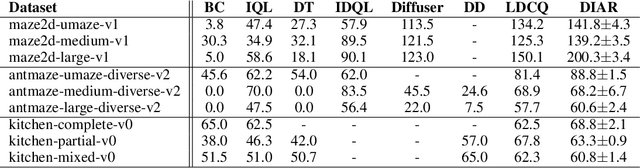
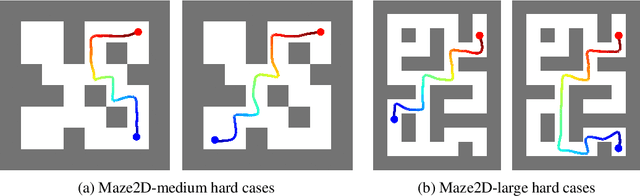

We propose a novel offline reinforcement learning (offline RL) approach, introducing the Diffusion-model-guided Implicit Q-learning with Adaptive Revaluation (DIAR) framework. We address two key challenges in offline RL: out-of-distribution samples and long-horizon problems. We leverage diffusion models to learn state-action sequence distributions and incorporate value functions for more balanced and adaptive decision-making. DIAR introduces an Adaptive Revaluation mechanism that dynamically adjusts decision lengths by comparing current and future state values, enabling flexible long-term decision-making. Furthermore, we address Q-value overestimation by combining Q-network learning with a value function guided by a diffusion model. The diffusion model generates diverse latent trajectories, enhancing policy robustness and generalization. As demonstrated in tasks like Maze2D, AntMaze, and Kitchen, DIAR consistently outperforms state-of-the-art algorithms in long-horizon, sparse-reward environments.