 Add to Chrome
 Add to Firefox
 Add to Edge
Replay Attack
Papers and Code
Adaptive Quantum-Safe Cryptography for 6G Vehicular Networks via Context-Aware Optimization
Feb 01, 2026
Powerful quantum computers in the future may be able to break the security used for communication between vehicles and other devices (Vehicle-to-Everything, or V2X). New security methods called post-quantum cryptography can help protect these systems, but they often require more computing power and can slow down communication, posing a challenge for fast 6G vehicle networks. In this paper, we propose an adaptive post-quantum cryptography (PQC) framework that predicts short-term mobility and channel variations and dynamically selects suitable lattice-, code-, or hash-based PQC configurations using a predictive multi-objective evolutionary algorithm (APMOEA) to meet vehicular latency and security constraints.However, frequent cryptographic reconfiguration in dynamic vehicular environments introduces new attack surfaces during algorithm transitions. A secure monotonic-upgrade protocol prevents downgrade, replay, and desynchronization attacks during transitions. Theoretical results show decision stability under bounded prediction error, latency boundedness under mobility drift, and correctness under small forecast noise. These results demonstrate a practical path toward quantum-safe cryptography in future 6G vehicular networks. Through extensive experiments based on realistic mobility (LuST), weather (ERA5), and NR-V2X channel traces, we show that the proposed framework reduces end-to-end latency by up to 27\%, lowers communication overhead by up to 65\%, and effectively stabilizes cryptographic switching behavior using reinforcement learning. Moreover, under the evaluated adversarial scenarios, the monotonic-upgrade protocol successfully prevents downgrade, replay, and desynchronization attacks.

TempoNet: Learning Realistic Communication and Timing Patterns for Network Traffic Simulation
Jan 22, 2026Realistic network traffic simulation is critical for evaluating intrusion detection systems, stress-testing network protocols, and constructing high-fidelity environments for cybersecurity training. While attack traffic can often be layered into training environments using red-teaming or replay methods, generating authentic benign background traffic remains a core challenge -- particularly in simulating the complex temporal and communication dynamics of real-world networks. This paper introduces TempoNet, a novel generative model that combines multi-task learning with multi-mark temporal point processes to jointly model inter-arrival times and all packet- and flow-header fields. TempoNet captures fine-grained timing patterns and higher-order correlations such as host-pair behavior and seasonal trends, addressing key limitations of GAN-, LLM-, and Bayesian-based methods that fail to reproduce structured temporal variation. TempoNet produces temporally consistent, high-fidelity traces, validated on real-world datasets. Furthermore, we show that intrusion detection models trained on TempoNet-generated background traffic perform comparably to those trained on real data, validating its utility for real-world security applications.
Be Your Own Red Teamer: Safety Alignment via Self-Play and Reflective Experience Replay
Jan 15, 2026Large Language Models (LLMs) have achieved remarkable capabilities but remain vulnerable to adversarial ``jailbreak'' attacks designed to bypass safety guardrails. Current safety alignment methods depend heavily on static external red teaming, utilizing fixed defense prompts or pre-collected adversarial datasets. This leads to a rigid defense that overfits known patterns and fails to generalize to novel, sophisticated threats. To address this critical limitation, we propose empowering the model to be its own red teamer, capable of achieving autonomous and evolving adversarial attacks. Specifically, we introduce Safety Self- Play (SSP), a system that utilizes a single LLM to act concurrently as both the Attacker (generating jailbreaks) and the Defender (refusing harmful requests) within a unified Reinforcement Learning (RL) loop, dynamically evolving attack strategies to uncover vulnerabilities while simultaneously strengthening defense mechanisms. To ensure the Defender effectively addresses critical safety issues during the self-play, we introduce an advanced Reflective Experience Replay Mechanism, which uses an experience pool accumulated throughout the process. The mechanism employs a Upper Confidence Bound (UCB) sampling strategy to focus on failure cases with low rewards, helping the model learn from past hard mistakes while balancing exploration and exploitation. Extensive experiments demonstrate that our SSP approach autonomously evolves robust defense capabilities, significantly outperforming baselines trained on static adversarial datasets and establishing a new benchmark for proactive safety alignment.
Lightweight Resolution-Aware Audio Deepfake Detection via Cross-Scale Attention and Consistency Learning
Jan 10, 2026Audio deepfake detection has become increasingly challenging due to rapid advances in speech synthesis and voice conversion technologies, particularly under channel distortions, replay attacks, and real-world recording conditions. This paper proposes a resolution-aware audio deepfake detection framework that explicitly models and aligns multi-resolution spectral representations through cross-scale attention and consistency learning. Unlike conventional single-resolution or implicit feature-fusion approaches, the proposed method enforces agreement across complementary time--frequency scales. The proposed framework is evaluated on three representative benchmarks: ASVspoof 2019 (LA and PA), the Fake-or-Real (FoR) dataset, and the In-the-Wild Audio Deepfake dataset under a speaker-disjoint protocol. The method achieves near-perfect performance on ASVspoof LA (EER 0.16%), strong robustness on ASVspoof PA (EER 5.09%), FoR rerecorded audio (EER 4.54%), and in-the-wild deepfakes (AUC 0.98, EER 4.81%), significantly outperforming single-resolution and non-attention baselines under challenging conditions. The proposed model remains lightweight and efficient, requiring only 159k parameters and less than 1~GFLOP per inference, making it suitable for practical deployment. Comprehensive ablation studies confirm the critical contributions of cross-scale attention and consistency learning, while gradient-based interpretability analysis reveals that the model learns resolution-consistent and semantically meaningful spectral cues across diverse spoofing conditions. These results demonstrate that explicit cross-resolution modeling provides a principled, robust, and scalable foundation for next-generation audio deepfake detection systems.
Risk-Aware Human-in-the-Loop Framework with Adaptive Intrusion Response for Autonomous Vehicles
Jan 16, 2026Autonomous vehicles must remain safe and effective when encountering rare long-tailed scenarios or cyber-physical intrusions during driving. We present RAIL, a risk-aware human-in-the-loop framework that turns heterogeneous runtime signals into calibrated control adaptations and focused learning. RAIL fuses three cues (curvature actuation integrity, time-to-collision proximity, and observation-shift consistency) into an Intrusion Risk Score (IRS) via a weighted Noisy-OR. When IRS exceeds a threshold, actions are blended with a cue-specific shield using a learned authority, while human override remains available; when risk is low, the nominal policy executes. A contextual bandit arbitrates among shields based on the cue vector, improving mitigation choices online. RAIL couples Soft Actor-Critic (SAC) with risk-prioritized replay and dual rewards so that takeovers and near misses steer learning while nominal behavior remains covered. On MetaDrive, RAIL achieves a Test Return (TR) of 360.65, a Test Success Rate (TSR) of 0.85, a Test Safety Violation (TSV) of 0.75, and a Disturbance Rate (DR) of 0.0027, while logging only 29.07 training safety violations, outperforming RL, safe RL, offline/imitation learning, and prior HITL baselines. Under Controller Area Network (CAN) injection and LiDAR spoofing attacks, it improves Success Rate (SR) to 0.68 and 0.80, lowers the Disengagement Rate under Attack (DRA) to 0.37 and 0.03, and reduces the Attack Success Rate (ASR) to 0.34 and 0.11. In CARLA, RAIL attains a TR of 1609.70 and TSR of 0.41 with only 8000 steps.
Sparse Threats, Focused Defense: Criticality-Aware Robust Reinforcement Learning for Safe Autonomous Driving
Jan 05, 2026Reinforcement learning (RL) has shown considerable potential in autonomous driving (AD), yet its vulnerability to perturbations remains a critical barrier to real-world deployment. As a primary countermeasure, adversarial training improves policy robustness by training the AD agent in the presence of an adversary that deliberately introduces perturbations. Existing approaches typically model the interaction as a zero-sum game with continuous attacks. However, such designs overlook the inherent asymmetry between the agent and the adversary and then fail to reflect the sparsity of safety-critical risks, rendering the achieved robustness inadequate for practical AD scenarios. To address these limitations, we introduce criticality-aware robust RL (CARRL), a novel adversarial training approach for handling sparse, safety-critical risks in autonomous driving. CARRL consists of two interacting components: a risk exposure adversary (REA) and a risk-targeted robust agent (RTRA). We model the interaction between the REA and RTRA as a general-sum game, allowing the REA to focus on exposing safety-critical failures (e.g., collisions) while the RTRA learns to balance safety with driving efficiency. The REA employs a decoupled optimization mechanism to better identify and exploit sparse safety-critical moments under a constrained budget. However, such focused attacks inevitably result in a scarcity of adversarial data. The RTRA copes with this scarcity by jointly leveraging benign and adversarial experiences via a dual replay buffer and enforces policy consistency under perturbations to stabilize behavior. Experimental results demonstrate that our approach reduces the collision rate by at least 22.66\% across all cases compared to state-of-the-art baseline methods.
NOS-Gate: Queue-Aware Streaming IDS for Consumer Gateways under Timing-Controlled Evasion
Jan 01, 2026Timing and burst patterns can leak through encryption, and an adaptive adversary can exploit them. This undermines metadata-only detection in a stand-alone consumer gateway. Therefore, consumer gateways need streaming intrusion detection on encrypted traffic using metadata only, under tight CPU and latency budgets. We present a streaming IDS for stand-alone gateways that instantiates a lightweight two-state unit derived from Network-Optimised Spiking (NOS) dynamics per flow, named NOS-Gate. NOS-Gate scores fixed-length windows of metadata features and, under a $K$-of-$M$ persistence rule, triggers a reversible mitigation that temporarily reduces the flow's weight under weighted fair queueing (WFQ). We evaluate NOS-Gate under timing-controlled evasion using an executable 'worlds' benchmark that specifies benign device processes, auditable attacker budgets, contention structure, and packet-level WFQ replay to quantify queue impact. All methods are calibrated label-free via burn-in quantile thresholding. Across multiple reproducible worlds and malicious episodes, at an achieved $0.1%$ false-positive operating point, NOS-Gate attains 0.952 incident recall versus 0.857 for the best baseline in these runs. Under gating, it reduces p99.9 queueing delay and p99.9 collateral delay with a mean scoring cost of ~ 2.09 μs per flow-window on CPU.
SoK: Security Evaluation of Wi-Fi CSI Biometrics: Attacks, Metrics, and Systemic Weaknesses
Nov 14, 2025Wi-Fi Channel State Information (CSI) has been repeatedly proposed as a biometric modality, often with reports of high accuracy and operational feasibility. However, the field lacks a consolidated understanding of its security properties, adversarial resilience, and methodological consistency. This Systematization of Knowledge (SoK) examines CSI-based biometric authentication through a security perspective, analyzing how existing work differs across sensing infrastructure, signal representations, feature pipelines, learning models, and evaluation methodologies. Our synthesis reveals systemic inconsistencies: reliance on aggregate accuracy metrics, limited reporting of FAR/FRR/EER, absence of per-user risk analysis, and scarce consideration of threat models or adversarial feasibility. We construct a unified evaluation framework to empirically expose these issues and demonstrate how security-relevant metrics, such as per-class EER, FCS, and the Gini Coefficient, uncover risk concentration that remains hidden under traditional reporting practices. Our analysis highlights concrete attack surfaces and shows how methodological choices materially influence vulnerability profiles, which include replay, geometric mimicry, and environmental perturbation. Based on these findings, we articulate the security boundaries of current CSI biometrics and provide guidelines for rigorous evaluation, reproducible experimentation, and future research directions. This SoK offers the security community a structured, evidence-driven reassessment of Wi-Fi CSI biometrics and their suitability as an authentication primitive.
Potent but Stealthy: Rethink Profile Pollution against Sequential Recommendation via Bi-level Constrained Reinforcement Paradigm
Nov 14, 2025Sequential Recommenders, which exploit dynamic user intents through interaction sequences, is vulnerable to adversarial attacks. While existing attacks primarily rely on data poisoning, they require large-scale user access or fake profiles thus lacking practicality. In this paper, we focus on the Profile Pollution Attack that subtly contaminates partial user interactions to induce targeted mispredictions. Previous PPA methods suffer from two limitations, i.e., i) over-reliance on sequence horizon impact restricts fine-grained perturbations on item transitions, and ii) holistic modifications cause detectable distribution shifts. To address these challenges, we propose a constrained reinforcement driven attack CREAT that synergizes a bi-level optimization framework with multi-reward reinforcement learning to balance adversarial efficacy and stealthiness. We first develop a Pattern Balanced Rewarding Policy, which integrates pattern inversion rewards to invert critical patterns and distribution consistency rewards to minimize detectable shifts via unbalanced co-optimal transport. Then we employ a Constrained Group Relative Reinforcement Learning paradigm, enabling step-wise perturbations through dynamic barrier constraints and group-shared experience replay, achieving targeted pollution with minimal detectability. Extensive experiments demonstrate the effectiveness of CREAT.
Acoustic Simulation Framework for Multi-channel Replay Speech Detection
Sep 18, 2025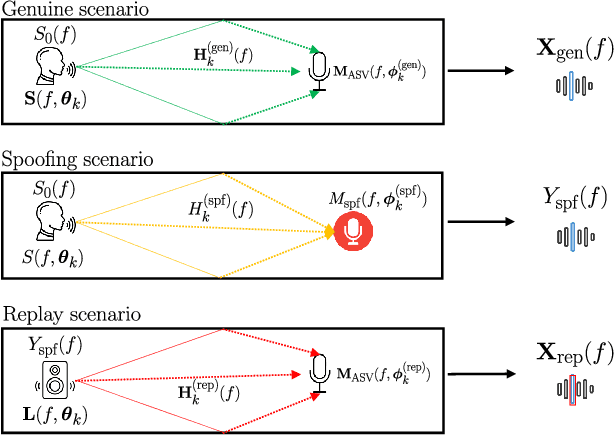
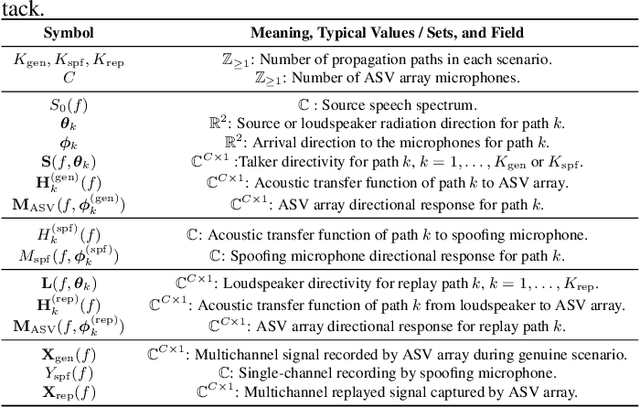
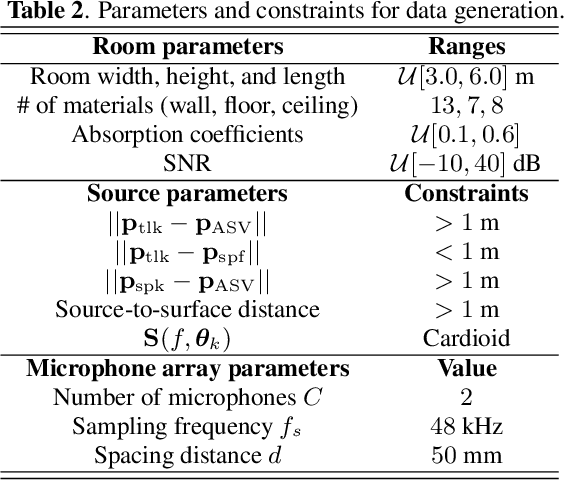
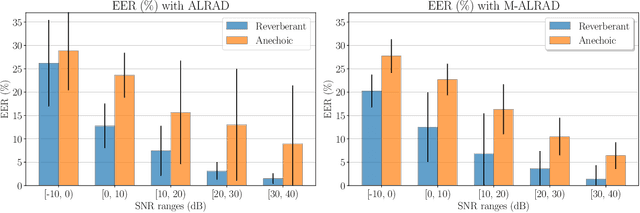
Replay speech attacks pose a significant threat to voice-controlled systems, especially in smart environments where voice assistants are widely deployed. While multi-channel audio offers spatial cues that can enhance replay detection robustness, existing datasets and methods predominantly rely on single-channel recordings. In this work, we introduce an acoustic simulation framework designed to simulate multi-channel replay speech configurations using publicly available resources. Our setup models both genuine and spoofed speech across varied environments, including realistic microphone and loudspeaker impulse responses, room acoustics, and noise conditions. The framework employs measured loudspeaker directionalities during the replay attack to improve the realism of the simulation. We define two spoofing settings, which simulate whether a reverberant or an anechoic speech is used in the replay scenario, and evaluate the impact of omnidirectional and diffuse noise on detection performance. Using the state-of-the-art M-ALRAD model for replay speech detection, we demonstrate that synthetic data can support the generalization capabilities of the detector across unseen enclosures.