 Add to Chrome
 Add to Firefox
 Add to Edge
TempoNet: Learning Realistic Communication and Timing Patterns for Network Traffic Simulation
Jan 22, 2026
Realistic network traffic simulation is critical for evaluating intrusion detection systems, stress-testing network protocols, and constructing high-fidelity environments for cybersecurity training. While attack traffic can often be layered into training environments using red-teaming or replay methods, generating authentic benign background traffic remains a core challenge -- particularly in simulating the complex temporal and communication dynamics of real-world networks. This paper introduces TempoNet, a novel generative model that combines multi-task learning with multi-mark temporal point processes to jointly model inter-arrival times and all packet- and flow-header fields. TempoNet captures fine-grained timing patterns and higher-order correlations such as host-pair behavior and seasonal trends, addressing key limitations of GAN-, LLM-, and Bayesian-based methods that fail to reproduce structured temporal variation. TempoNet produces temporally consistent, high-fidelity traces, validated on real-world datasets. Furthermore, we show that intrusion detection models trained on TempoNet-generated background traffic perform comparably to those trained on real data, validating its utility for real-world security applications.

SchemaDB: Structures in Relational Datasets
Nov 24, 2021
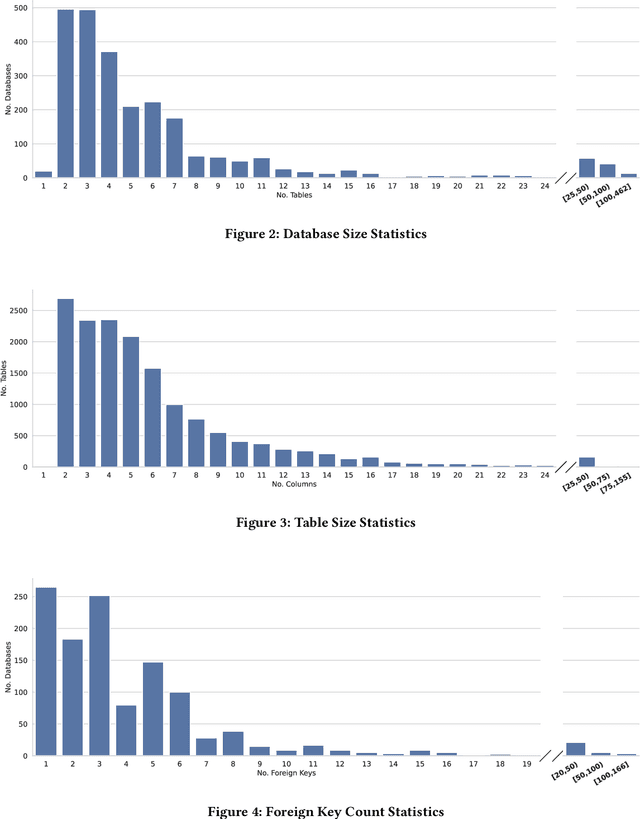

In this paper we introduce the SchemaDB data-set; a collection of relational database schemata in both sql and graph formats. Databases are not commonly shared publicly for reasons of privacy and security, so schemata are not available for study. Consequently, an understanding of database structures in the wild is lacking, and most examples found publicly belong to common development frameworks or are derived from textbooks or engine benchmark designs. SchemaDB contains 2,500 samples of relational schemata found in public repositories which we have standardised to MySQL syntax. We provide our gathering and transformation methodology, summary statistics, and structural analysis, and discuss potential downstream research tasks in several domains.