 Add to Chrome
 Add to Firefox
 Add to Edge
Nsfw
Papers and Code
JANUS: A Lightweight Framework for Jailbreaking Text-to-Image Models via Distribution Optimization
Mar 22, 2026
Text-to-image (T2I) models such as Stable Diffusion and DALLE remain susceptible to generating harmful or Not-Safe-For-Work (NSFW) content under jailbreak attacks despite deployed safety filters. Existing jailbreak attacks either rely on proxy-loss optimization instead of the true end-to-end objective, or depend on large-scale and costly RL-trained generators. Motivated by these limitations, we propose JANUS , a lightweight framework that formulates jailbreak as optimizing a structured prompt distribution under a black-box, end-to-end reward from the T2I system and its safety filters. JANUS replaces a high-capacity generator with a low-dimensional mixing policy over two semantically anchored prompt distributions, enabling efficient exploration while preserving the target semantics. On modern T2I models, we outperform state-of-the-art jailbreak methods, improving ASR-8 from 25.30% to 43.15% on Stable Diffusion 3.5 Large Turbo with consistently higher CLIP and NSFW scores. JANUS succeeds across both open-source and commercial models. These findings expose structural weaknesses in current T2I safety pipelines and motivate stronger, distribution-aware defenses. Warning: This paper contains model outputs that may be offensive.

Localized Concept Erasure in Text-to-Image Diffusion Models via High-Level Representation Misdirection
Feb 23, 2026Recent advances in text-to-image (T2I) diffusion models have seen rapid and widespread adoption. However, their powerful generative capabilities raise concerns about potential misuse for synthesizing harmful, private, or copyrighted content. To mitigate such risks, concept erasure techniques have emerged as a promising solution. Prior works have primarily focused on fine-tuning the denoising component (e.g., the U-Net backbone). However, recent causal tracing studies suggest that visual attribute information is localized in the early self-attention layers of the text encoder, indicating a potential alternative for concept erasing. Building on this insight, we conduct preliminary experiments and find that directly fine-tuning early layers can suppress target concepts but often degrades the generation quality of non-target concepts. To overcome this limitation, we propose High-Level Representation Misdirection (HiRM), which misdirects high-level semantic representations of target concepts in the text encoder toward designated vectors such as random directions or semantically defined directions (e.g., supercategories), while updating only early layers that contain causal states of visual attributes. Our decoupling strategy enables precise concept removal with minimal impact on unrelated concepts, as demonstrated by strong results on UnlearnCanvas and NSFW benchmarks across diverse targets (e.g., objects, styles, nudity). HiRM also preserves generative utility at low training cost, transfers to state-of-the-art architectures such as Flux without additional training, and shows synergistic effects with denoiser-based concept erasing methods.
Differential Vector Erasure: Unified Training-Free Concept Erasure for Flow Matching Models
Feb 01, 2026Text-to-image diffusion models have demonstrated remarkable capabilities in generating high-quality images, yet their tendency to reproduce undesirable concepts, such as NSFW content, copyrighted styles, or specific objects, poses growing concerns for safe and controllable deployment. While existing concept erasure approaches primarily focus on DDPM-based diffusion models and rely on costly fine-tuning, the recent emergence of flow matching models introduces a fundamentally different generative paradigm for which prior methods are not directly applicable. In this paper, we propose Differential Vector Erasure (DVE), a training-free concept erasure method specifically designed for flow matching models. Our key insight is that semantic concepts are implicitly encoded in the directional structure of the velocity field governing the generative flow. Leveraging this observation, we construct a differential vector field that characterizes the directional discrepancy between a target concept and a carefully chosen anchor concept. During inference, DVE selectively removes concept-specific components by projecting the velocity field onto the differential direction, enabling precise concept suppression without affecting irrelevant semantics. Extensive experiments on FLUX demonstrate that DVE consistently outperforms existing baselines on a wide range of concept erasure tasks, including NSFW suppression, artistic style removal, and object erasure, while preserving image quality and diversity.
The Illusion of Forgetting: Attack Unlearned Diffusion via Initial Latent Variable Optimization
Jan 30, 2026Although unlearning-based defenses claim to purge Not-Safe-For-Work (NSFW) concepts from diffusion models (DMs), we reveals that this "forgetting" is largely an illusion. Unlearning partially disrupts the mapping between linguistic symbols and the underlying knowledge, which remains intact as dormant memories. We find that the distributional discrepancy in the denoising process serves as a measurable indicator of how much of the mapping is retained, also reflecting the strength of unlearning. Inspired by this, we propose IVO (Initial Latent Variable Optimization), a concise and powerful attack framework that reactivates these dormant memories by reconstructing the broken mappings. Through Image Inversion}, Adversarial Optimization and Reused Attack, IVO optimizes initial latent variables to realign the noise distribution of unlearned models with their original unsafe states. Extensive experiments across 8 widely used unlearning techniques demonstrate that IVO achieves superior attack success rates and strong semantic consistency, exposing fundamental flaws in current defenses. The code is available at anonymous.4open.science/r/IVO/. Warning: This paper has unsafe images that may offend some readers.
SafeRedir: Prompt Embedding Redirection for Robust Unlearning in Image Generation Models
Jan 13, 2026Image generation models (IGMs), while capable of producing impressive and creative content, often memorize a wide range of undesirable concepts from their training data, leading to the reproduction of unsafe content such as NSFW imagery and copyrighted artistic styles. Such behaviors pose persistent safety and compliance risks in real-world deployments and cannot be reliably mitigated by post-hoc filtering, owing to the limited robustness of such mechanisms and a lack of fine-grained semantic control. Recent unlearning methods seek to erase harmful concepts at the model level, which exhibit the limitations of requiring costly retraining, degrading the quality of benign generations, or failing to withstand prompt paraphrasing and adversarial attacks. To address these challenges, we introduce SafeRedir, a lightweight inference-time framework for robust unlearning via prompt embedding redirection. Without modifying the underlying IGMs, SafeRedir adaptively routes unsafe prompts toward safe semantic regions through token-level interventions in the embedding space. The framework comprises two core components: a latent-aware multi-modal safety classifier for identifying unsafe generation trajectories, and a token-level delta generator for precise semantic redirection, equipped with auxiliary predictors for token masking and adaptive scaling to localize and regulate the intervention. Empirical results across multiple representative unlearning tasks demonstrate that SafeRedir achieves effective unlearning capability, high semantic and perceptual preservation, robust image quality, and enhanced resistance to adversarial attacks. Furthermore, SafeRedir generalizes effectively across a variety of diffusion backbones and existing unlearned models, validating its plug-and-play compatibility and broad applicability. Code and data are available at https://github.com/ryliu68/SafeRedir.
EMMA: Concept Erasure Benchmark with Comprehensive Semantic Metrics and Diverse Categories
Dec 19, 2025The widespread adoption of text-to-image (T2I) generation has raised concerns about privacy, bias, and copyright violations. Concept erasure techniques offer a promising solution by selectively removing undesired concepts from pre-trained models without requiring full retraining. However, these methods are often evaluated on a limited set of concepts, relying on overly simplistic and direct prompts. To test the boundaries of concept erasure techniques, and assess whether they truly remove targeted concepts from model representations, we introduce EMMA, a benchmark that evaluates five key dimensions of concept erasure over 12 metrics. EMMA goes beyond standard metrics like image quality and time efficiency, testing robustness under challenging conditions, including indirect descriptions, visually similar non-target concepts, and potential gender and ethnicity bias, providing a socially aware analysis of method behavior. Using EMMA, we analyze five concept erasure methods across five domains (objects, celebrities, art styles, NSFW, and copyright). Our results show that existing methods struggle with implicit prompts (i.e., generating the erased concept when it is indirectly referenced) and visually similar non-target concepts (i.e., failing to generate non-targeted concepts resembling the erased one), while some amplify gender and ethnicity bias compared to the original model.
SGM: Safety Glasses for Multimodal Large Language Models via Neuron-Level Detoxification
Dec 17, 2025Disclaimer: Samples in this paper may be harmful and cause discomfort. Multimodal large language models (MLLMs) enable multimodal generation but inherit toxic, biased, and NSFW signals from weakly curated pretraining corpora, causing safety risks, especially under adversarial triggers that late, opaque training-free detoxification methods struggle to handle. We propose SGM, a white-box neuron-level multimodal intervention that acts like safety glasses for toxic neurons: it selectively recalibrates a small set of toxic expert neurons via expertise-weighted soft suppression, neutralizing harmful cross-modal activations without any parameter updates. We establish MM-TOXIC-QA, a multimodal toxicity evaluation framework, and compare SGM with existing detoxification techniques. Experiments on open-source MLLMs show that SGM mitigates toxicity in standard and adversarial conditions, cutting harmful rates from 48.2\% to 2.5\% while preserving fluency and multimodal reasoning. SGM is extensible, and its combined defenses, denoted as SGM*, integrate with existing detoxification methods for stronger safety performance, providing an interpretable, low-cost solution for toxicity-controlled multimodal generation.
Value-Aligned Prompt Moderation via Zero-Shot Agentic Rewriting for Safe Image Generation
Nov 12, 2025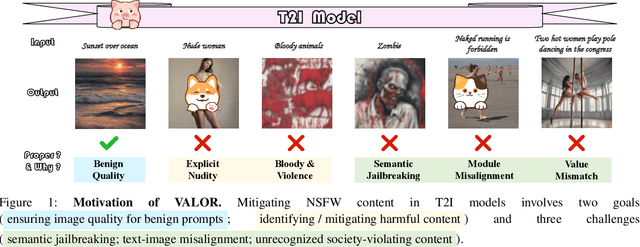
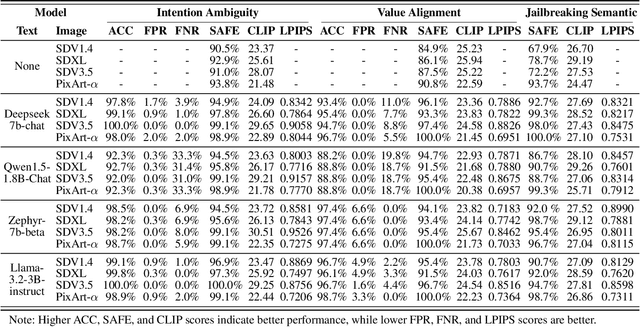
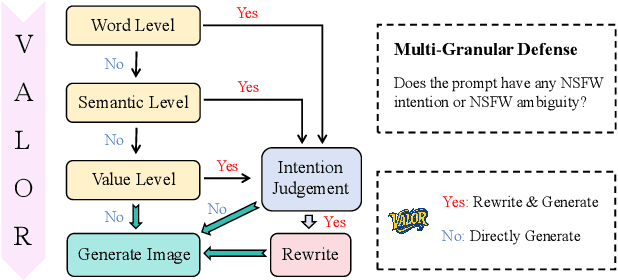
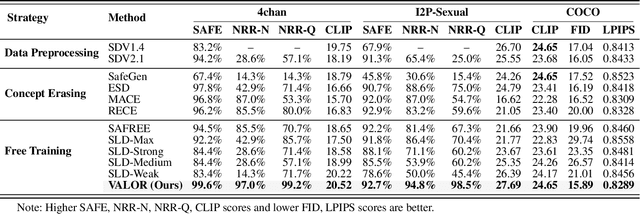
Generative vision-language models like Stable Diffusion demonstrate remarkable capabilities in creative media synthesis, but they also pose substantial risks of producing unsafe, offensive, or culturally inappropriate content when prompted adversarially. Current defenses struggle to align outputs with human values without sacrificing generation quality or incurring high costs. To address these challenges, we introduce VALOR (Value-Aligned LLM-Overseen Rewriter), a modular, zero-shot agentic framework for safer and more helpful text-to-image generation. VALOR integrates layered prompt analysis with human-aligned value reasoning: a multi-level NSFW detector filters lexical and semantic risks; a cultural value alignment module identifies violations of social norms, legality, and representational ethics; and an intention disambiguator detects subtle or indirect unsafe implications. When unsafe content is detected, prompts are selectively rewritten by a large language model under dynamic, role-specific instructions designed to preserve user intent while enforcing alignment. If the generated image still fails a safety check, VALOR optionally performs a stylistic regeneration to steer the output toward a safer visual domain without altering core semantics. Experiments across adversarial, ambiguous, and value-sensitive prompts show that VALOR significantly reduces unsafe outputs by up to 100.00% while preserving prompt usefulness and creativity. These results highlight VALOR as a scalable and effective approach for deploying safe, aligned, and helpful image generation systems in open-world settings.
Evaluating Machine Translation Datasets for Low-Web Data Languages: A Gendered Lens
Nov 05, 2025As low-resourced languages are increasingly incorporated into NLP research, there is an emphasis on collecting large-scale datasets. But in prioritizing quantity over quality, we risk 1) building language technologies that perform poorly for these languages and 2) producing harmful content that perpetuates societal biases. In this paper, we investigate the quality of Machine Translation (MT) datasets for three low-resourced languages--Afan Oromo, Amharic, and Tigrinya, with a focus on the gender representation in the datasets. Our findings demonstrate that while training data has a large representation of political and religious domain text, benchmark datasets are focused on news, health, and sports. We also found a large skew towards the male gender--in names of persons, the grammatical gender of verbs, and in stereotypical depictions in the datasets. Further, we found harmful and toxic depictions against women, which were more prominent for the language with the largest amount of data, underscoring that quantity does not guarantee quality. We hope that our work inspires further inquiry into the datasets collected for low-resourced languages and prompts early mitigation of harmful content. WARNING: This paper contains discussion of NSFW content that some may find disturbing.
Security Risk of Misalignment between Text and Image in Multi-modal Model
Oct 30, 2025Despite the notable advancements and versatility of multi-modal diffusion models, such as text-to-image models, their susceptibility to adversarial inputs remains underexplored. Contrary to expectations, our investigations reveal that the alignment between textual and Image modalities in existing diffusion models is inadequate. This misalignment presents significant risks, especially in the generation of inappropriate or Not-Safe-For-Work (NSFW) content. To this end, we propose a novel attack called Prompt-Restricted Multi-modal Attack (PReMA) to manipulate the generated content by modifying the input image in conjunction with any specified prompt, without altering the prompt itself. PReMA is the first attack that manipulates model outputs by solely creating adversarial images, distinguishing itself from prior methods that primarily generate adversarial prompts to produce NSFW content. Consequently, PReMA poses a novel threat to the integrity of multi-modal diffusion models, particularly in image-editing applications that operate with fixed prompts. Comprehensive evaluations conducted on image inpainting and style transfer tasks across various models confirm the potent efficacy of PReMA.