 Add to Chrome
 Add to Firefox
 Add to Edge
Exposing Functional Fusion: A New Class of Strategic Backdoor in Dynamic Prompt Architectures
May 19, 2026
Existing ViT backdoor attacks based on backbone-overwriting full-tuning are computationally expensive and inflict performance degradation. This has forced adversaries towards the Visual Parameter-Efficient Fine-Tuning (PEFT) paradigm, dominated by adapter-based (e.g., LoRA) and prompt-based (e.g., VPT) approaches. While adapter security has seen initial study, the risks of the burgeoning prompt-based ecosystem remain critically unexplored. We fill this critical gap, exposing how the evolution of VPT towards dynamic and context-aware architectures can facilitate a far more dangerous and emergent threat. This vulnerability arises even though these dynamic modules unlock superior benign performance. We propose VIPER, an attack framework built on a lightweight, dynamic Visual Prompt Generator (VPG) that demonstrates this vulnerability. Critically, this dynamic architecture enables Functional Fusion: an emergent phenomenon where malicious logic and benign task utility are tightly fused into the same sparse, high-magnitude parameter core. This fusion creates a formidable ``hostage" dilemma, as pruning the attack necessarily destroys the benign performance. Comprehensive evaluations show VIPER effectively addresses the attacker's trilemma: VIPER not only achieves state-of-the-art performance on clean data, but also maintains near-100% ASR even under 90% VPG-module pruning (where LoRA attacks collapse), while adding only an imperceptible 0.06ms (1.16%) of inference latency. VIPER's results, driven by Functional Fusion, expose a new, paradigm-level risk in dynamic prompt architectures.

Value-Aligned Prompt Moderation via Zero-Shot Agentic Rewriting for Safe Image Generation
Nov 12, 2025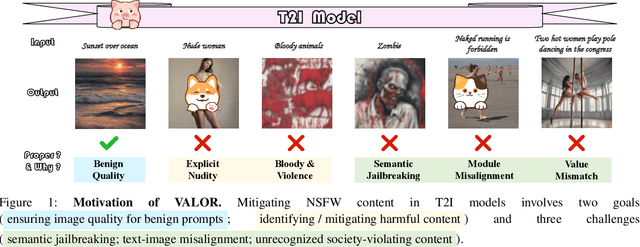
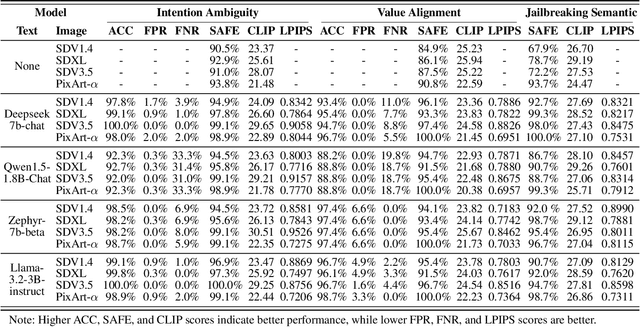
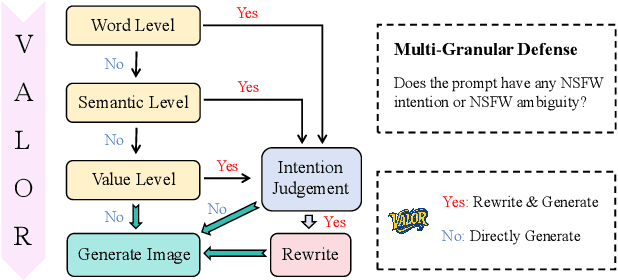
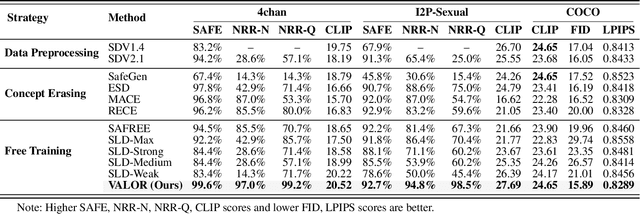
Generative vision-language models like Stable Diffusion demonstrate remarkable capabilities in creative media synthesis, but they also pose substantial risks of producing unsafe, offensive, or culturally inappropriate content when prompted adversarially. Current defenses struggle to align outputs with human values without sacrificing generation quality or incurring high costs. To address these challenges, we introduce VALOR (Value-Aligned LLM-Overseen Rewriter), a modular, zero-shot agentic framework for safer and more helpful text-to-image generation. VALOR integrates layered prompt analysis with human-aligned value reasoning: a multi-level NSFW detector filters lexical and semantic risks; a cultural value alignment module identifies violations of social norms, legality, and representational ethics; and an intention disambiguator detects subtle or indirect unsafe implications. When unsafe content is detected, prompts are selectively rewritten by a large language model under dynamic, role-specific instructions designed to preserve user intent while enforcing alignment. If the generated image still fails a safety check, VALOR optionally performs a stylistic regeneration to steer the output toward a safer visual domain without altering core semantics. Experiments across adversarial, ambiguous, and value-sensitive prompts show that VALOR significantly reduces unsafe outputs by up to 100.00% while preserving prompt usefulness and creativity. These results highlight VALOR as a scalable and effective approach for deploying safe, aligned, and helpful image generation systems in open-world settings.
AILoRA: Function-Aware Asymmetric Initialization for Low-Rank Adaptation of Large Language Models
Oct 09, 2025Parameter-efficient finetuning (PEFT) aims to mitigate the substantial computational and memory overhead involved in adapting large-scale pretrained models to diverse downstream tasks. Among numerous PEFT strategies, Low-Rank Adaptation (LoRA) has emerged as one of the most widely adopted approaches due to its robust empirical performance and low implementation complexity. In practical deployment, LoRA is typically applied to the $W^Q$ and $W^V$ projection matrices of self-attention modules, enabling an effective trade-off between model performance and parameter efficiency. While LoRA has achieved considerable empirical success, it still encounters challenges such as suboptimal performance and slow convergence. To address these limitations, we introduce \textbf{AILoRA}, a novel parameter-efficient method that incorporates function-aware asymmetric low-rank priors. Our empirical analysis reveals that the projection matrices $W^Q$ and $W^V$ in the self-attention mechanism exhibit distinct parameter characteristics, stemming from their functional differences. Specifically, $W^Q$ captures task-specific semantic space knowledge essential for attention distributions computation, making its parameters highly sensitive to downstream task variations. In contrast, $W^V$ encodes token-level feature representations that tend to remain stable across tasks and layers. Leveraging these insights, AILoRA performs a function-aware initialization by injecting the principal components of $W^Q$ to retain task-adaptive capacity, and the minor components of $W^V$ to preserve generalizable feature representations. This asymmetric initialization strategy enables LoRA modules to better capture the specialized roles of attention parameters, thereby enhancing both finetuning performance and convergence efficiency.