 Add to Chrome
 Add to Firefox
 Add to Edge
Mllm Evaluation Aesthetics
Papers and Code
RetouchIQ: MLLM Agents for Instruction-Based Image Retouching with Generalist Reward
Feb 19, 2026
Recent advances in multimodal large language models (MLLMs) have shown great potential for extending vision-language reasoning to professional tool-based image editing, enabling intuitive and creative editing. A promising direction is to use reinforcement learning (RL) to enable MLLMs to reason about and execute optimal tool-use plans within professional image-editing software. However, training remains challenging due to the lack of reliable, verifiable reward signals that can reflect the inherently subjective nature of creative editing. In this work, we introduce RetouchIQ, a framework that performs instruction-based executable image editing through MLLM agents guided by a generalist reward model. RetouchIQ interprets user-specified editing intentions and generates corresponding, executable image adjustments, bridging high-level aesthetic goals with precise parameter control. To move beyond conventional, rule-based rewards that compute similarity against a fixed reference image using handcrafted metrics, we propose a generalist reward model, an RL fine-tuned MLLM that evaluates edited results through a set of generated metrics on a case-by-case basis. Then, the reward model provides scalar feedback through multimodal reasoning, enabling reinforcement learning with high-quality, instruction-consistent gradients. We curate an extended dataset with 190k instruction-reasoning pairs and establish a new benchmark for instruction-based image editing. Experiments show that RetouchIQ substantially improves both semantic consistency and perceptual quality over previous MLLM-based and diffusion-based editing systems. Our findings demonstrate the potential of generalist reward-driven MLLM agents as flexible, explainable, and executable assistants for professional image editing.

ShowTable: Unlocking Creative Table Visualization with Collaborative Reflection and Refinement
Dec 15, 2025While existing generation and unified models excel at general image generation, they struggle with tasks requiring deep reasoning, planning, and precise data-to-visual mapping abilities beyond general scenarios. To push beyond the existing limitations, we introduce a new and challenging task: creative table visualization, requiring the model to generate an infographic that faithfully and aesthetically visualizes the data from a given table. To address this challenge, we propose ShowTable, a pipeline that synergizes MLLMs with diffusion models via a progressive self-correcting process. The MLLM acts as the central orchestrator for reasoning the visual plan and judging visual errors to provide refined instructions, the diffusion execute the commands from MLLM, achieving high-fidelity results. To support this task and our pipeline, we introduce three automated data construction pipelines for training different modules. Furthermore, we introduce TableVisBench, a new benchmark with 800 challenging instances across 5 evaluation dimensions, to assess performance on this task. Experiments demonstrate that our pipeline, instantiated with different models, significantly outperforms baselines, highlighting its effective multi-modal reasoning, generation, and error correction capabilities.
BannerAgency: Advertising Banner Design with Multimodal LLM Agents
Mar 14, 2025Advertising banners are critical for capturing user attention and enhancing advertising campaign effectiveness. Creating aesthetically pleasing banner designs while conveying the campaign messages is challenging due to the large search space involving multiple design elements. Additionally, advertisers need multiple sizes for different displays and various versions to target different sectors of audiences. Since design is intrinsically an iterative and subjective process, flexible editability is also in high demand for practical usage. While current models have served as assistants to human designers in various design tasks, they typically handle only segments of the creative design process or produce pixel-based outputs that limit editability. This paper introduces a training-free framework for fully automated banner ad design creation, enabling frontier multimodal large language models (MLLMs) to streamline the production of effective banners with minimal manual effort across diverse marketing contexts. We present BannerAgency, an MLLM agent system that collaborates with advertisers to understand their brand identity and banner objectives, generates matching background images, creates blueprints for foreground design elements, and renders the final creatives as editable components in Figma or SVG formats rather than static pixels. To facilitate evaluation and future research, we introduce BannerRequest400, a benchmark featuring 100 unique logos paired with 400 diverse banner requests. Through quantitative and qualitative evaluations, we demonstrate the framework's effectiveness, emphasizing the quality of the generated banner designs, their adaptability to various banner requests, and their strong editability enabled by this component-based approach.
UNIAA: A Unified Multi-modal Image Aesthetic Assessment Baseline and Benchmark
Apr 15, 2024

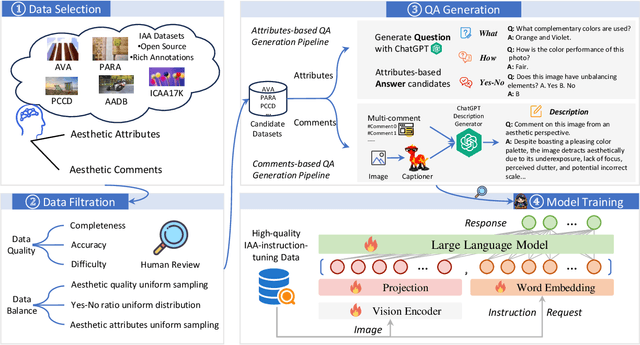
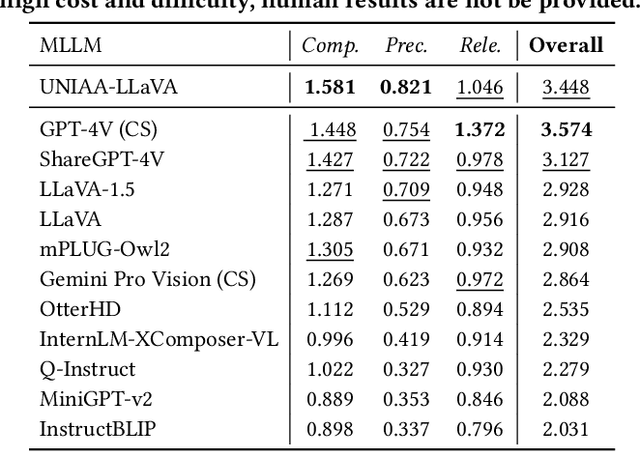
As an alternative to expensive expert evaluation, Image Aesthetic Assessment (IAA) stands out as a crucial task in computer vision. However, traditional IAA methods are typically constrained to a single data source or task, restricting the universality and broader application. In this work, to better align with human aesthetics, we propose a Unified Multi-modal Image Aesthetic Assessment (UNIAA) framework, including a Multi-modal Large Language Model (MLLM) named UNIAA-LLaVA and a comprehensive benchmark named UNIAA-Bench. We choose MLLMs with both visual perception and language ability for IAA and establish a low-cost paradigm for transforming the existing datasets into unified and high-quality visual instruction tuning data, from which the UNIAA-LLaVA is trained. To further evaluate the IAA capability of MLLMs, we construct the UNIAA-Bench, which consists of three aesthetic levels: Perception, Description, and Assessment. Extensive experiments validate the effectiveness and rationality of UNIAA. UNIAA-LLaVA achieves competitive performance on all levels of UNIAA-Bench, compared with existing MLLMs. Specifically, our model performs better than GPT-4V in aesthetic perception and even approaches the junior-level human. We find MLLMs have great potential in IAA, yet there remains plenty of room for further improvement. The UNIAA-LLaVA and UNIAA-Bench will be released.