 Add to Chrome
 Add to Firefox
 Add to Edge
Medical Segmentation Decathlon
Papers and Code
SwInception -- Local Attention Meets Convolutions
May 28, 2026
Sparse vision transformers have gained popularity as efficient encoders for medical volumetric segmentation, with Swin emerging as a prominent choice. Swin uses local attention to reduce complexity and yields excellent performance for many tasks but still tends to overfit on small datasets. To mitigate this weakness, we propose a novel architecture that further enhances Swin's inductive bias by introducing Inception blocks in the feed-forward layers. The introduction of these multi-branch convolutions enables more direct reasoning over local, multi-scale features within the transformer block. We have also modified the decoder layers in order to capture finer details using fewer parameters. We demonstrate a performance improvement on eleven different medical datasets through extensive experimentation. We specifically showcase advancements over the previous state-of-the-art backbones on benchmark challenges like the Medical Segmentation Decathlon and Beyond the Cranial Vault. By showing that the existing inductive bias in Swin can be further improved, our work presents a promising avenue for enhancing the capabilities of sparse vision transformers for both medical and natural image segmentation tasks. Code and pre-trained weights can be accessed at https://github.com/Eiphodos/SwInception.

DALight-3D: A Lightweight 3D U-Net for Brain Tumor Segmentation from Multi-Modal MRI
May 06, 2026Automatic brain tumor segmentation from multi-modal MRI remains challenging because volumetric models often incur substantial computational cost. This paper presents DALight-3D, a compact 3D U-Net variant that combines depthwise separable 3D convolutions, identifier-conditioned normalization, cross-slice attention, and adaptive skip fusion. The method is evaluated on the Medical Segmentation Decathlon Task01 BrainTumour benchmark under matched optimization settings against standard 3D U-Net, Attention U-Net, Residual 3D U-Net, and V-Net baselines. In the reported 50-epoch comparison, DALight-3D achieves a mean Dice of 0.727 with 2.22M parameters, compared with 0.710 Dice and 3.20M parameters for Residual 3D U-Net. Component-wise ablations show consistent performance degradation when SepConv, identifier-conditioned normalization, CSA, or SSFB is removed. These results indicate that DALight-3D offers a favorable accuracy-efficiency trade-off within the present benchmark setting.
Robustness Evaluation of a Foundation Segmentation Model Under Simulated Domain Shifts in Abdominal CT: Implications for Health Digital Twin Deployment
Apr 28, 2026Foundation segmentation models such as the Segment Anything Model (SAM) have demonstrated strong generalization across natural images; however, their robustness under clinically realistic medical imaging domain shifts remains insufficiently quantified. We present a systematic slice-level robustness audit of SAM (ViT-B) for spleen segmentation in abdominal CT using 1,051 nonempty slices from 41 volumes in the Medical Segmentation Decathlon. A standardized ground-truth-derived bounding-box protocol was used to isolate encoder robustness from prompt uncertainty. Controlled perturbations simulating inter-scanner variability, including Gaussian noise, blur, contrast scaling, gamma correction, and resolution mismatch, were applied across ten conditions. The clean baseline achieved a mean Dice score of 0.9145 (95% CI: [0.909, 0.919]) with a failure rate of 0.67%. Across all perturbations, the absolute mean ΔDice remained below 0.01. Paired Wilcoxon signed-rank tests with Benjamini-Hochberg false discovery rate correction identified statistically significant but small-magnitude changes under selected conditions, while McNemar analysis showed no significant increase in failure probability. These findings indicate that SAM exhibits stable segmentation behavior under moderate CT domain shifts, supporting its role as a robust foundation baseline for medical image segmentation research. As health digital twins increasingly incorporate foundation segmentation models for anatomical modeling and organ-level monitoring, formal characterization of robustness under real-world imaging variability is a necessary step toward trustworthy deployment.
ZScribbleSeg: A comprehensive segmentation framework with modeling of efficient annotation and maximization of scribble supervision
May 07, 2026Curating fully annotated datasets for medical image segmentation is labour-intensive and expertise-demanding. To alleviate this problem, prior studies have explored scribble annotations for weakly supervised segmentation. Existing solutions mainly compute losses on annotated areas and generate pseudo labels by propagating annotations to adjacent regions. However, these methods often suffer from inaccurate and unrealistic segmentations due to insufficient supervision and incomplete shape information. In contrast, we first investigate the principle of good scribble annotations, which leads to efficient scribble forms via supervision maximization and randomness simulation. We further introduce regularization terms to encode the spatial relationship and the shape constraints, where the EM algorithm is utilized to estimate the mixture ratios of label classes. These ratios are critical in identifying the unlabeled pixels for each class and correcting erroneous predictions, thus the accurate estimation lays the foundation for the incorporation of spatial prior. Finally, we integrate the efficient scribble supervision with the prior into a framework, referred to as ZScribbleSeg, and apply it to multiple scenarios. Leveraging only scribble annotations, ZScribbleSeg achieves competitive performance on six segmentation tasks including ACDC, MSCMRseg, BTCV, MyoPS, Decathlon-BrainTumor and Decathlon-Prostate. Our code will be released via https://github.com/DLwbm123/ZScribbleSeg.
PanGuide3D: Cohort-Robust Pancreas Tumor Segmentation via Probabilistic Pancreas Conditioning and a Transformer Bottleneck
Apr 22, 2026Pancreatic tumor segmentation in contrast-enhanced computed tomography (CT) is clinically important yet technically challenging: lesions are often small, heterogeneous, and easily confused with surrounding soft tissue, and models that perform well on one cohort frequently degrade under cohort shift. Our goal is to improve cross-cohort generalization while keeping the model architecture simple, efficient, and practical for 3D CT segmentation. We introduce PanGuide3D, a cohort-robust architecture with a shared 3D encoder, a pancreas decoder that predicts a probabilistic pancreas map, and a tumor decoder that is explicitly conditioned on this pancreas probability at multiple scales via differentiable soft gating. To capture long-range context under distribution shift, we further add a lightweight Transformer bottleneck in the U-Net bottleneck representation. We evaluate cohort transfer by training on the PanTS (Pancreatic Tumor Segmentation) cohort and testing both in-cohort (PanTS) and out-of-cohort on MSD (Medical Segmentation Decathlon) Task07 Pancreas, using matched preprocessing and training protocols across strong baselines. We collect voxel-level segmentation metrics, patient-level tumor detection, subgroup analyses by tumor size and anatomical location, volume-conditioned performance analyses, and calibration measurements to assess reliability. Across the evaluated models, PanGuide3D achieves the best overall tumor performance and shows improved cross-cohort generalization, particularly for small tumors and challenging anatomical locations, while reducing anatomically implausible false positives. These findings support probabilistic anatomical conditioning as a practical strategy for improving cross-cohort robustness in an end-to-end model and suggest potential utility for contouring support, treatment planning, and multi-institutional studies.
VIDS: A Verified Imaging Dataset Standard for Medical AI
Apr 19, 2026Medical imaging AI development is fundamentally dependent on annotated datasets, yet no existing standard provides machine-enforceable validation across dataset structure, annotation provenance, quality documentation, and ML readiness within a single framework. DICOM standardizes image acquisition, storage, and communication at the individual study level. BIDS organizes neuroimaging research datasets with consistent naming conventions. Neither addresses the curation layer, viz., who annotated what, when, with what tool, and to what quality standard. This paper presents VIDS (Verified Imaging Dataset Standard), an open specification that defines folder layout, file naming, annotation provenance schemas, quality documentation, and 21 machine-enforceable validation rules across two compliance profiles. VIDS uses NIfTI as a canonical working format while preserving full DICOM metadata in sidecars for traceability, and supports export to any downstream ML framework (nnU-Net, MONAI, COCO, flat NIfTI) without loss of provenance. Twenty-two compliance dimensions are defined and four major public datasets -- LIDC-IDRI, BraTS, CheXpert, and the Medical Segmentation Decathlon -- are benchmarked against these dimensions. Even widely used datasets satisfy only 20--39% of these dimensions, with provenance and quality documentation as the largest systematic gaps. LIDC-Hybrid-100 is released as a 100-subject VIDS-compliant reference CT dataset with consensus segmentation masks from four radiologist annotations (mean pairwise Dice 0.7765), validating 21/21 on the Full compliance profile. VIDS is fully open source: the specification is CC BY 4.0, all tools are Apache 2.0, the reference validator is available on PyPI (pip install vids-validator), and LIDC-Hybrid-100 is published on Zenodo (https://doi.org/10.5281/zenodo.19582717).
Auto-nnU-Net: Towards Automated Medical Image Segmentation
May 22, 2025Medical Image Segmentation (MIS) includes diverse tasks, from bone to organ segmentation, each with its own challenges in finding the best segmentation model. The state-of-the-art AutoML-related MIS-framework nnU-Net automates many aspects of model configuration but remains constrained by fixed hyperparameters and heuristic design choices. As a full-AutoML framework for MIS, we propose Auto-nnU-Net, a novel nnU-Net variant enabling hyperparameter optimization (HPO), neural architecture search (NAS), and hierarchical NAS (HNAS). Additionally, we propose Regularized PriorBand to balance model accuracy with the computational resources required for training, addressing the resource constraints often faced in real-world medical settings that limit the feasibility of extensive training procedures. We evaluate our approach across diverse MIS datasets from the well-established Medical Segmentation Decathlon, analyzing the impact of AutoML techniques on segmentation performance, computational efficiency, and model design choices. The results demonstrate that our AutoML approach substantially improves the segmentation performance of nnU-Net on 6 out of 10 datasets and is on par on the other datasets while maintaining practical resource requirements. Our code is available at https://github.com/LUH-AI/AutonnUNet.
TK-Mamba: Marrying KAN with Mamba for Text-Driven 3D Medical Image Segmentation
May 24, 2025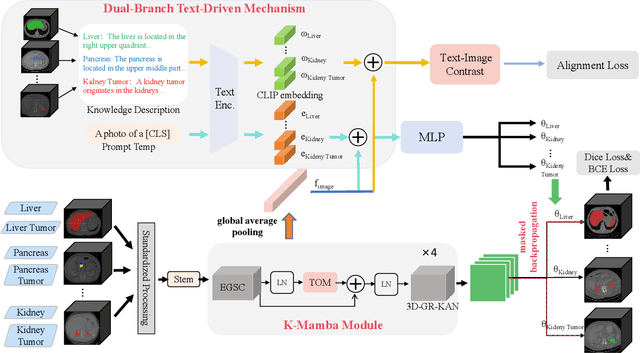
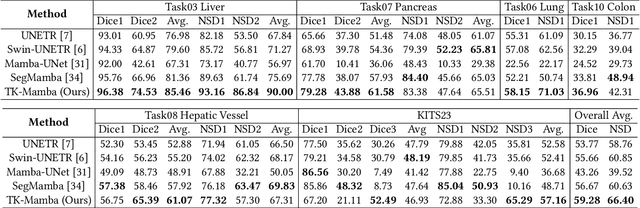
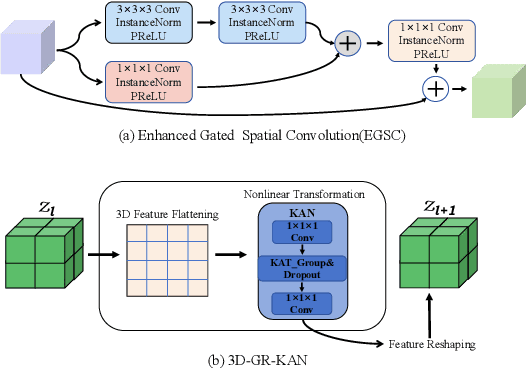
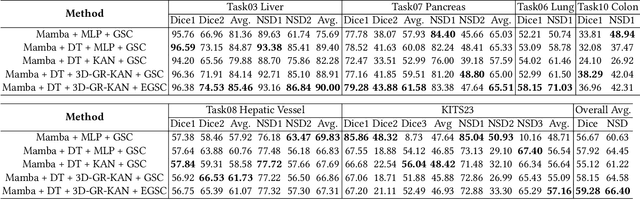
3D medical image segmentation is vital for clinical diagnosis and treatment but is challenged by high-dimensional data and complex spatial dependencies. Traditional single-modality networks, such as CNNs and Transformers, are often limited by computational inefficiency and constrained contextual modeling in 3D settings. We introduce a novel multimodal framework that leverages Mamba and Kolmogorov-Arnold Networks (KAN) as an efficient backbone for long-sequence modeling. Our approach features three key innovations: First, an EGSC (Enhanced Gated Spatial Convolution) module captures spatial information when unfolding 3D images into 1D sequences. Second, we extend Group-Rational KAN (GR-KAN), a Kolmogorov-Arnold Networks variant with rational basis functions, into 3D-Group-Rational KAN (3D-GR-KAN) for 3D medical imaging - its first application in this domain - enabling superior feature representation tailored to volumetric data. Third, a dual-branch text-driven strategy leverages CLIP's text embeddings: one branch swaps one-hot labels for semantic vectors to preserve inter-organ semantic relationships, while the other aligns images with detailed organ descriptions to enhance semantic alignment. Experiments on the Medical Segmentation Decathlon (MSD) and KiTS23 datasets show our method achieving state-of-the-art performance, surpassing existing approaches in accuracy and efficiency. This work highlights the power of combining advanced sequence modeling, extended network architectures, and vision-language synergy to push forward 3D medical image segmentation, delivering a scalable solution for clinical use. The source code is openly available at https://github.com/yhy-whu/TK-Mamba.
MiniGPT-Pancreas: Multimodal Large Language Model for Pancreas Cancer Classification and Detection
Dec 20, 2024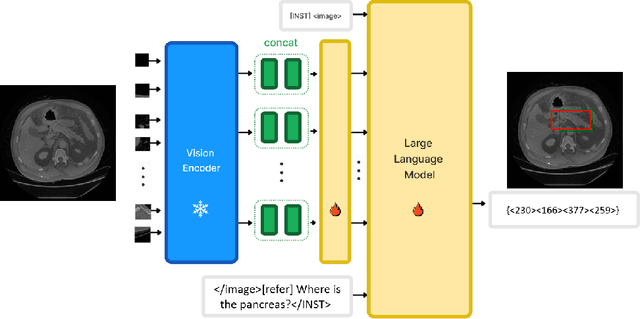
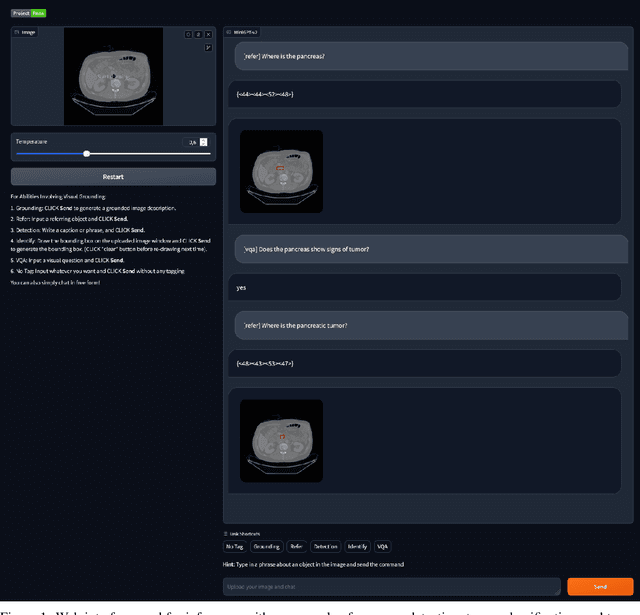
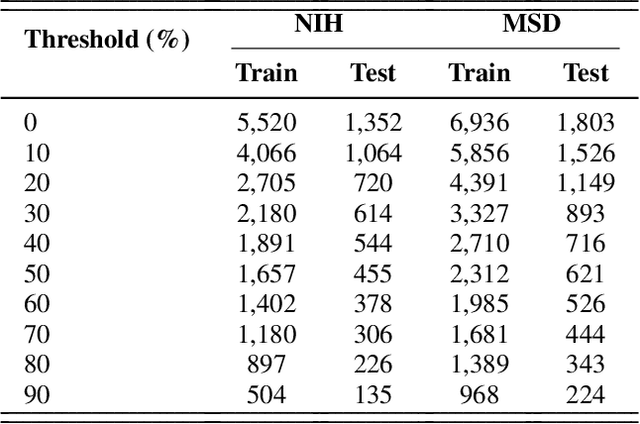
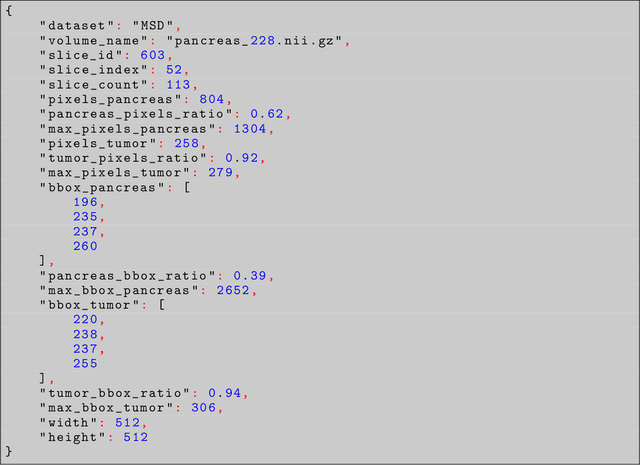
Problem: Pancreas radiological imaging is challenging due to the small size, blurred boundaries, and variability of shape and position of the organ among patients. Goal: In this work we present MiniGPT-Pancreas, a Multimodal Large Language Model (MLLM), as an interactive chatbot to support clinicians in pancreas cancer diagnosis by integrating visual and textual information. Methods: MiniGPT-v2, a general-purpose MLLM, was fine-tuned in a cascaded way for pancreas detection, tumor classification, and tumor detection with multimodal prompts combining questions and computed tomography scans from the National Institute of Health (NIH), and Medical Segmentation Decathlon (MSD) datasets. The AbdomenCT-1k dataset was used to detect the liver, spleen, kidney, and pancreas. Results: MiniGPT-Pancreas achieved an Intersection over Union (IoU) of 0.595 and 0.550 for the detection of pancreas on NIH and MSD datasets, respectively. For the pancreas cancer classification task on the MSD dataset, accuracy, precision, and recall were 0.876, 0.874, and 0.878, respectively. When evaluating MiniGPT-Pancreas on the AbdomenCT-1k dataset for multi-organ detection, the IoU was 0.8399 for the liver, 0.722 for the kidney, 0.705 for the spleen, and 0.497 for the pancreas. For the pancreas tumor detection task, the IoU score was 0.168 on the MSD dataset. Conclusions: MiniGPT-Pancreas represents a promising solution to support clinicians in the classification of pancreas images with pancreas tumors. Future research is needed to improve the score on the detection task, especially for pancreas tumors.
Uncertainty-Error correlations in Evidential Deep Learning models for biomedical segmentation
Oct 24, 2024In this work, we examine the effectiveness of an uncertainty quantification framework known as Evidential Deep Learning applied in the context of biomedical image segmentation. This class of models involves assigning Dirichlet distributions as priors for segmentation labels, and enables a few distinct definitions of model uncertainties. Using the cardiac and prostate MRI images available in the Medical Segmentation Decathlon for validation, we found that Evidential Deep Learning models with U-Net backbones generally yielded superior correlations between prediction errors and uncertainties relative to the conventional baseline equipped with Shannon entropy measure, Monte-Carlo Dropout and Deep Ensemble methods. We also examined these models' effectiveness in active learning, finding that relative to the standard Shannon entropy-based sampling, they yielded higher point-biserial uncertainty-error correlations while attaining similar performances in Dice-Sorensen coefficients. These superior features of EDL models render them well-suited for segmentation tasks that warrant a critical sensitivity in detecting large model errors.