 Add to Chrome
 Add to Firefox
 Add to Edge
Md17
Papers and Code
DEQuify your force field: More efficient simulations using deep equilibrium models
Sep 10, 2025
Machine learning force fields show great promise in enabling more accurate molecular dynamics simulations compared to manually derived ones. Much of the progress in recent years was driven by exploiting prior knowledge about physical systems, in particular symmetries under rotation, translation, and reflections. In this paper, we argue that there is another important piece of prior information that, thus fa,r hasn't been explored: Simulating a molecular system is necessarily continuous, and successive states are therefore extremely similar. Our contribution is to show that we can exploit this information by recasting a state-of-the-art equivariant base model as a deep equilibrium model. This allows us to recycle intermediate neural network features from previous time steps, enabling us to improve both accuracy and speed by $10\%-20\%$ on the MD17, MD22, and OC20 200k datasets, compared to the non-DEQ base model. The training is also much more memory efficient, allowing us to train more expressive models on larger systems.

GeoRecon: Graph-Level Representation Learning for 3D Molecules via Reconstruction-Based Pretraining
Jun 16, 2025The pretraining-and-finetuning paradigm has driven significant advances across domains, such as natural language processing and computer vision, with representative pretraining paradigms such as masked language modeling and next-token prediction. However, in molecular representation learning, the task design remains largely limited to node-level denoising, which is effective at modeling local atomic environments, yet maybe insufficient for capturing the global molecular structure required by graph-level property prediction tasks, such as energy estimation and molecular regression. In this work, we present GeoRecon, a novel graph-level pretraining framework that shifts the focus from individual atoms to the molecule as an integrated whole. GeoRecon introduces a graph-level reconstruction task: during pretraining, the model is trained to generate an informative graph representation capable of accurately guiding reconstruction of the molecular geometry. This encourages the model to learn coherent, global structural features rather than isolated atomic details. Without relying on additional supervision or external data, GeoRecon outperforms node-centric baselines on multiple molecular benchmarks (e.g., QM9, MD17), demonstrating the benefit of incorporating graph-level reconstruction for learning more holistic and geometry-aware molecular embeddings.
Efficient Prediction of SO(3)-Equivariant Hamiltonian Matrices via SO(2) Local Frames
Jun 11, 2025We consider the task of predicting Hamiltonian matrices to accelerate electronic structure calculations, which plays an important role in physics, chemistry, and materials science. Motivated by the inherent relationship between the off-diagonal blocks of the Hamiltonian matrix and the SO(2) local frame, we propose a novel and efficient network, called QHNetV2, that achieves global SO(3) equivariance without the costly SO(3) Clebsch-Gordan tensor products. This is achieved by introducing a set of new efficient and powerful SO(2)-equivariant operations and performing all off-diagonal feature updates and message passing within SO(2) local frames, thereby eliminating the need of SO(3) tensor products. Moreover, a continuous SO(2) tensor product is performed within the SO(2) local frame at each node to fuse node features, mimicking the symmetric contraction operation. Extensive experiments on the large QH9 and MD17 datasets demonstrate that our model achieves superior performance across a wide range of molecular structures and trajectories, highlighting its strong generalization capability. The proposed SO(2) operations on SO(2) local frames offer a promising direction for scalable and symmetry-aware learning of electronic structures. Our code will be released as part of the AIRS library https://github.com/divelab/AIRS.
High-order Equivariant Flow Matching for Density Functional Theory Hamiltonian Prediction
May 24, 2025Density functional theory (DFT) is a fundamental method for simulating quantum chemical properties, but it remains expensive due to the iterative self-consistent field (SCF) process required to solve the Kohn-Sham equations. Recently, deep learning methods are gaining attention as a way to bypass this step by directly predicting the Hamiltonian. However, they rely on deterministic regression and do not consider the highly structured nature of Hamiltonians. In this work, we propose QHFlow, a high-order equivariant flow matching framework that generates Hamiltonian matrices conditioned on molecular geometry. Flow matching models continuous-time trajectories between simple priors and complex targets, learning the structured distributions over Hamiltonians instead of direct regression. To further incorporate symmetry, we use a neural architecture that predicts SE(3)-equivariant vector fields, improving accuracy and generalization across diverse geometries. To further enhance physical fidelity, we additionally introduce a fine-tuning scheme to align predicted orbital energies with the target. QHFlow achieves state-of-the-art performance, reducing Hamiltonian error by 71% on MD17 and 53% on QH9. Moreover, we further show that QHFlow accelerates the DFT process without trading off the solution quality when initializing SCF iterations with the predicted Hamiltonian, significantly reducing the number of iterations and runtime.
Potential Score Matching: Debiasing Molecular Structure Sampling with Potential Energy Guidance
Mar 18, 2025The ensemble average of physical properties of molecules is closely related to the distribution of molecular conformations, and sampling such distributions is a fundamental challenge in physics and chemistry. Traditional methods like molecular dynamics (MD) simulations and Markov chain Monte Carlo (MCMC) sampling are commonly used but can be time-consuming and costly. Recently, diffusion models have emerged as efficient alternatives by learning the distribution of training data. Obtaining an unbiased target distribution is still an expensive task, primarily because it requires satisfying ergodicity. To tackle these challenges, we propose Potential Score Matching (PSM), an approach that utilizes the potential energy gradient to guide generative models. PSM does not require exact energy functions and can debias sample distributions even when trained on limited and biased data. Our method outperforms existing state-of-the-art (SOTA) models on the Lennard-Jones (LJ) potential, a commonly used toy model. Furthermore, we extend the evaluation of PSM to high-dimensional problems using the MD17 and MD22 datasets. The results demonstrate that molecular distributions generated by PSM more closely approximate the Boltzmann distribution compared to traditional diffusion models.
Graph Fourier Neural ODEs: Bridging Spatial and Temporal Multiscales in Molecular Dynamics
Nov 03, 2024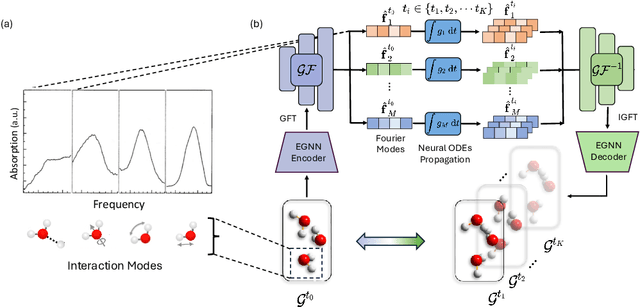
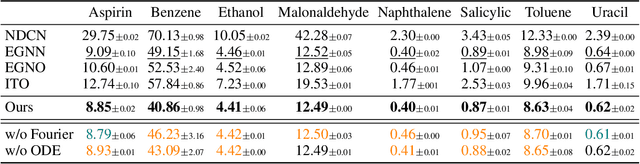
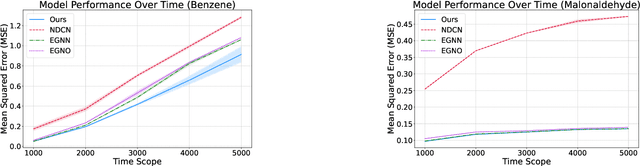
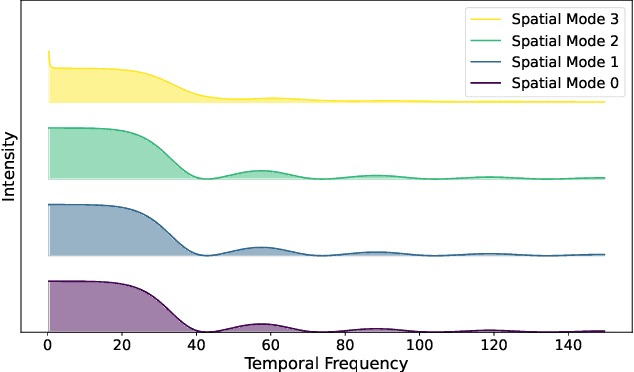
Molecular dynamics simulations are crucial for understanding complex physical, chemical, and biological processes at the atomic level. However, accurately capturing interactions across multiple spatial and temporal scales remains a significant challenge. We present a novel framework that jointly models spatial and temporal multiscale interactions in molecular dynamics. Our approach leverages Graph Fourier Transforms to decompose molecular structures into different spatial scales and employs Neural Ordinary Differential Equations to model the temporal dynamics in a curated manner influenced by the spatial modes. This unified framework links spatial structures with temporal evolution in a flexible manner, enabling more accurate and comprehensive simulations of molecular systems. We evaluate our model on the MD17 dataset, demonstrating consistent performance improvements over state-of-the-art baselines across multiple molecules, particularly under challenging conditions such as irregular timestep sampling and long-term prediction horizons. Ablation studies confirm the significant contributions of both spatial and temporal multiscale modeling components. Our method advances the simulation of complex molecular systems, potentially accelerating research in computational chemistry, drug discovery, and materials science.
Are High-Degree Representations Really Unnecessary in Equivariant Graph Neural Networks?
Oct 15, 2024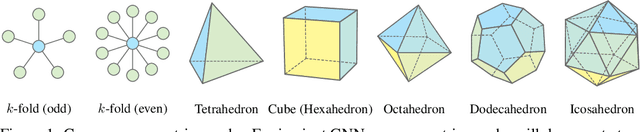
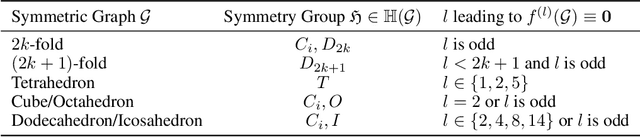
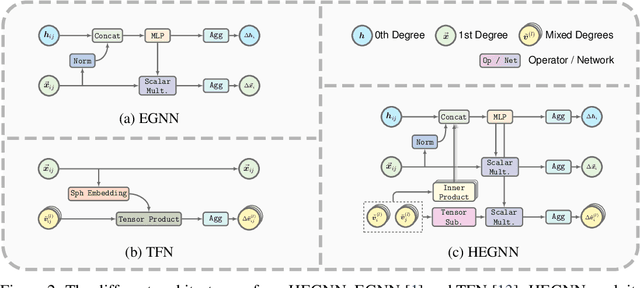
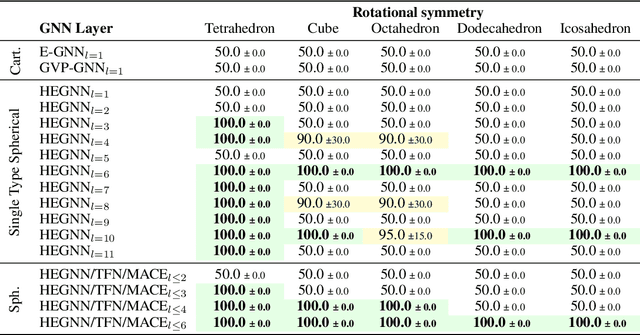
Equivariant Graph Neural Networks (GNNs) that incorporate E(3) symmetry have achieved significant success in various scientific applications. As one of the most successful models, EGNN leverages a simple scalarization technique to perform equivariant message passing over only Cartesian vectors (i.e., 1st-degree steerable vectors), enjoying greater efficiency and efficacy compared to equivariant GNNs using higher-degree steerable vectors. This success suggests that higher-degree representations might be unnecessary. In this paper, we disprove this hypothesis by exploring the expressivity of equivariant GNNs on symmetric structures, including $k$-fold rotations and regular polyhedra. We theoretically demonstrate that equivariant GNNs will always degenerate to a zero function if the degree of the output representations is fixed to 1 or other specific values. Based on this theoretical insight, we propose HEGNN, a high-degree version of EGNN to increase the expressivity by incorporating high-degree steerable vectors while maintaining EGNN's efficiency through the scalarization trick. Our extensive experiments demonstrate that HEGNN not only aligns with our theoretical analyses on toy datasets consisting of symmetric structures, but also shows substantial improvements on more complicated datasets such as $N$-body and MD17. Our theoretical findings and empirical results potentially open up new possibilities for the research of equivariant GNNs.
Learning Equivariant Non-Local Electron Density Functionals
Oct 10, 2024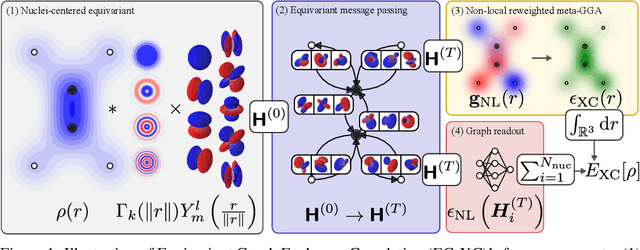
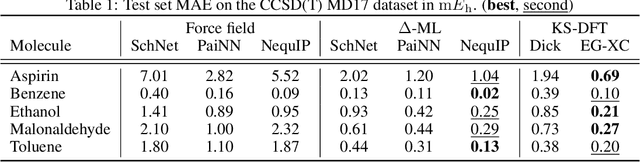
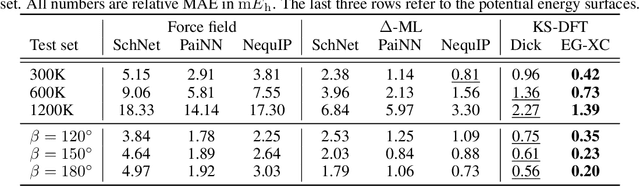
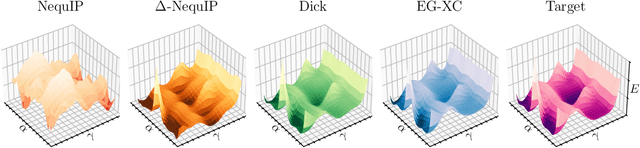
The accuracy of density functional theory hinges on the approximation of non-local contributions to the exchange-correlation (XC) functional. To date, machine-learned and human-designed approximations suffer from insufficient accuracy, limited scalability, or dependence on costly reference data. To address these issues, we introduce Equivariant Graph Exchange Correlation (EG-XC), a novel non-local XC functional based on equivariant graph neural networks. EG-XC combines semi-local functionals with a non-local feature density parametrized by an equivariant nuclei-centered point cloud representation of the electron density to capture long-range interactions. By differentiating through a self-consistent field solver, we train EG-XC requiring only energy targets. In our empirical evaluation, we find EG-XC to accurately reconstruct `gold-standard' CCSD(T) energies on MD17. On out-of-distribution conformations of 3BPA, EG-XC reduces the relative MAE by 35% to 50%. Remarkably, EG-XC excels in data efficiency and molecular size extrapolation on QM9, matching force fields trained on 5 times more and larger molecules. On identical training sets, EG-XC yields on average 51% lower MAEs.
A Clifford Algebraic Approach to E(n)-Equivariant High-order Graph Neural Networks
Oct 07, 2024



Designing neural network architectures that can handle data symmetry is crucial. This is especially important for geometric graphs whose properties are equivariance under Euclidean transformations. Current equivariant graph neural networks (EGNNs), particularly those using message passing, have a limitation in expressive power. Recent high-order graph neural networks can overcome this limitation, yet they lack equivariance properties, representing a notable drawback in certain applications in chemistry and physical sciences. In this paper, we introduce the Clifford Group Equivariant Graph Neural Networks (CG-EGNNs), a novel EGNN that enhances high-order message passing by integrating high-order local structures in the context of Clifford algebras. As a key benefit of using Clifford algebras, CG-EGNN can learn functions that capture equivariance from positional features. By adopting the high-order message passing mechanism, CG-EGNN gains richer information from neighbors, thus improving model performance. Furthermore, we establish the universality property of the $k$-hop message passing framework, showcasing greater expressive power of CG-EGNNs with additional $k$-hop message passing mechanism. We empirically validate that CG-EGNNs outperform previous methods on various benchmarks including n-body, CMU motion capture, and MD17, highlighting their effectiveness in geometric deep learning.
Distribution Learning for Molecular Regression
Jul 30, 2024
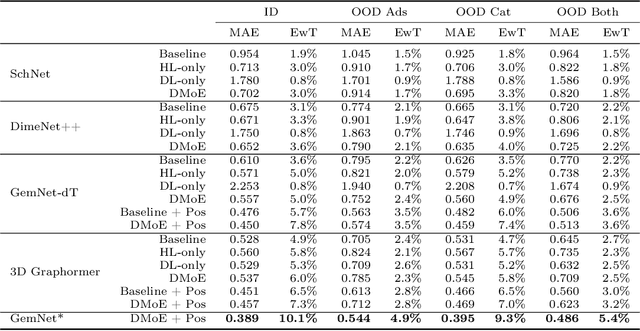
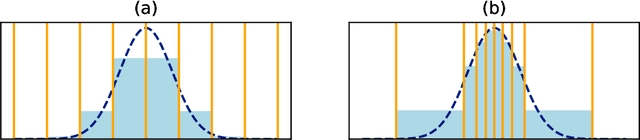
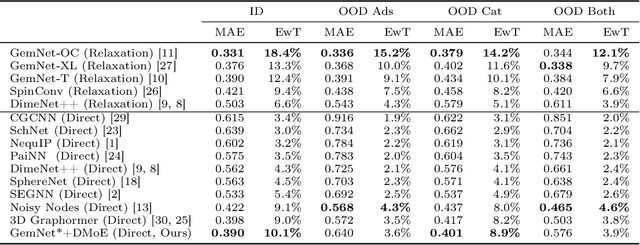
Using "soft" targets to improve model performance has been shown to be effective in classification settings, but the usage of soft targets for regression is a much less studied topic in machine learning. The existing literature on the usage of soft targets for regression fails to properly assess the method's limitations, and empirical evaluation is quite limited. In this work, we assess the strengths and drawbacks of existing methods when applied to molecular property regression tasks. Our assessment outlines key biases present in existing methods and proposes methods to address them, evaluated through careful ablation studies. We leverage these insights to propose Distributional Mixture of Experts (DMoE): A model-independent, and data-independent method for regression which trains a model to predict probability distributions of its targets. Our proposed loss function combines the cross entropy between predicted and target distributions and the L1 distance between their expected values to produce a loss function that is robust to the outlined biases. We evaluate the performance of DMoE on different molecular property prediction datasets -- Open Catalyst (OC20), MD17, and QM9 -- across different backbone model architectures -- SchNet, GemNet, and Graphormer. Our results demonstrate that the proposed method is a promising alternative to classical regression for molecular property prediction tasks, showing improvements over baselines on all datasets and architectures.