 Add to Chrome
 Add to Firefox
 Add to Edge
3D Molecule Generation from Rigid Motifs via SE(3) Flows
Jan 23, 2026
Three-dimensional molecular structure generation is typically performed at the level of individual atoms, yet molecular graph generation techniques often consider fragments as their structural units. Building on the advances in frame-based protein structure generation, we extend these fragmentation ideas to 3D, treating general molecules as sets of rigid-body motifs. Utilising this representation, we employ SE(3)-equivariant generative modelling for de novo 3D molecule generation from rigid motifs. In our evaluations, we observe comparable or superior results to state-of-the-art across benchmarks, surpassing it in atom stability on GEOM-Drugs, while yielding a 2x to 10x reduction in generation steps and offering 3.5x compression in molecular representations compared to the standard atom-based methods.

Learning Equivariant Non-Local Electron Density Functionals
Oct 10, 2024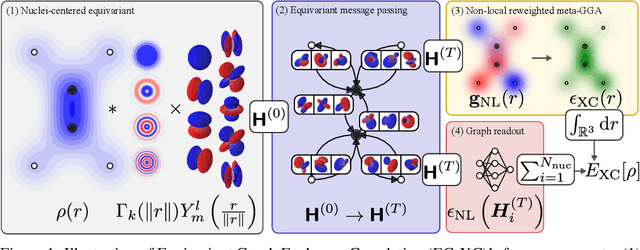
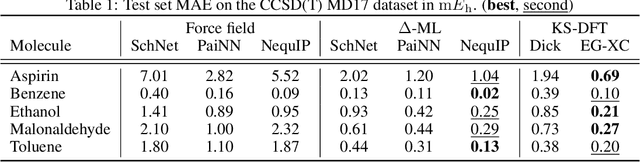
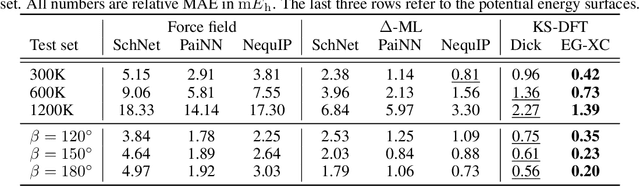
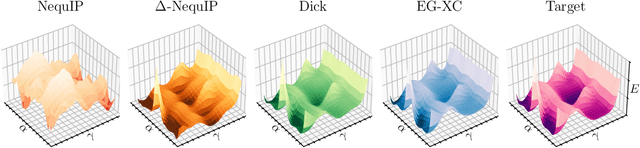
The accuracy of density functional theory hinges on the approximation of non-local contributions to the exchange-correlation (XC) functional. To date, machine-learned and human-designed approximations suffer from insufficient accuracy, limited scalability, or dependence on costly reference data. To address these issues, we introduce Equivariant Graph Exchange Correlation (EG-XC), a novel non-local XC functional based on equivariant graph neural networks. EG-XC combines semi-local functionals with a non-local feature density parametrized by an equivariant nuclei-centered point cloud representation of the electron density to capture long-range interactions. By differentiating through a self-consistent field solver, we train EG-XC requiring only energy targets. In our empirical evaluation, we find EG-XC to accurately reconstruct `gold-standard' CCSD(T) energies on MD17. On out-of-distribution conformations of 3BPA, EG-XC reduces the relative MAE by 35% to 50%. Remarkably, EG-XC excels in data efficiency and molecular size extrapolation on QM9, matching force fields trained on 5 times more and larger molecules. On identical training sets, EG-XC yields on average 51% lower MAEs.