 Add to Chrome
 Add to Firefox
 Add to Edge
Fast Ocr
Papers and Code
HiMu: Hierarchical Multimodal Frame Selection for Long Video Question Answering
Mar 19, 2026
Long-form video question answering requires reasoning over extended temporal contexts, making frame selection critical for large vision-language models (LVLMs) bound by finite context windows. Existing methods face a sharp trade-off: similarity-based selectors are fast but collapse compositional queries into a single dense vector, losing sub-event ordering and cross-modal bindings; agent-based methods recover this structure through iterative LVLM inference, but at prohibitive cost. We introduce HiMu, a training-free framework that bridges this gap. A single text-only LLM call decomposes the query into a hierarchical logic tree whose leaves are atomic predicates, each routed to a lightweight expert spanning vision (CLIP, open-vocabulary detection, OCR) and audio (ASR, CLAP). The resulting signals are normalized, temporally smoothed to align different modalities, and composed bottom-up through fuzzy-logic operators that enforce temporal sequencing and adjacency, producing a continuous satisfaction curve. Evaluations on Video-MME, LongVideoBench and HERBench-Lite show that HiMu advances the efficiency-accuracy Pareto front: at 16 frames with Qwen3-VL 8B it outperforms all competing selectors, and with GPT-4o it surpasses agentic systems operating at 32-512 frames while requiring roughly 10x fewer FLOPs.

Diffusion Reinforcement Learning via Centered Reward Distillation
Mar 14, 2026Diffusion and flow models achieve State-Of-The-Art (SOTA) generative performance, yet many practically important behaviors such as fine-grained prompt fidelity, compositional correctness, and text rendering are weakly specified by score or flow matching pretraining objectives. Reinforcement Learning (RL) fine-tuning with external, black-box rewards is a natural remedy, but diffusion RL is often brittle. Trajectory-based methods incur high memory cost and high-variance gradient estimates; forward-process approaches converge faster but can suffer from distribution drift, and hence reward hacking. In this work, we present \textbf{Centered Reward Distillation (CRD)}, a diffusion RL framework derived from KL-regularized reward maximization built on forward-process-based fine-tuning. The key insight is that the intractable normalizing constant cancels under \emph{within-prompt centering}, yielding a well-posed reward-matching objective. To enable reliable text-to-image fine-tuning, we introduce techniques that explicitly control distribution drift: (\textit{i}) decoupling the sampler from the moving reference to prevent ratio-signal collapse, (\textit{ii}) KL anchoring to a CFG-guided pretrained model to control long-run drift and align with the inference-time semantics of the pre-trained model, and (\textit{iii}) reward-adaptive KL strength to accelerate early learning under large KL regularization while reducing late-stage exploitation of reward-model loopholes. Experiments on text-to-image post-training with \texttt{GenEval} and \texttt{OCR} rewards show that CRD achieves competitive SOTA reward optimization results with fast convergence and reduced reward hacking, as validated on unseen preference metrics.
Evaluating OCR Performance for Assistive Technology: Effects of Walking Speed, Camera Placement, and Camera Type
Feb 02, 2026Optical character recognition (OCR), which converts printed or handwritten text into machine-readable form, is widely used in assistive technology for people with blindness and low vision. Yet, most evaluations rely on static datasets that do not reflect the challenges of mobile use. In this study, we systematically evaluated OCR performance under both static and dynamic conditions. Static tests measured detection range across distances of 1-7 meters and viewing angles of 0-75 degrees horizontally. Dynamic tests examined the impact of motion by varying walking speed from slow (0.8 m/s) to very fast (1.8 m/s) and comparing three camera mounting positions: head-mounted, shoulder-mounted, and hand-held. We evaluated both a smartphone and smart glasses, using the phone's main and ultra-wide cameras. Four OCR engines were benchmarked to assess accuracy at different distances and viewing angles: Google Vision, PaddleOCR 3.0, EasyOCR, and Tesseract. PaddleOCR 3.0 was then used to evaluate accuracy at different walking speeds. Accuracy was computed at the character level using the Levenshtein ratio against manually defined ground truth. Results showed that recognition accuracy declined with increased walking speed and wider viewing angles. Google Vision achieved the highest overall accuracy, with PaddleOCR close behind as the strongest open-source alternative. Across devices, the phone's main camera achieved the highest accuracy, and a shoulder-mounted placement yielded the highest average among body positions; however, differences among shoulder, head, and hand were not statistically significant.
Seeing Straight: Document Orientation Detection for Efficient OCR
Nov 06, 2025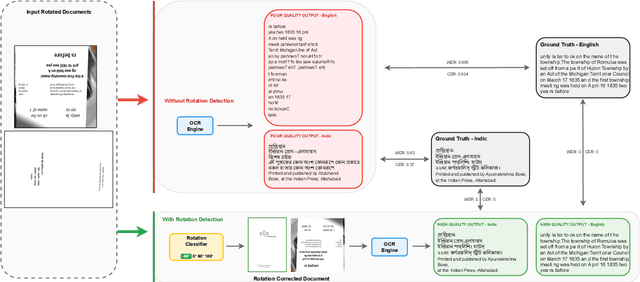

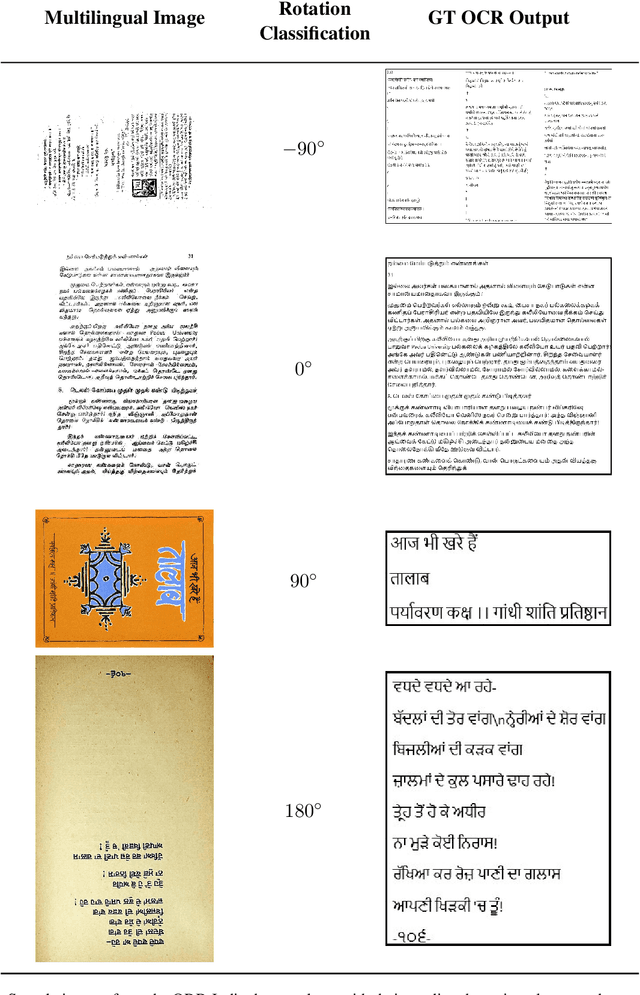
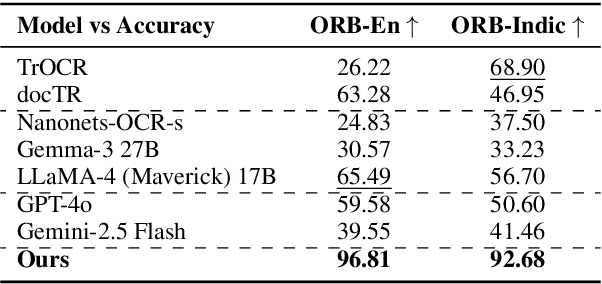
Despite significant advances in document understanding, determining the correct orientation of scanned or photographed documents remains a critical pre-processing step in the real world settings. Accurate rotation correction is essential for enhancing the performance of downstream tasks such as Optical Character Recognition (OCR) where misalignment commonly arises due to user errors, particularly incorrect base orientations of the camera during capture. In this study, we first introduce OCR-Rotation-Bench (ORB), a new benchmark for evaluating OCR robustness to image rotations, comprising (i) ORB-En, built from rotation-transformed structured and free-form English OCR datasets, and (ii) ORB-Indic, a novel multilingual set spanning 11 Indic mid to low-resource languages. We also present a fast, robust and lightweight rotation classification pipeline built on the vision encoder of Phi-3.5-Vision model with dynamic image cropping, fine-tuned specifically for 4-class rotation task in a standalone fashion. Our method achieves near-perfect 96% and 92% accuracy on identifying the rotations respectively on both the datasets. Beyond classification, we demonstrate the critical role of our module in boosting OCR performance: closed-source (up to 14%) and open-weights models (up to 4x) in the simulated real-world setting.
Reading in the Dark with Foveated Event Vision
Jun 07, 2025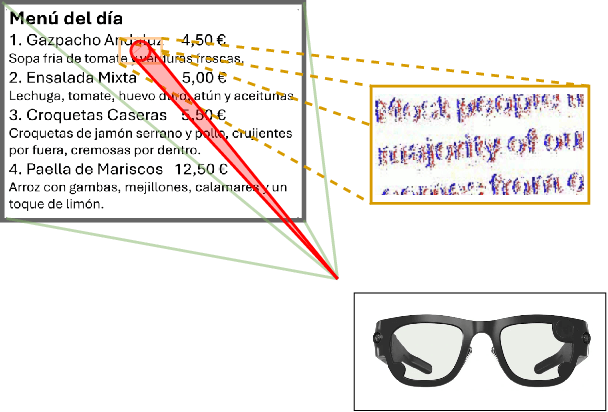
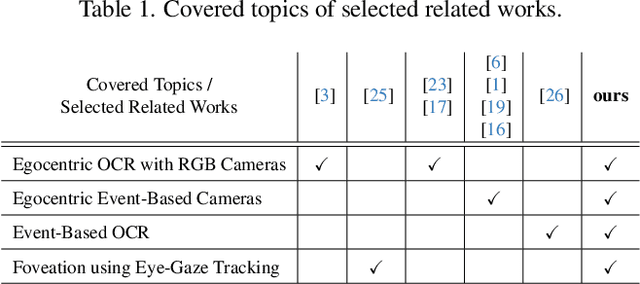
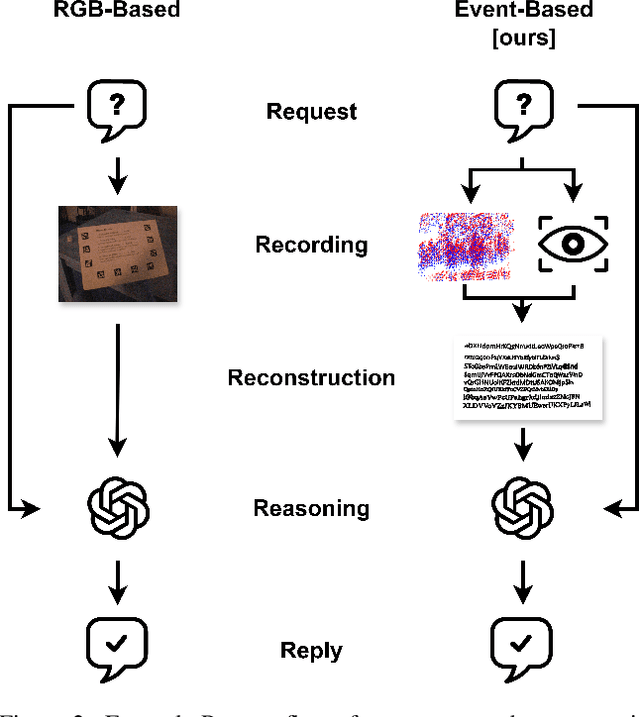
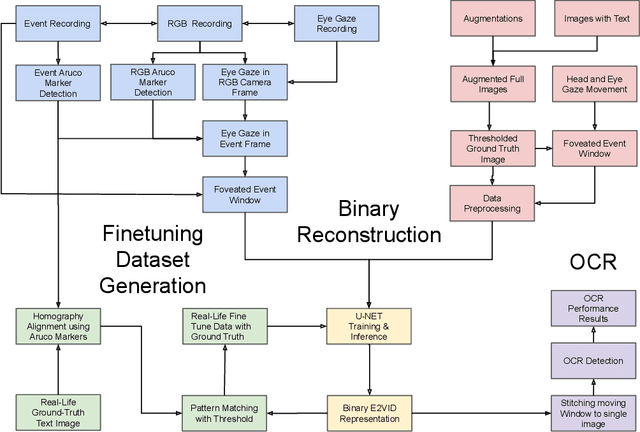
Current smart glasses equipped with RGB cameras struggle to perceive the environment in low-light and high-speed motion scenarios due to motion blur and the limited dynamic range of frame cameras. Additionally, capturing dense images with a frame camera requires large bandwidth and power consumption, consequently draining the battery faster. These challenges are especially relevant for developing algorithms that can read text from images. In this work, we propose a novel event-based Optical Character Recognition (OCR) approach for smart glasses. By using the eye gaze of the user, we foveate the event stream to significantly reduce bandwidth by around 98% while exploiting the benefits of event cameras in high-dynamic and fast scenes. Our proposed method performs deep binary reconstruction trained on synthetic data and leverages multimodal LLMs for OCR, outperforming traditional OCR solutions. Our results demonstrate the ability to read text in low light environments where RGB cameras struggle while using up to 2400 times less bandwidth than a wearable RGB camera.
PP-DocBee: Improving Multimodal Document Understanding Through a Bag of Tricks
Mar 06, 2025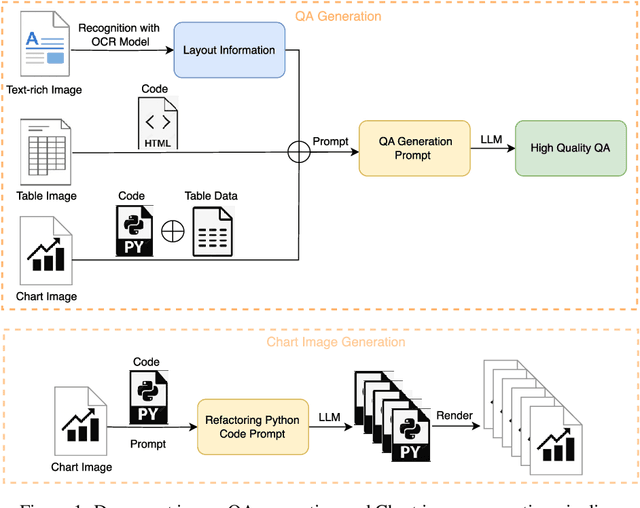
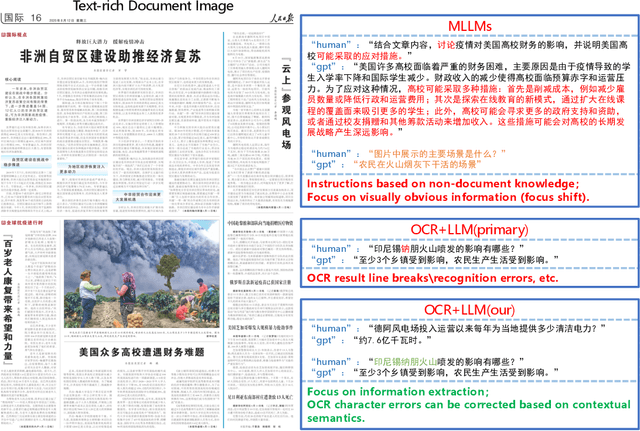
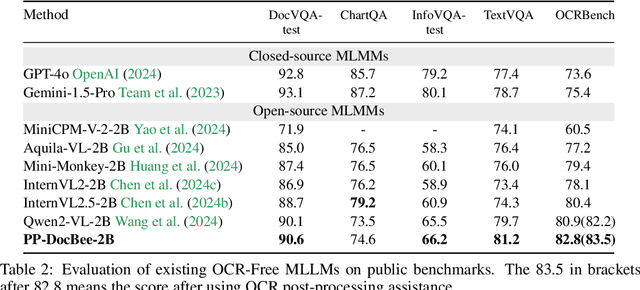
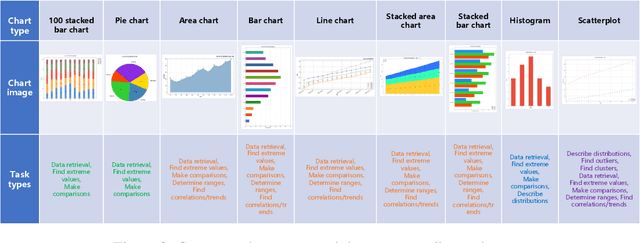
With the rapid advancement of digitalization, various document images are being applied more extensively in production and daily life, and there is an increasingly urgent need for fast and accurate parsing of the content in document images. Therefore, this report presents PP-DocBee, a novel multimodal large language model designed for end-to-end document image understanding. First, we develop a data synthesis strategy tailored to document scenarios in which we build a diverse dataset to improve the model generalization. Then, we apply a few training techniques, including dynamic proportional sampling, data preprocessing, and OCR postprocessing strategies. Extensive evaluations demonstrate the superior performance of PP-DocBee, achieving state-of-the-art results on English document understanding benchmarks and even outperforming existing open source and commercial models in Chinese document understanding. The source code and pre-trained models are publicly available at \href{https://github.com/PaddlePaddle/PaddleMIX}{https://github.com/PaddlePaddle/PaddleMIX}.
Online Fault Tolerance Strategy for Abrupt Reachability Constraint Changes
Jan 03, 2025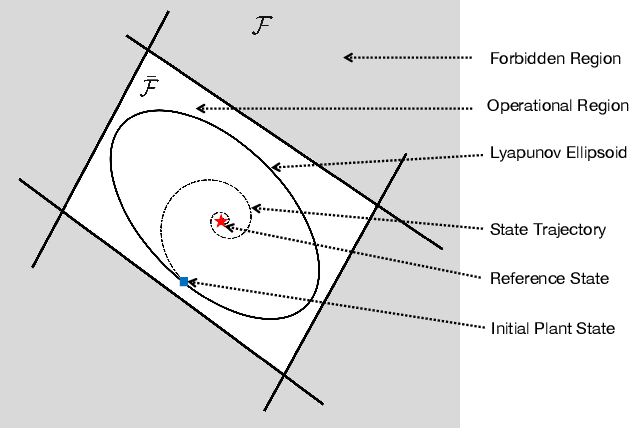
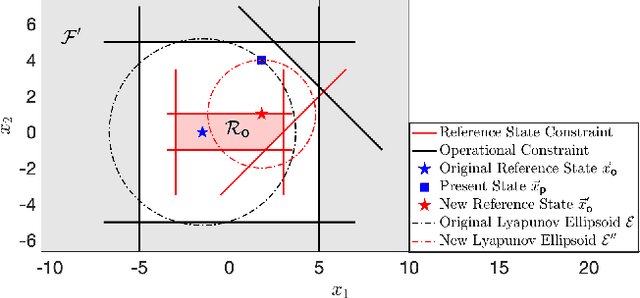
When a system's constraints change abruptly, the system's reachability safety does no longer sustain. Thus, the system can reach a forbidden/dangerous value. Conventional remedy practically involves online controller redesign (OCR) to re-establish the reachability's compliance with the new constraints, which, however, is usually too slow. There is a need for an online strategy capable of managing runtime changes in reachability constraints. However, to the best of the authors' knowledge, this topic has not been addressed in the existing literature. In this paper, we propose a fast fault tolerance strategy to recover the system's reachability safety in runtime. Instead of redesigning the system's controller, we propose to change the system's reference state to modify the system's reachability to comply with the new constraints. We frame the reference state search as an optimization problem and employ the Karush-Kuhn-Tucker (KKT) method as well as the Interior Point Method (IPM) based Newton's method (as a fallback for the KKT method) for fast solution derivation. The optimization also allows more future fault tolerance. Numerical simulations demonstrate that our method outperforms the conventional OCR method in terms of computational efficiency and success rate. Specifically, the results show that the proposed method finds a solution $10^{2}$ (with the IPM based Newton's method) $\sim 10^{4}$ (with the KKT method) times faster than the OCR method. Additionally, the improvement rate of the success rate of our method over the OCR method is $40.81\%$ without considering the deadline of run time. The success rate remains at $49.44\%$ for the proposed method, while it becomes $0\%$ for the OCR method when a deadline of $1.5 \; seconds$ is imposed.
SVTRv2: CTC Beats Encoder-Decoder Models in Scene Text Recognition
Nov 24, 2024Connectionist temporal classification (CTC)-based scene text recognition (STR) methods, e.g., SVTR, are widely employed in OCR applications, mainly due to their simple architecture, which only contains a visual model and a CTC-aligned linear classifier, and therefore fast inference. However, they generally have worse accuracy than encoder-decoder-based methods (EDTRs), particularly in challenging scenarios. In this paper, we propose SVTRv2, a CTC model that beats leading EDTRs in both accuracy and inference speed. SVTRv2 introduces novel upgrades to handle text irregularity and utilize linguistic context, which endows it with the capability to deal with challenging and diverse text instances. First, a multi-size resizing (MSR) strategy is proposed to adaptively resize the text and maintain its readability. Meanwhile, we introduce a feature rearrangement module (FRM) to ensure that visual features accommodate the alignment requirement of CTC well, thus alleviating the alignment puzzle. Second, we propose a semantic guidance module (SGM). It integrates linguistic context into the visual model, allowing it to leverage language information for improved accuracy. Moreover, SGM can be omitted at the inference stage and would not increase the inference cost. We evaluate SVTRv2 in both standard and recent challenging benchmarks, where SVTRv2 is fairly compared with 24 mainstream STR models across multiple scenarios, including different types of text irregularity, languages, and long text. The results indicate that SVTRv2 surpasses all the EDTRs across the scenarios in terms of accuracy and speed. Code is available at https://github.com/Topdu/OpenOCR.
Optimizing Nepali PDF Extraction: A Comparative Study of Parser and OCR Technologies
Jul 05, 2024This research compares PDF parsing and Optical Character Recognition (OCR) methods for extracting Nepali content from PDFs. PDF parsing offers fast and accurate extraction but faces challenges with non-Unicode Nepali fonts. OCR, specifically PyTesseract, overcomes these challenges, providing versatility for both digital and scanned PDFs. The study reveals that while PDF parsers are faster, their accuracy fluctuates based on PDF types. In contrast, OCRs, with a focus on PyTesseract, demonstrate consistent accuracy at the expense of slightly longer extraction times. Considering the project's emphasis on Nepali PDFs, PyTesseract emerges as the most suitable library, balancing extraction speed and accuracy.
Image-text matching for large-scale book collections
Jul 29, 2024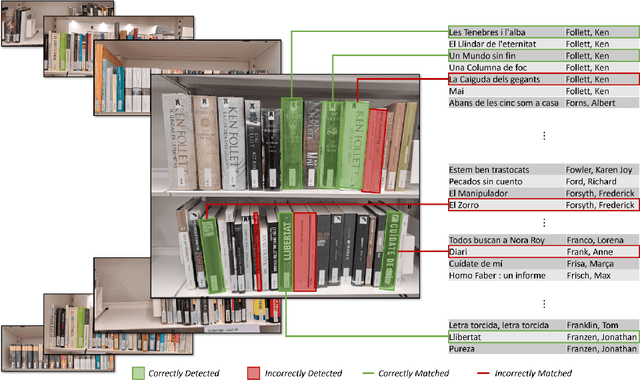
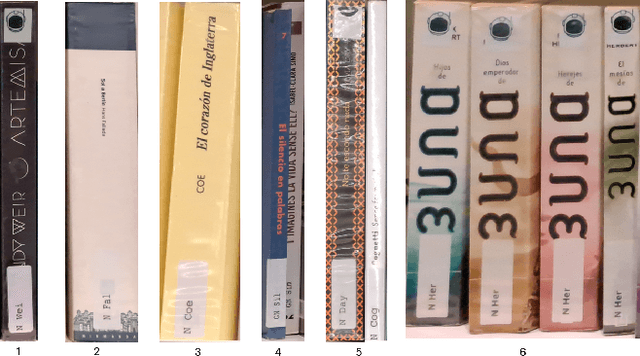
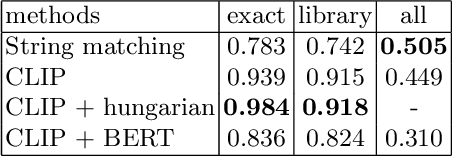
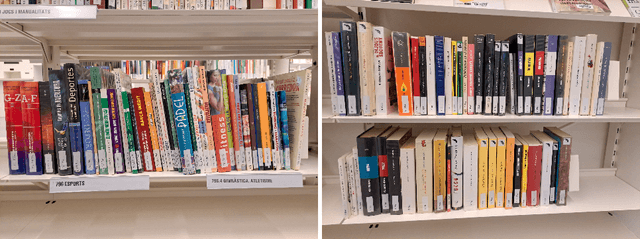
We address the problem of detecting and mapping all books in a collection of images to entries in a given book catalogue. Instead of performing independent retrieval for each book detected, we treat the image-text mapping problem as a many-to-many matching process, looking for the best overall match between the two sets. We combine a state-of-the-art segmentation method (SAM) to detect book spines and extract book information using a commercial OCR. We then propose a two-stage approach for text-image matching, where CLIP embeddings are used first for fast matching, followed by a second slower stage to refine the matching, employing either the Hungarian Algorithm or a BERT-based model trained to cope with noisy OCR input and partial text matches. To evaluate our approach, we publish a new dataset of annotated bookshelf images that covers the whole book collection of a public library in Spain. In addition, we provide two target lists of book metadata, a closed-set of 15k book titles that corresponds to the known library inventory, and an open-set of 2.3M book titles to simulate an open-world scenario. We report results on two settings, on one hand on a matching-only task, where the book segments and OCR is given and the objective is to perform many-to-many matching against the target lists, and a combined detection and matching task, where books must be first detected and recognised before they are matched to the target list entries. We show that both the Hungarian Matching and the proposed BERT-based model outperform a fuzzy string matching baseline, and we highlight inherent limitations of the matching algorithms as the target increases in size, and when either of the two sets (detected books or target book list) is incomplete. The dataset and code are available at https://github.com/llabres/library-dataset