 Add to Chrome
 Add to Firefox
 Add to Edge
From Texts to Scores: Tracing the Emergence of Essay Quality Representations in Large Language Models
Jun 18, 2026
Recent advances in Large Language Models (LLMs) have substantially transformed Automated Essay Scoring (AES), yet the internal mechanisms underlying LLM-based scoring remain poorly understood. In this work, we systematically analyze the hidden representations of eight LLMs across two English essay datasets (ASAP++, CSEE) and one Portuguese dataset (ENEM). Using linear probing, cross-prompt generalization, dimensionality reduction, and neuron-level analyses, we find consistent evidence that essay quality information is encoded in a linearly accessible form within LLM representations. These representations emerge progressively across layers, remain robust across prompting strategies, and partially transfer across essay prompts despite differences in scoring rubrics. In addition, nonlinear probes provide only marginal and inconsistent improvements over linear probes, suggesting that most essay quality information is already linearly decodable. We further identify individual ``essay scoring neurons'' whose activations strongly correlate with essay scores and whose behavior is sensitive to targeted intervention. Moreover, the layer-wise distribution of these neurons systematically shifts with essay length, with longer essays relying more heavily on deeper layers. Overall, our findings provide evidence that LLMs encode structured representations related to essay quality and offer new insights into the interpretability of LLM-based AES systems.

CLIF: Concept-Level Influence Functions for Transparent Bottleneck Models
May 19, 2026In recent years, the black-box nature of deep learning models has limited their application in high-stakes domains such as medical diagnosis and finance, where interpretability is essential. To address this, we propose a novel approach using influence functions to enhance interpretability in NLP models at both the sample and concept levels. Experiments on CEBaB and Yelp datasets show that influence functions effectively identify the most impactful training samples, both helpful and harmful, on model predictions. By adjusting the labels and weights of these samples, we demonstrate that model performance can be restored to baseline levels without retraining, confirming the value of influence functions for efficient data debugging. Furthermore, our concept-level analysis identifies key concepts within Concept Bottleneck Models (CBM) that significantly affect predictions. Modifying these concepts alters model behavior observably, providing clear insights into the decision process.
Agri-CPJ: A Training-Free Explainable Framework for Agricultural Pest Diagnosis Using Caption-Prompt-Judge and LLM-as-a-Judge
Apr 26, 2026Crop disease diagnosis from field photographs faces two recurring problems: models that score well on benchmarks frequently hallucinate species names, and when predictions are correct, the reasoning behind them is typically inaccessible to the practitioner. This paper describes Agri-CPJ (Caption-Prompt-Judge), a training-free few-shot framework in which a large vision-language model first generates a structured morphological caption, iteratively refined through multi-dimensional quality gating, before any diagnostic question is answered. Two candidate responses are then generated from complementary viewpoints, and an LLM judge selects the stronger one based on domain-specific criteria. Caption refinement is the component with the largest individual impact: ablations confirm that skipping it consistently degrades downstream accuracy across both models tested. On CDDMBench, pairing GPT-5-Nano with GPT-5-mini-generated captions yields \textbf{+22.7} pp in disease classification and \textbf{+19.5} points in QA score over no-caption baselines. Evaluated without modification on AgMMU-MCQs, GPT-5-Nano reached 77.84\% and Qwen-VL-Chat reached 64.54\%, placing them at or above most open-source models of comparable scale despite the format shift from open-ended to multiple-choice. The structured caption and judge rationale together constitute a readable audit trail: a practitioner who disagrees with a diagnosis can identify the specific caption observation that was incorrect. Code and data are publicly available https://github.com/CPJ-Agricultural/CPJ-Agricultural-Diagnosis
Online Fault Tolerance Strategy for Abrupt Reachability Constraint Changes
Jan 03, 2025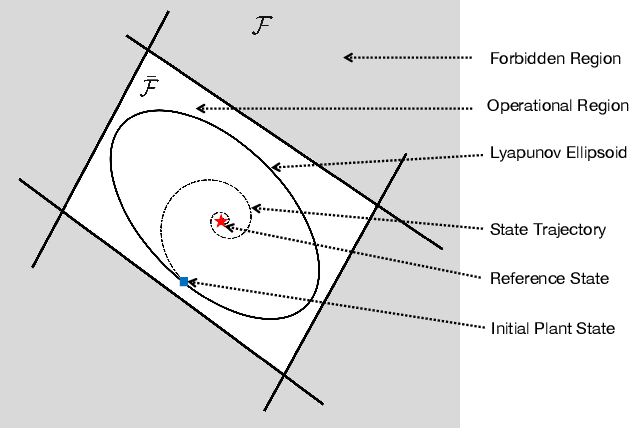
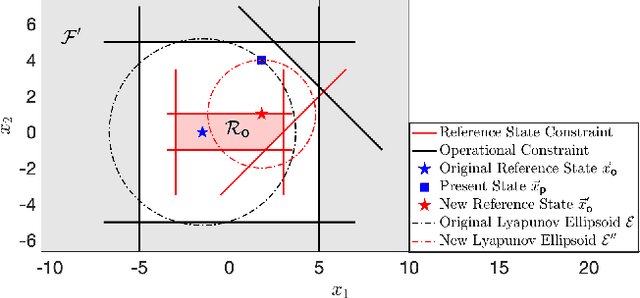
When a system's constraints change abruptly, the system's reachability safety does no longer sustain. Thus, the system can reach a forbidden/dangerous value. Conventional remedy practically involves online controller redesign (OCR) to re-establish the reachability's compliance with the new constraints, which, however, is usually too slow. There is a need for an online strategy capable of managing runtime changes in reachability constraints. However, to the best of the authors' knowledge, this topic has not been addressed in the existing literature. In this paper, we propose a fast fault tolerance strategy to recover the system's reachability safety in runtime. Instead of redesigning the system's controller, we propose to change the system's reference state to modify the system's reachability to comply with the new constraints. We frame the reference state search as an optimization problem and employ the Karush-Kuhn-Tucker (KKT) method as well as the Interior Point Method (IPM) based Newton's method (as a fallback for the KKT method) for fast solution derivation. The optimization also allows more future fault tolerance. Numerical simulations demonstrate that our method outperforms the conventional OCR method in terms of computational efficiency and success rate. Specifically, the results show that the proposed method finds a solution $10^{2}$ (with the IPM based Newton's method) $\sim 10^{4}$ (with the KKT method) times faster than the OCR method. Additionally, the improvement rate of the success rate of our method over the OCR method is $40.81\%$ without considering the deadline of run time. The success rate remains at $49.44\%$ for the proposed method, while it becomes $0\%$ for the OCR method when a deadline of $1.5 \; seconds$ is imposed.