 Add to Chrome
 Add to Firefox
 Add to Edge
Structured Diffusion Bridges: Inductive Bias for Denoising Diffusion Bridges
May 06, 2026
Modality translation is inherently under-constrained, as multiple cross-modal mappings may yield the same marginals. Recent work has shown that diffusion bridges are effective for this task. However, most existing approaches rely on fully paired datasets, thereby imposing a single data-driven constraint. We propose a diffusion-bridge framework that characterizes the space of admissible solutions and restricts it via alignment constraints, treating paired supervision as an optional heuristic rather than a prerequisite. We validate our method on synthetic and real modality translation benchmarks across unpaired, semi-paired, and paired regimes, showing consistent performance across supervision levels. Notably, \textbf{it achieves near fully-paired quality with a substantial relaxation in pairing requirements, and remaining applicable in the unpaired regime}. These results highlight diffusion bridges as a flexible foundation for modality translation beyond fully paired data.

HiMu: Hierarchical Multimodal Frame Selection for Long Video Question Answering
Mar 19, 2026Long-form video question answering requires reasoning over extended temporal contexts, making frame selection critical for large vision-language models (LVLMs) bound by finite context windows. Existing methods face a sharp trade-off: similarity-based selectors are fast but collapse compositional queries into a single dense vector, losing sub-event ordering and cross-modal bindings; agent-based methods recover this structure through iterative LVLM inference, but at prohibitive cost. We introduce HiMu, a training-free framework that bridges this gap. A single text-only LLM call decomposes the query into a hierarchical logic tree whose leaves are atomic predicates, each routed to a lightweight expert spanning vision (CLIP, open-vocabulary detection, OCR) and audio (ASR, CLAP). The resulting signals are normalized, temporally smoothed to align different modalities, and composed bottom-up through fuzzy-logic operators that enforce temporal sequencing and adjacency, producing a continuous satisfaction curve. Evaluations on Video-MME, LongVideoBench and HERBench-Lite show that HiMu advances the efficiency-accuracy Pareto front: at 16 frames with Qwen3-VL 8B it outperforms all competing selectors, and with GPT-4o it surpasses agentic systems operating at 32-512 frames while requiring roughly 10x fewer FLOPs.
PREGEN: Uncovering Latent Thoughts in Composed Video Retrieval
Jan 20, 2026Composed Video Retrieval (CoVR) aims to retrieve a video based on a query video and a modifying text. Current CoVR methods fail to fully exploit modern Vision-Language Models (VLMs), either using outdated architectures or requiring computationally expensive fine-tuning and slow caption generation. We introduce PREGEN (PRE GENeration extraction), an efficient and powerful CoVR framework that overcomes these limitations. Our approach uniquely pairs a frozen, pre-trained VLM with a lightweight encoding model, eliminating the need for any VLM fine-tuning. We feed the query video and modifying text into the VLM and extract the hidden state of the final token from each layer. A simple encoder is then trained on these pooled representations, creating a semantically rich and compact embedding for retrieval. PREGEN significantly advances the state of the art, surpassing all prior methods on standard CoVR benchmarks with substantial gains in Recall@1 of +27.23 and +69.59. Our method demonstrates robustness across different VLM backbones and exhibits strong zero-shot generalization to more complex textual modifications, highlighting its effectiveness and semantic capabilities.
HERBench: A Benchmark for Multi-Evidence Integration in Video Question Answering
Dec 16, 2025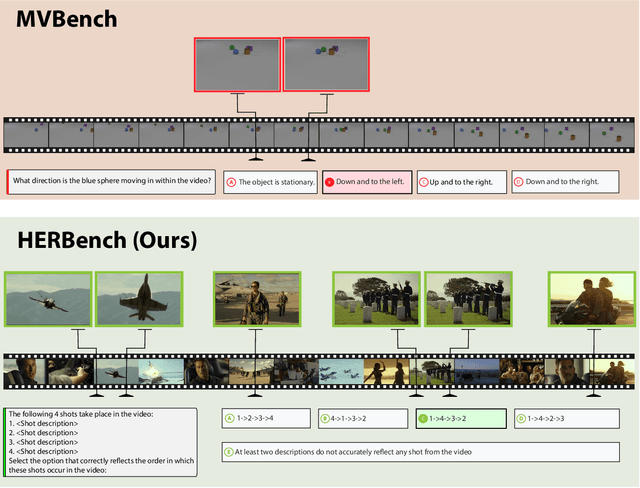
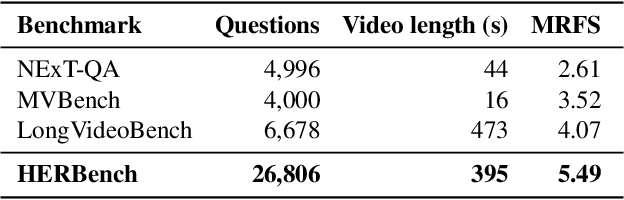
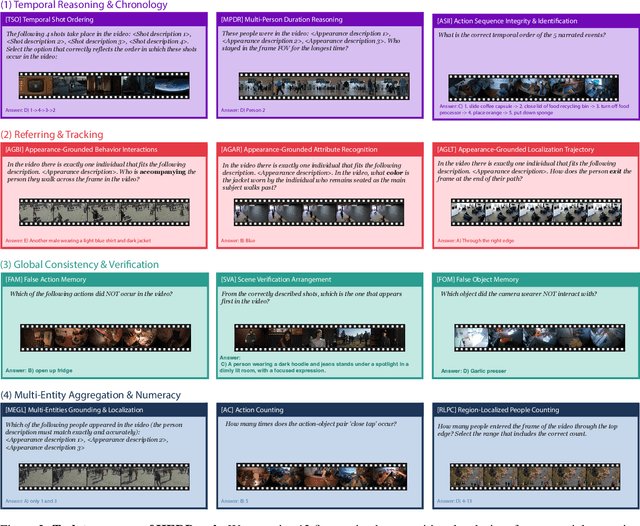
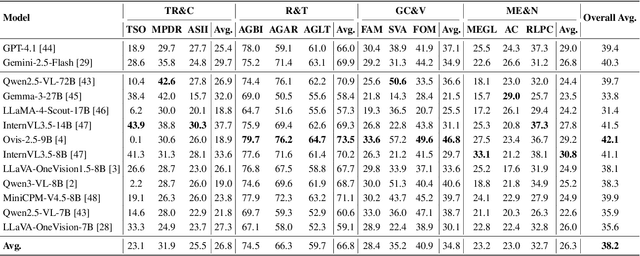
Video Large Language Models (Video-LLMs) are rapidly improving, yet current Video Question Answering (VideoQA) benchmarks often allow questions to be answered from a single salient cue, under-testing reasoning that must aggregate multiple, temporally separated visual evidence. We present HERBench, a VideoQA benchmark purpose-built to assess multi-evidence integration across time. Each question requires aggregating at least three non-overlapping evidential cues across distinct video segments, so neither language priors nor a single snapshot can suffice. HERBench comprises 26K five-way multiple-choice questions organized into twelve compositional tasks that probe identity binding, cross-entity relations, temporal ordering, co-occurrence verification, and counting. To make evidential demand measurable, we introduce the Minimum Required Frame-Set (MRFS), the smallest number of frames a model must fuse to answer correctly, and show that HERBench imposes substantially higher demand than prior datasets (mean MRFS 5.5 vs. 2.6-4.2). Evaluating 13 state-of-the-art Video-LLMs on HERBench reveals pervasive failures: accuracies of 31-42% are only slightly above the 20% random-guess baseline. We disentangle this failure into two critical bottlenecks: (1) a retrieval deficit, where frame selectors overlook key evidence, and (2) a fusion deficit, where models fail to integrate information even when all necessary evidence is provided. By making cross-time evidence both unavoidable and quantifiable, HERBench establishes a principled target for advancing robust, compositional video understanding.
Active propulsion noise shaping for multi-rotor aircraft localization
Feb 29, 2024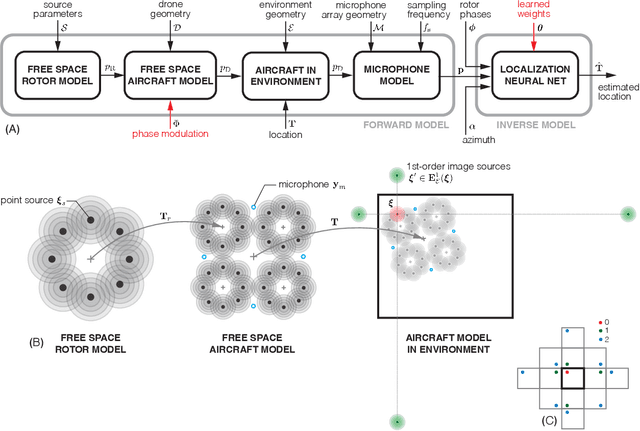
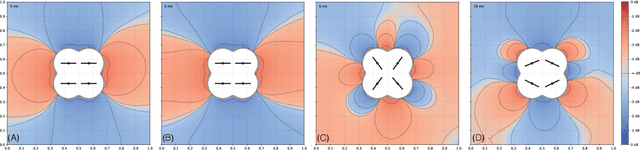
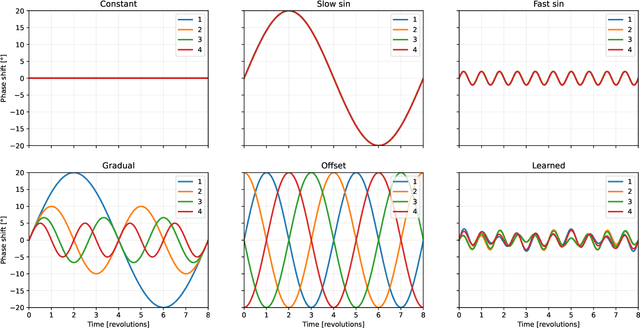
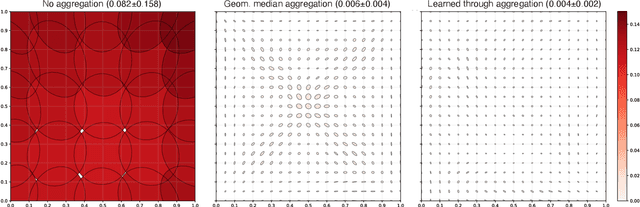
Multi-rotor aerial autonomous vehicles (MAVs) primarily rely on vision for navigation purposes. However, visual localization and odometry techniques suffer from poor performance in low or direct sunlight, a limited field of view, and vulnerability to occlusions. Acoustic sensing can serve as a complementary or even alternative modality for vision in many situations, and it also has the added benefits of lower system cost and energy footprint, which is especially important for micro aircraft. This paper proposes actively controlling and shaping the aircraft propulsion noise generated by the rotors to benefit localization tasks, rather than considering it a harmful nuisance. We present a neural network architecture for selfnoise-based localization in a known environment. We show that training it simultaneously with learning time-varying rotor phase modulation achieves accurate and robust localization. The proposed methods are evaluated using a computationally affordable simulation of MAV rotor noise in 2D acoustic environments that is fitted to real recordings of rotor pressure fields.