 Add to Chrome
 Add to Firefox
 Add to Edge
PACMS: Submodular Context Selection as a Pluggable Engine for LLM Agents
Jun 18, 2026
Conversational and tool-using LLM agents operate over a context window that fills from several directions simultaneously. As a session proceeds, the agent accumulates user and assistant turns, entries drawn from a persistent memory store, and often largest of all, the verbatim outputs of tool calls such as file reads, search results, and API responses. Once the cumulative context exceeds the model's token budget, the framework must decide what to keep. The prevailing mechanism is recency truncation, sometimes paired with periodic summarization. This is topic-blind: a fact established early in a session is discarded simply because it is old, even when the current user query is about exactly that fact; conversely, verbose but irrelevant recent material is retained. Agents that must recall information across many turns, the defining case for memory, are precisely where recency truncation fails. Existing alternatives sit outside the agent's assembly step. Retrieval augmented generation fetches external documents into the prompt but does not arbitrate the agent's \emph{already-present} pooled context. Context-compression methods reduce token count by rewriting or pruning text, but operate query-blind and lossily. Neither treats memory entries, conversation turns, and tool outputs as a single candidate pool to be selected from by relevance at the moment the prompt is assembled.

IndicVisionBench: Benchmarking Cultural and Multilingual Understanding in VLMs
Nov 06, 2025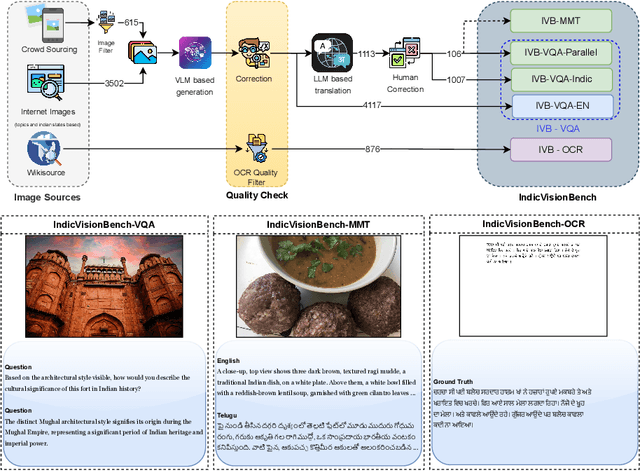
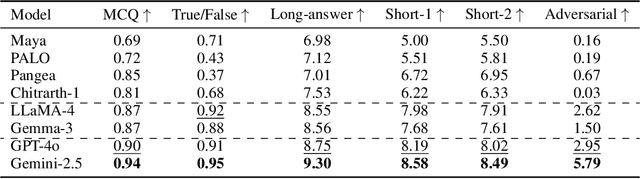
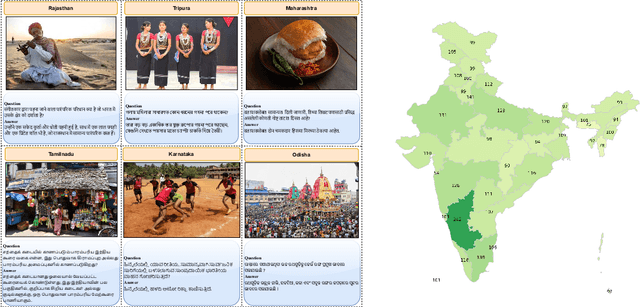

Vision-language models (VLMs) have demonstrated impressive generalization across multimodal tasks, yet most evaluation benchmarks remain Western-centric, leaving open questions about their performance in culturally diverse and multilingual settings. To address this gap, we introduce IndicVisionBench, the first large-scale benchmark centered on the Indian subcontinent. Covering English and 10 Indian languages, our benchmark spans 3 multimodal tasks, including Optical Character Recognition (OCR), Multimodal Machine Translation (MMT), and Visual Question Answering (VQA), covering 6 kinds of question types. Our final benchmark consists of a total of ~5K images and 37K+ QA pairs across 13 culturally grounded topics. In addition, we release a paired parallel corpus of annotations across 10 Indic languages, creating a unique resource for analyzing cultural and linguistic biases in VLMs. We evaluate a broad spectrum of 8 models, from proprietary closed-source systems to open-weights medium and large-scale models. Our experiments reveal substantial performance gaps, underscoring the limitations of current VLMs in culturally diverse contexts. By centering cultural diversity and multilinguality, IndicVisionBench establishes a reproducible evaluation framework that paves the way for more inclusive multimodal research.
Seeing Straight: Document Orientation Detection for Efficient OCR
Nov 06, 2025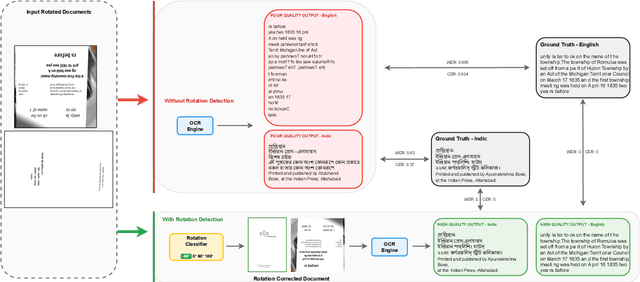

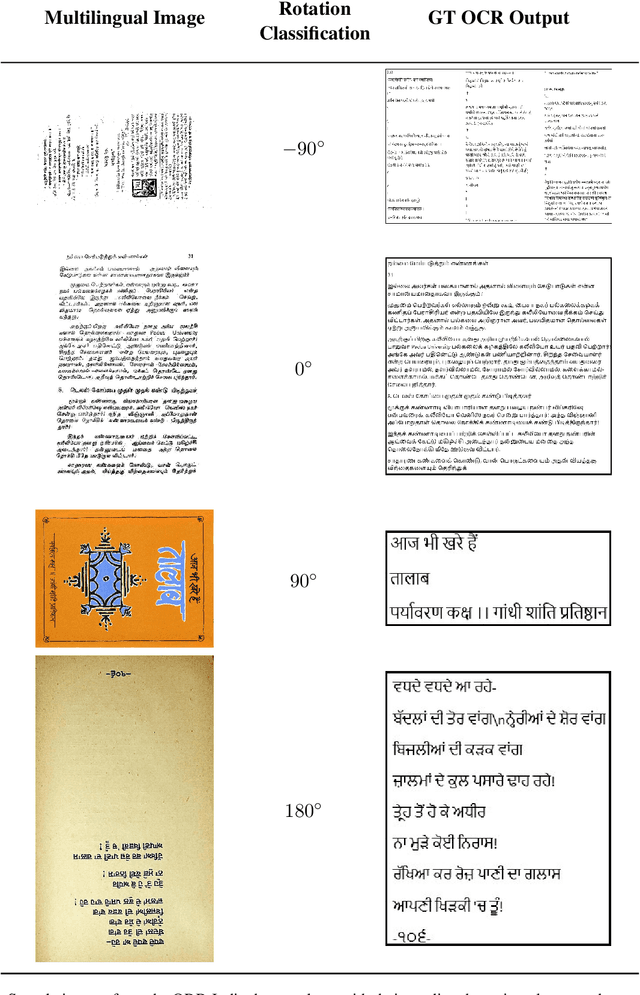
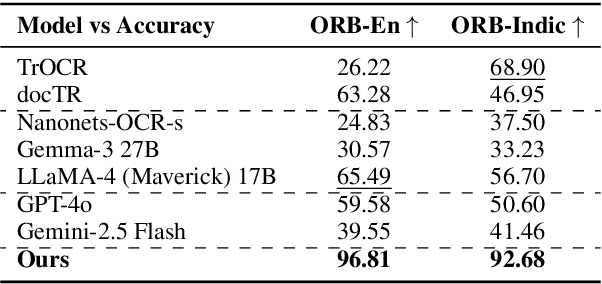
Despite significant advances in document understanding, determining the correct orientation of scanned or photographed documents remains a critical pre-processing step in the real world settings. Accurate rotation correction is essential for enhancing the performance of downstream tasks such as Optical Character Recognition (OCR) where misalignment commonly arises due to user errors, particularly incorrect base orientations of the camera during capture. In this study, we first introduce OCR-Rotation-Bench (ORB), a new benchmark for evaluating OCR robustness to image rotations, comprising (i) ORB-En, built from rotation-transformed structured and free-form English OCR datasets, and (ii) ORB-Indic, a novel multilingual set spanning 11 Indic mid to low-resource languages. We also present a fast, robust and lightweight rotation classification pipeline built on the vision encoder of Phi-3.5-Vision model with dynamic image cropping, fine-tuned specifically for 4-class rotation task in a standalone fashion. Our method achieves near-perfect 96% and 92% accuracy on identifying the rotations respectively on both the datasets. Beyond classification, we demonstrate the critical role of our module in boosting OCR performance: closed-source (up to 14%) and open-weights models (up to 4x) in the simulated real-world setting.
A Novel Deep Learning Method for Thermal to Annotated Thermal-Optical Fused Images
Jul 13, 2021


Thermal Images profile the passive radiation of objects and capture them in grayscale images. Such images have a very different distribution of data compared to optical colored images. We present here a work that produces a grayscale thermo-optical fused mask given a thermal input. This is a deep learning based pioneering work since to the best of our knowledge, there exists no other work on thermal-optical grayscale fusion. Our method is also unique in the sense that the deep learning method we are proposing here works on the Discrete Wavelet Transform (DWT) domain instead of the gray level domain. As a part of this work, we also present a new and unique database for obtaining the region of interest in thermal images based on an existing thermal visual paired database, containing the Region of Interest on 5 different classes of data. Finally, we are proposing a simple low cost overhead statistical measure for identifying the region of interest in the fused images, which we call as the Region of Fusion (RoF). Experiments on the database show encouraging results in identifying the region of interest in the fused images. We also show that they can be processed better in the mixed form rather than with only thermal images.
A Novel Registration & Colorization Technique for Thermal to Cross Domain Colorized Images
Jan 18, 2021


Thermal images can be obtained as either grayscale images or pseudo colored images based on the thermal profile of the object being captured. We present a novel registration method that works on images captured via multiple thermal imagers irrespective of make and internal resolution as well as a colorization scheme that can be used to obtain a colorized thermal image which is similar to an optical image, while retaining the information of the thermal profile as a part of the output, thus providing information of both domains jointly. We call this a cross domain colorized image. We also outline a new public thermal-optical paired database that we are presenting as a part of this paper, containing unique data points obtained via multiple thermal imagers. Finally, we compare the results with prior literature, show how our results are different and discuss on some future work that can be explored further in this domain as well.