 Add to Chrome
 Add to Firefox
 Add to Edge
HiMu: Hierarchical Multimodal Frame Selection for Long Video Question Answering
Mar 19, 2026
Long-form video question answering requires reasoning over extended temporal contexts, making frame selection critical for large vision-language models (LVLMs) bound by finite context windows. Existing methods face a sharp trade-off: similarity-based selectors are fast but collapse compositional queries into a single dense vector, losing sub-event ordering and cross-modal bindings; agent-based methods recover this structure through iterative LVLM inference, but at prohibitive cost. We introduce HiMu, a training-free framework that bridges this gap. A single text-only LLM call decomposes the query into a hierarchical logic tree whose leaves are atomic predicates, each routed to a lightweight expert spanning vision (CLIP, open-vocabulary detection, OCR) and audio (ASR, CLAP). The resulting signals are normalized, temporally smoothed to align different modalities, and composed bottom-up through fuzzy-logic operators that enforce temporal sequencing and adjacency, producing a continuous satisfaction curve. Evaluations on Video-MME, LongVideoBench and HERBench-Lite show that HiMu advances the efficiency-accuracy Pareto front: at 16 frames with Qwen3-VL 8B it outperforms all competing selectors, and with GPT-4o it surpasses agentic systems operating at 32-512 frames while requiring roughly 10x fewer FLOPs.

HERBench: A Benchmark for Multi-Evidence Integration in Video Question Answering
Dec 16, 2025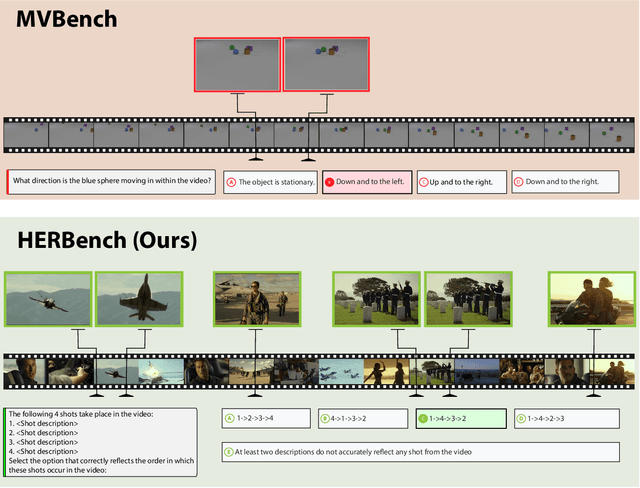
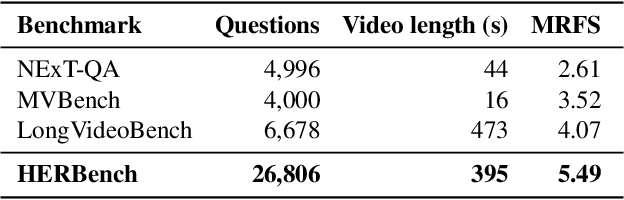
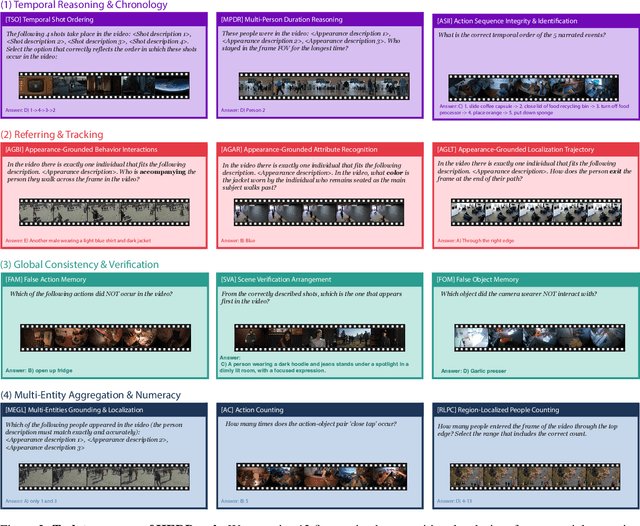
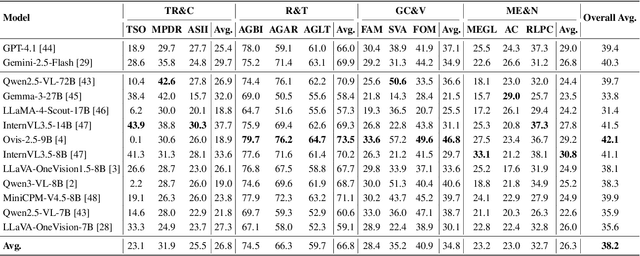
Video Large Language Models (Video-LLMs) are rapidly improving, yet current Video Question Answering (VideoQA) benchmarks often allow questions to be answered from a single salient cue, under-testing reasoning that must aggregate multiple, temporally separated visual evidence. We present HERBench, a VideoQA benchmark purpose-built to assess multi-evidence integration across time. Each question requires aggregating at least three non-overlapping evidential cues across distinct video segments, so neither language priors nor a single snapshot can suffice. HERBench comprises 26K five-way multiple-choice questions organized into twelve compositional tasks that probe identity binding, cross-entity relations, temporal ordering, co-occurrence verification, and counting. To make evidential demand measurable, we introduce the Minimum Required Frame-Set (MRFS), the smallest number of frames a model must fuse to answer correctly, and show that HERBench imposes substantially higher demand than prior datasets (mean MRFS 5.5 vs. 2.6-4.2). Evaluating 13 state-of-the-art Video-LLMs on HERBench reveals pervasive failures: accuracies of 31-42% are only slightly above the 20% random-guess baseline. We disentangle this failure into two critical bottlenecks: (1) a retrieval deficit, where frame selectors overlook key evidence, and (2) a fusion deficit, where models fail to integrate information even when all necessary evidence is provided. By making cross-time evidence both unavoidable and quantifiable, HERBench establishes a principled target for advancing robust, compositional video understanding.