 Add to Chrome
 Add to Firefox
 Add to Edge
Fast Simulated Annealing
Papers and Code
VEDA: 3D Molecular Generation via Variance-Exploding Diffusion with Annealing
Nov 11, 2025
Diffusion models show promise for 3D molecular generation, but face a fundamental trade-off between sampling efficiency and conformational accuracy. While flow-based models are fast, they often produce geometrically inaccurate structures, as they have difficulty capturing the multimodal distributions of molecular conformations. In contrast, denoising diffusion models are more accurate but suffer from slow sampling, a limitation attributed to sub-optimal integration between diffusion dynamics and SE(3)-equivariant architectures. To address this, we propose VEDA, a unified SE(3)-equivariant framework that combines variance-exploding diffusion with annealing to efficiently generate conformationally accurate 3D molecular structures. Specifically, our key technical contributions include: (1) a VE schedule that enables noise injection functionally analogous to simulated annealing, improving 3D accuracy and reducing relaxation energy; (2) a novel preconditioning scheme that reconciles the coordinate-predicting nature of SE(3)-equivariant networks with a residual-based diffusion objective, and (3) a new arcsin-based scheduler that concentrates sampling in critical intervals of the logarithmic signal-to-noise ratio. On the QM9 and GEOM-DRUGS datasets, VEDA matches the sampling efficiency of flow-based models, achieving state-of-the-art valency stability and validity with only 100 sampling steps. More importantly, VEDA's generated structures are remarkably stable, as measured by their relaxation energy during GFN2-xTB optimization. The median energy change is only 1.72 kcal/mol, significantly lower than the 32.3 kcal/mol from its architectural baseline, SemlaFlow. Our framework demonstrates that principled integration of VE diffusion with SE(3)-equivariant architectures can achieve both high chemical accuracy and computational efficiency.

Probabilistic Approximate Optimization: A New Variational Monte Carlo Algorithm
Jul 10, 2025We introduce a generalized \textit{Probabilistic Approximate Optimization Algorithm (PAOA)}, a classical variational Monte Carlo framework that extends and formalizes prior work by Weitz \textit{et al.}~\cite{Combes_2023}, enabling parameterized and fast sampling on present-day Ising machines and probabilistic computers. PAOA operates by iteratively modifying the couplings of a network of binary stochastic units, guided by cost evaluations from independent samples. We establish a direct correspondence between derivative-free updates and the gradient of the full $2^N \times 2^N$ Markov flow, showing that PAOA admits a principled variational formulation. Simulated annealing emerges as a limiting case under constrained parameterizations, and we implement this regime on an FPGA-based probabilistic computer with on-chip annealing to solve large 3D spin-glass problems. Benchmarking PAOA against QAOA on the canonical 26-spin Sherrington-Kirkpatrick model with matched parameters reveals superior performance for PAOA. We show that PAOA naturally extends simulated annealing by optimizing multiple temperature profiles, leading to improved performance over SA on heavy-tailed problems such as SK-L\'evy.
High-fidelity Grain Growth Modeling: Leveraging Deep Learning for Fast Computations
May 08, 2025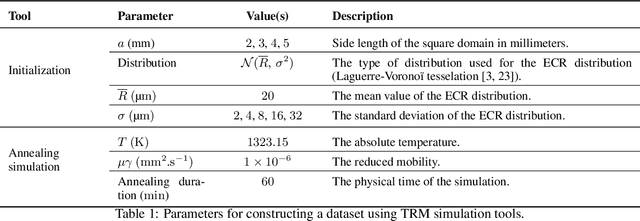
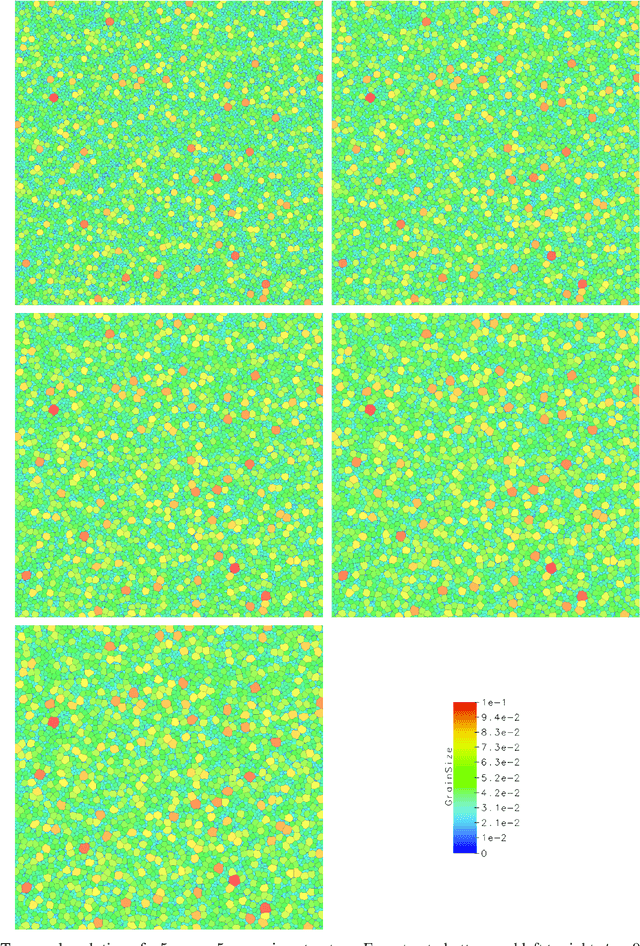
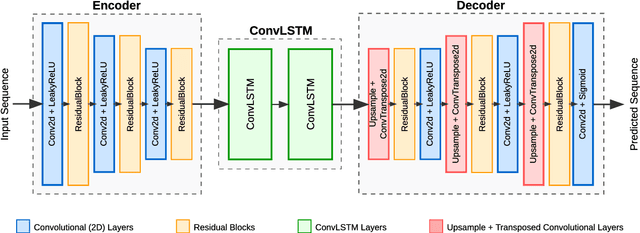
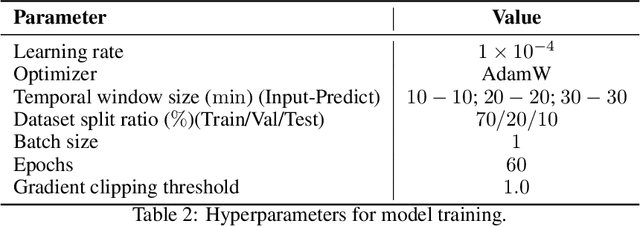
Grain growth simulation is crucial for predicting metallic material microstructure evolution during annealing and resulting final mechanical properties, but traditional partial differential equation-based methods are computationally expensive, creating bottlenecks in materials design and manufacturing. In this work, we introduce a machine learning framework that combines a Convolutional Long Short-Term Memory networks with an Autoencoder to efficiently predict grain growth evolution. Our approach captures both spatial and temporal aspects of grain evolution while encoding high-dimensional grain structure data into a compact latent space for pattern learning, enhanced by a novel composite loss function combining Mean Squared Error, Structural Similarity Index Measurement, and Boundary Preservation to maintain structural integrity of grain boundary topology of the prediction. Results demonstrated that our machine learning approach accelerates grain growth prediction by up to \SI{89}{\times} faster, reducing computation time from \SI{10}{\minute} to approximately \SI{10}{\second} while maintaining high-fidelity predictions. The best model (S-30-30) achieving a structural similarity score of \SI{86.71}{\percent} and mean grain size error of just \SI{0.07}{\percent}. All models accurately captured grain boundary topology, morphology, and size distributions. This approach enables rapid microstructural prediction for applications where conventional simulations are prohibitively time-consuming, potentially accelerating innovation in materials science and manufacturing.
A Multi-UAV Formation Obstacle Avoidance Method Combined Improved Simulated Annealing and Adaptive Artificial Potential Field
Apr 15, 2025The traditional Artificial Potential Field (APF) method exhibits limitations in its force distribution: excessive attraction when UAVs are far from the target may cause collisions with obstacles, while insufficient attraction near the goal often results in failure to reach the target. Furthermore, APF is highly susceptible to local minima, compromising motion reliability in complex environments. To address these challenges, this paper presents a novel hybrid obstacle avoidance algorithm-Deflected Simulated Annealing-Adaptive Artificial Potential Field (DSA-AAPF)-which combines an improved simulated annealing mechanism with an enhanced APF model. The proposed approach integrates a Leader-Follower distributed formation strategy with the APF framework, where the resultant force formulation is redefined to smooth UAV trajectories. An adaptive gravitational gain function is introduced to dynamically adjust UAV velocity based on environmental context, and a fast-converging controller ensures accurate and efficient convergence to the target. Moreover, a directional deflection mechanism is embedded within the simulated annealing process, enabling UAVs to escape local minima caused by semi-enclosed obstacles through continuous rotational motion. The simulation results, covering formation reconfiguration, complex obstacle avoidance, and entrapment escape, demonstrate the feasibility, robustness, and superiority of the proposed DSA-AAPF algorithm.
Pre-processing matters: A segment search method for WSI classification
Apr 17, 2024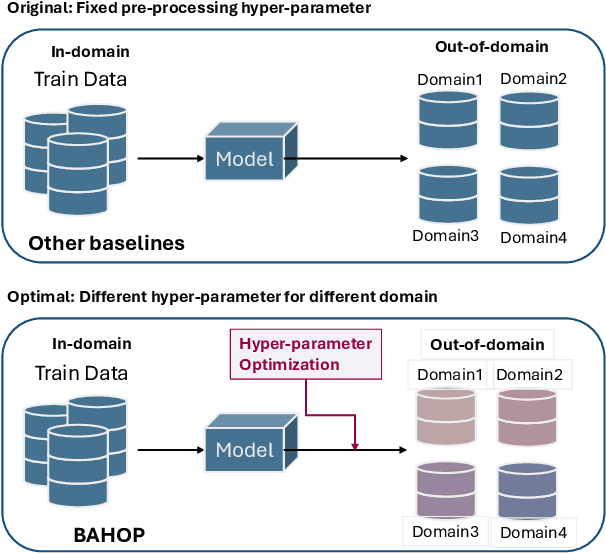
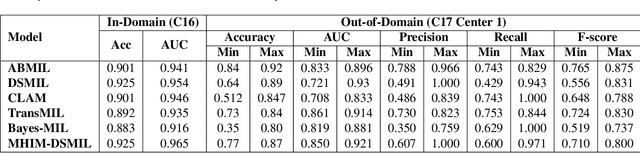
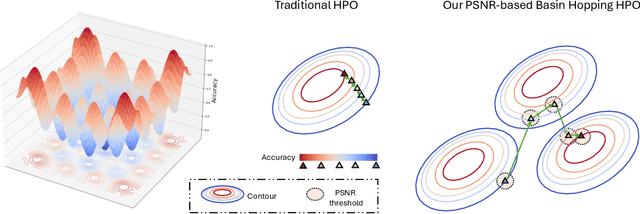
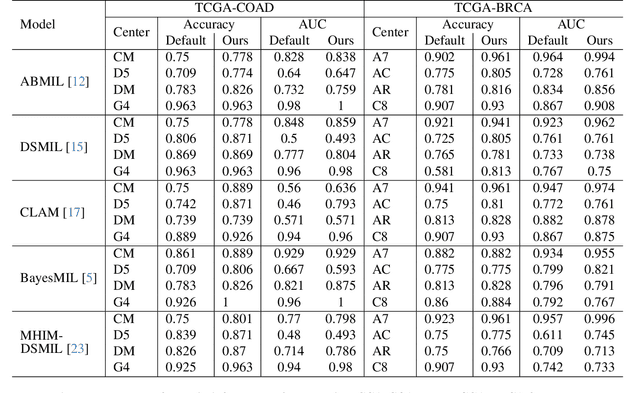
Pre-processing for whole slide images can affect classification performance both in the training and inference stages. Our study analyzes the impact of pre-processing parameters on inference and training across single- and multiple-domain datasets. However, searching for an optimal parameter set is time-consuming. To overcome this, we propose a novel Similarity-based Simulated Annealing approach for fast parameter tuning to enhance inference performance on single-domain data. Our method demonstrates significant performance improvements in accuracy, which raise accuracy from 0.512 to 0.847 in a single domain. We further extend our insight into training performance in multi-domain data by employing a novel Bayesian optimization to search optimal pre-processing parameters, resulting in a high AUC of 0.967. We highlight that better pre-processing for WSI can contribute to further accuracy improvement in the histology area.
CaloQVAE : Simulating high-energy particle-calorimeter interactions using hybrid quantum-classical generative models
Dec 15, 2023The Large Hadron Collider's high luminosity era presents major computational challenges in the analysis of collision events. Large amounts of Monte Carlo (MC) simulation will be required to constrain the statistical uncertainties of the simulated datasets below these of the experimental data. Modelling of high-energy particles propagating through the calorimeter section of the detector is the most computationally intensive MC simulation task. We introduce a technique combining recent advancements in generative models and quantum annealing for fast and efficient simulation of high-energy particle-calorimeter interactions.
RLPlanner: Reinforcement Learning based Floorplanning for Chiplets with Fast Thermal Analysis
Jan 16, 2024Chiplet-based systems have gained significant attention in recent years due to their low cost and competitive performance. As the complexity and compactness of a chiplet-based system increase, careful consideration must be given to microbump assignments, interconnect delays, and thermal limitations during the floorplanning stage. This paper introduces RLPlanner, an efficient early-stage floorplanning tool for chiplet-based systems with a novel fast thermal evaluation method. RLPlanner employs advanced reinforcement learning to jointly minimize total wirelength and temperature. To alleviate the time-consuming thermal calculations, RLPlanner incorporates the developed fast thermal evaluation method to expedite the iterations and optimizations. Comprehensive experiments demonstrate that our proposed fast thermal evaluation method achieves a mean absolute error (MAE) of 0.25 K and delivers over 120x speed-up compared to the open-source thermal solver HotSpot. When integrated with our fast thermal evaluation method, RLPlanner achieves an average improvement of 20.28\% in minimizing the target objective (a combination of wirelength and temperature), within a similar running time, compared to the classic simulated annealing method with HotSpot.
A fast and flexible algorithm for microstructure reconstruction combining simulated annealing and deep learning
Apr 25, 2023


The microstructure analyses of porous media have considerable research value for the study of macroscopic properties. As the premise of conducting these analyses, the accurate reconstruction of microstructure digital model is also an important component of the research. Computational reconstruction algorithms of microstructure have attracted much attention due to their low cost and excellent performance. However, it is still a challenge for computational reconstruction algorithms to achieve faster and more efficient reconstruction. The bottleneck lies in computational reconstruction algorithms, they are either too slow (traditional reconstruction algorithms) or not flexible to the training process (deep learning reconstruction algorithms). To address these limitations, we proposed a fast and flexible computational reconstruction algorithm, neural networks based on improved simulated annealing framework (ISAF-NN). The proposed algorithm is flexible and can complete training and reconstruction in a short time with only one two-dimensional image. By adjusting the size of input, it can also achieve reconstruction of arbitrary size. Finally, the proposed algorithm is experimentally performed on a variety of isotropic and anisotropic materials to verify the effectiveness and generalization.
Clustering Method for Time-Series Images Using Quantum-Inspired Computing Technology
May 26, 2023Time-series clustering serves as a powerful data mining technique for time-series data in the absence of prior knowledge about clusters. A large amount of time-series data with large size has been acquired and used in various research fields. Hence, clustering method with low computational cost is required. Given that a quantum-inspired computing technology, such as a simulated annealing machine, surpasses conventional computers in terms of fast and accurately solving combinatorial optimization problems, it holds promise for accomplishing clustering tasks that are challenging to achieve using existing methods. This study proposes a novel time-series clustering method that leverages an annealing machine. The proposed method facilitates an even classification of time-series data into clusters close to each other while maintaining robustness against outliers. Moreover, its applicability extends to time-series images. We compared the proposed method with a standard existing method for clustering an online distributed dataset. In the existing method, the distances between each data are calculated based on the Euclidean distance metric, and the clustering is performed using the k-means++ method. We found that both methods yielded comparable results. Furthermore, the proposed method was applied to a flow measurement image dataset containing noticeable noise with a signal-to-noise ratio of approximately 1. Despite a small signal variation of approximately 2%, the proposed method effectively classified the data without any overlap among the clusters. In contrast, the clustering results by the standard existing method and the conditional image sampling (CIS) method, a specialized technique for flow measurement data, displayed overlapping clusters. Consequently, the proposed method provides better results than the other two methods, demonstrating its potential as a superior clustering method.
SALSA: Simulated Annealing based Loop-Ordering Scheduler for DNN Accelerators
Apr 20, 2023
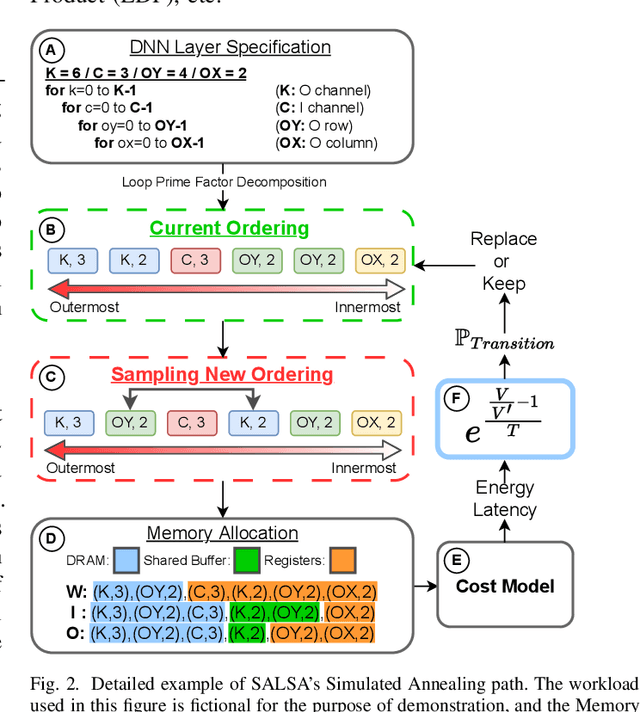
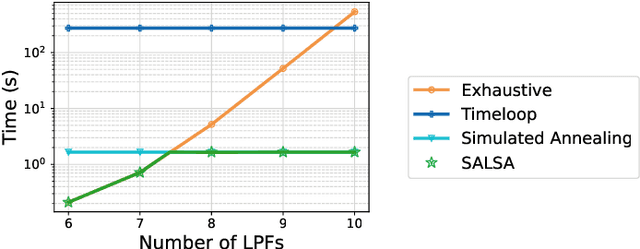
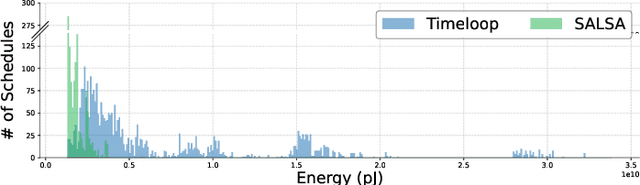
To meet the growing need for computational power for DNNs, multiple specialized hardware architectures have been proposed. Each DNN layer should be mapped onto the hardware with the most efficient schedule, however, SotA schedulers struggle to consistently provide optimum schedules in a reasonable time across all DNN-HW combinations. This paper proposes SALSA, a fast dual-engine scheduler to generate optimal execution schedules for both even and uneven mapping. We introduce a new strategy, combining exhaustive search with simulated annealing to address the dynamic nature of the loop ordering design space size across layers. SALSA is extensively benchmarked against two SotA schedulers, LOMA and Timeloop on 5 different DNNs, on average SALSA finds schedules with 11.9% and 7.6% lower energy while speeding up the search by 1.7x and 24x compared to LOMA and Timeloop, respectively.