 Add to Chrome
 Add to Firefox
 Add to Edge
Consep
Papers and Code
CellMamba: Adaptive Mamba for Accurate and Efficient Cell Detection
Dec 25, 2025
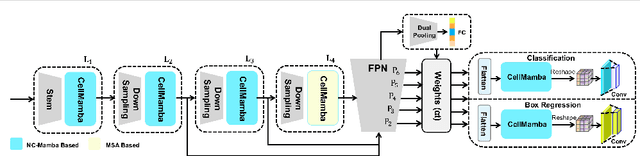
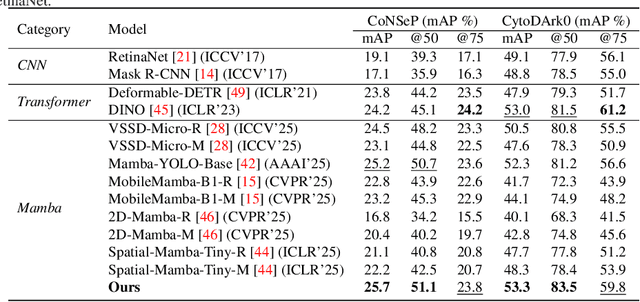
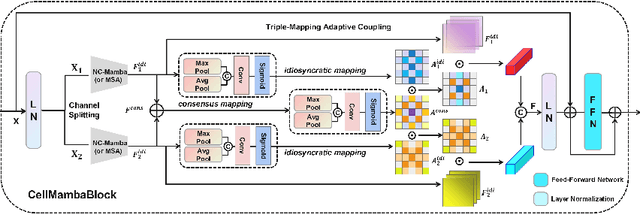

Cell detection in pathological images presents unique challenges due to densely packed objects, subtle inter-class differences, and severe background clutter. In this paper, we propose CellMamba, a lightweight and accurate one-stage detector tailored for fine-grained biomedical instance detection. Built upon a VSSD backbone, CellMamba integrates CellMamba Blocks, which couple either NC-Mamba or Multi-Head Self-Attention (MSA) with a novel Triple-Mapping Adaptive Coupling (TMAC) module. TMAC enhances spatial discriminability by splitting channels into two parallel branches, equipped with dual idiosyncratic and one consensus attention map, adaptively fused to preserve local sensitivity and global consistency. Furthermore, we design an Adaptive Mamba Head that fuses multi-scale features via learnable weights for robust detection under varying object sizes. Extensive experiments on two public datasets-CoNSeP and CytoDArk0-demonstrate that CellMamba outperforms both CNN-based, Transformer-based, and Mamba-based baselines in accuracy, while significantly reducing model size and inference latency. Our results validate CellMamba as an efficient and effective solution for high-resolution cell detection.

APSeg: Auto-Prompt Model with Acquired and Injected Knowledge for Nuclear Instance Segmentation and Classification
Apr 03, 2025
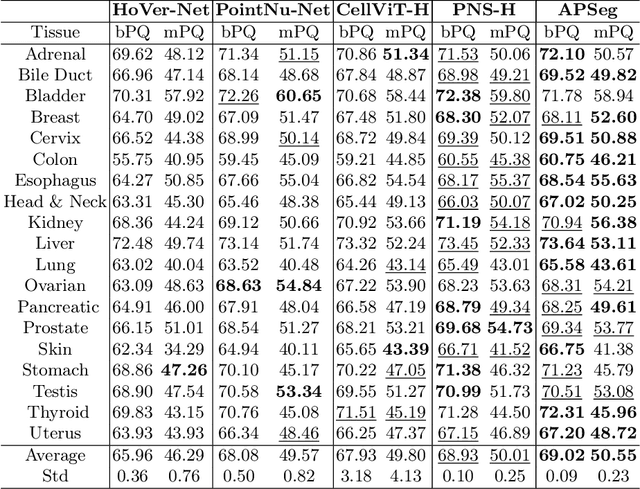
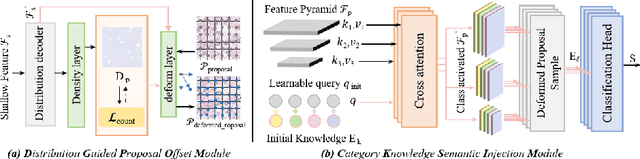
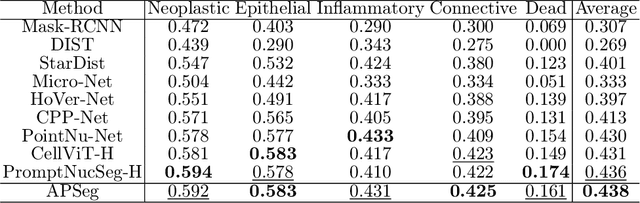
Nuclear instance segmentation and classification provide critical quantitative foundations for digital pathology diagnosis. With the advent of the foundational Segment Anything Model (SAM), the accuracy and efficiency of nuclear segmentation have improved significantly. However, SAM imposes a strong reliance on precise prompts, and its class-agnostic design renders its classification results entirely dependent on the provided prompts. Therefore, we focus on generating prompts with more accurate localization and classification and propose \textbf{APSeg}, \textbf{A}uto-\textbf{P}rompt model with acquired and injected knowledge for nuclear instance \textbf{Seg}mentation and classification. APSeg incorporates two knowledge-aware modules: (1) Distribution-Guided Proposal Offset Module (\textbf{DG-POM}), which learns distribution knowledge through density map guided, and (2) Category Knowledge Semantic Injection Module (\textbf{CK-SIM}), which injects morphological knowledge derived from category descriptions. We conducted extensive experiments on the PanNuke and CoNSeP datasets, demonstrating the effectiveness of our approach. The code will be released upon acceptance.
Instance Migration Diffusion for Nuclear Instance Segmentation in Pathology
Apr 02, 2025Nuclear instance segmentation plays a vital role in disease diagnosis within digital pathology. However, limited labeled data in pathological images restricts the overall performance of nuclear instance segmentation. To tackle this challenge, we propose a novel data augmentation framework Instance Migration Diffusion Model (IM-Diffusion), IM-Diffusion designed to generate more varied pathological images by constructing diverse nuclear layouts and internuclear spatial relationships. In detail, we introduce a Nuclear Migration Module (NMM) which constructs diverse nuclear layouts by simulating the process of nuclear migration. Building on this, we further present an Internuclear-regions Inpainting Module (IIM) to generate diverse internuclear spatial relationships by structure-aware inpainting. On the basis of the above, IM-Diffusion generates more diverse pathological images with different layouts and internuclear spatial relationships, thereby facilitating downstream tasks. Evaluation on the CoNSeP and GLySAC datasets demonstrate that the images generated by IM-Diffusion effectively enhance overall instance segmentation performance. Code will be made public later.
Cell Nuclei Detection and Classification in Whole Slide Images with Transformers
Feb 10, 2025Accurate and efficient cell nuclei detection and classification in histopathological Whole Slide Images (WSIs) are pivotal for digital pathology applications. Traditional cell segmentation approaches, while commonly used, are computationally expensive and require extensive post-processing, limiting their practicality for high-throughput clinical settings. In this paper, we propose a paradigm shift from segmentation to detection for extracting cell information from WSIs, introducing CellNuc-DETR as a more effective solution. We evaluate the accuracy performance of CellNuc-DETR on the PanNuke dataset and conduct cross-dataset evaluations on CoNSeP and MoNuSeg to assess robustness and generalization capabilities. Our results demonstrate state-of-the-art performance in both cell nuclei detection and classification tasks. Additionally, we assess the efficiency of CellNuc-DETR on large WSIs, showing that it not only outperforms current methods in accuracy but also significantly reduces inference times. Specifically, CellNuc-DETR is twice as fast as the fastest segmentation-based method, HoVer-NeXt, while achieving substantially higher accuracy. Moreover, it surpasses CellViT in accuracy and is approximately ten times more efficient in inference speed on WSIs. These results establish CellNuc-DETR as a superior approach for cell analysis in digital pathology, combining high accuracy with computational efficiency.
NuLite -- Lightweight and Fast Model for Nuclei Instance Segmentation and Classification
Aug 03, 2024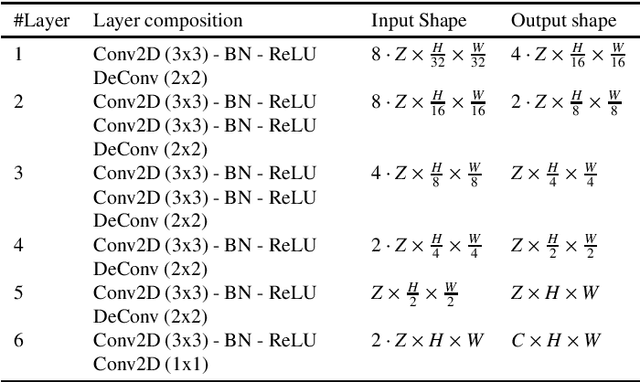
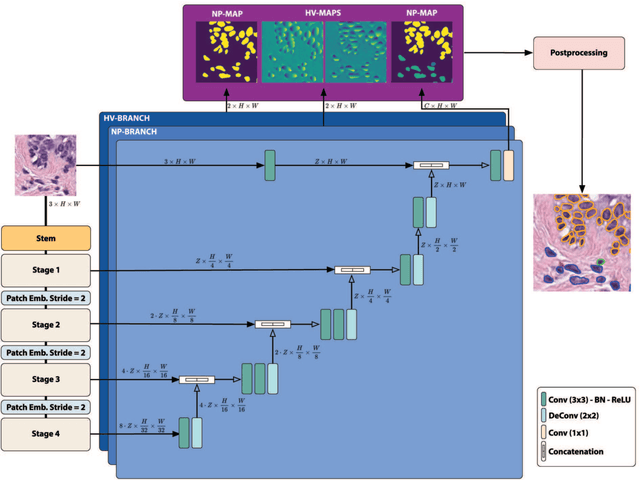
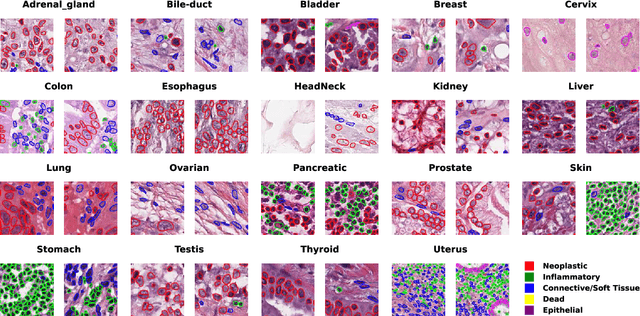
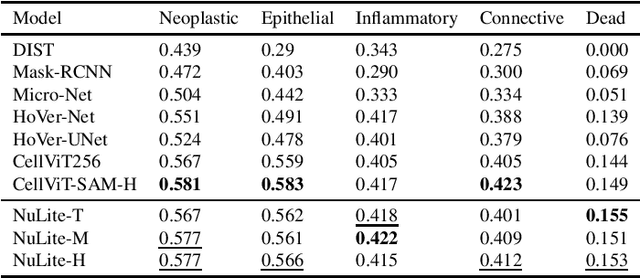
In pathology, accurate and efficient analysis of Hematoxylin and Eosin (H\&E) slides is crucial for timely and effective cancer diagnosis. Although many deep learning solutions for nuclei instance segmentation and classification exist in the literature, they often entail high computational costs and resource requirements, thus limiting their practical usage in medical applications. To address this issue, we introduce a novel convolutional neural network, NuLite, a U-Net-like architecture designed explicitly on Fast-ViT, a state-of-the-art (SOTA) lightweight CNN. We obtained three versions of our model, NuLite-S, NuLite-M, and NuLite-H, trained on the PanNuke dataset. The experimental results prove that our models equal CellViT (SOTA) in terms of panoptic quality and detection. However, our lightest model, NuLite-S, is 40 times smaller in terms of parameters and about 8 times smaller in terms of GFlops, while our heaviest model is 17 times smaller in terms of parameters and about 7 times smaller in terms of GFlops. Moreover, our model is up to about 8 times faster than CellViT. Lastly, to prove the effectiveness of our solution, we provide a robust comparison of external datasets, namely CoNseP, MoNuSeg, and GlySAC. Our model is publicly available at https://github.com/CosmoIknosLab/NuLite
ConSep: a Noise- and Reverberation-Robust Speech Separation Framework by Magnitude Conditioning
Mar 04, 2024Speech separation has recently made significant progress thanks to the fine-grained vision used in time-domain methods. However, several studies have shown that adopting Short-Time Fourier Transform (STFT) for feature extraction could be beneficial when encountering harsher conditions, such as noise or reverberation. Therefore, we propose a magnitude-conditioned time-domain framework, ConSep, to inherit the beneficial characteristics. The experiment shows that ConSep promotes performance in anechoic, noisy, and reverberant settings compared to two celebrated methods, SepFormer and Bi-Sep. Furthermore, we visualize the components of ConSep to strengthen the advantages and cohere with the actualities we have found in preliminary studies.
HoVer-UNet: Accelerating HoVerNet with UNet-based multi-class nuclei segmentation via knowledge distillation
Dec 04, 2023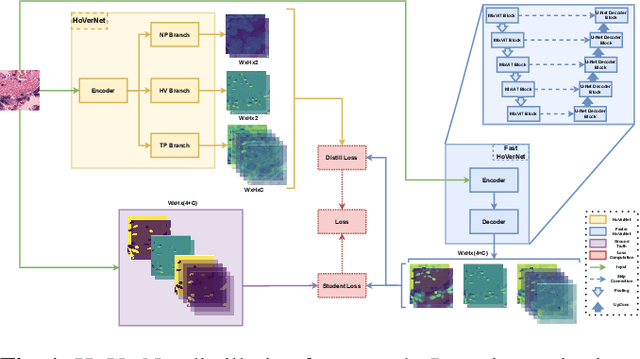
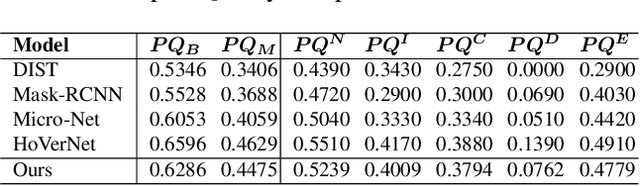
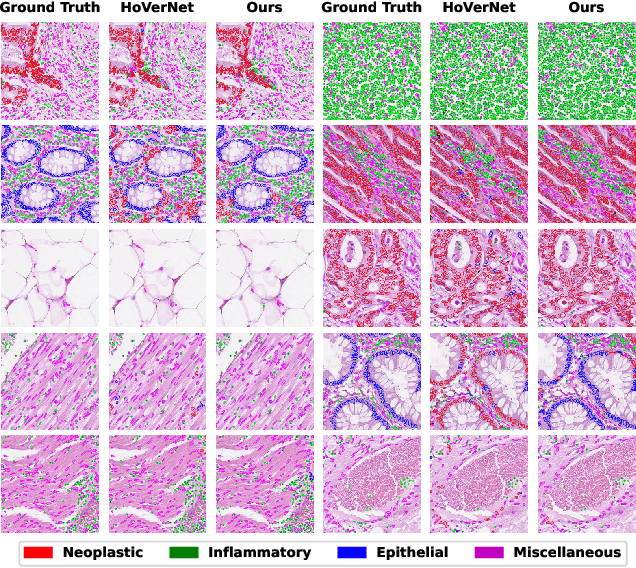
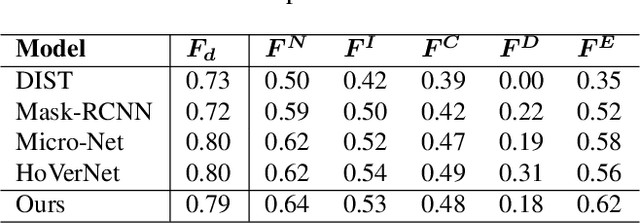
We present HoVer-UNet, an approach to distill the knowledge of the multi-branch HoVerNet framework for nuclei instance segmentation and classification in histopathology. We propose a compact, streamlined single UNet network with a Mix Vision Transformer backbone, and equip it with a custom loss function to optimally encode the distilled knowledge of HoVerNet, reducing computational requirements without compromising performances. We show that our model achieved results comparable to HoVerNet on the public PanNuke and Consep datasets with a three-fold reduction in inference time. We make the code of our model publicly available at https://github.com/DIAGNijmegen/HoVer-UNet.
Guided Prompting in SAM for Weakly Supervised Cell Segmentation in Histopathological Images
Nov 29, 2023Cell segmentation in histopathological images plays a crucial role in understanding, diagnosing, and treating many diseases. However, data annotation for this is expensive since there can be a large number of cells per image, and expert pathologists are needed for labelling images. Instead, our paper focuses on using weak supervision -- annotation from related tasks -- to induce a segmenter. Recent foundation models, such as Segment Anything (SAM), can use prompts to leverage additional supervision during inference. SAM has performed remarkably well in natural image segmentation tasks; however, its applicability to cell segmentation has not been explored. In response, we investigate guiding the prompting procedure in SAM for weakly supervised cell segmentation when only bounding box supervision is available. We develop two workflows: (1) an object detector's output as a test-time prompt to SAM (D-SAM), and (2) SAM as pseudo mask generator over training data to train a standalone segmentation model (SAM-S). On finding that both workflows have some complementary strengths, we develop an integer programming-based approach to reconcile the two sets of segmentation masks, achieving yet higher performance. We experiment on three publicly available cell segmentation datasets namely, ConSep, MoNuSeg, and TNBC, and find that all SAM-based solutions hugely outperform existing weakly supervised image segmentation models, obtaining 9-15 pt Dice gains.
DARC: Distribution-Aware Re-Coloring Model for Generalizable Nucleus Segmentation
Sep 01, 2023Nucleus segmentation is usually the first step in pathological image analysis tasks. Generalizable nucleus segmentation refers to the problem of training a segmentation model that is robust to domain gaps between the source and target domains. The domain gaps are usually believed to be caused by the varied image acquisition conditions, e.g., different scanners, tissues, or staining protocols. In this paper, we argue that domain gaps can also be caused by different foreground (nucleus)-background ratios, as this ratio significantly affects feature statistics that are critical to normalization layers. We propose a Distribution-Aware Re-Coloring (DARC) model that handles the above challenges from two perspectives. First, we introduce a re-coloring method that relieves dramatic image color variations between different domains. Second, we propose a new instance normalization method that is robust to the variation in foreground-background ratios. We evaluate the proposed methods on two H$\&$E stained image datasets, named CoNSeP and CPM17, and two IHC stained image datasets, called DeepLIIF and BC-DeepLIIF. Extensive experimental results justify the effectiveness of our proposed DARC model. Codes are available at \url{https://github.com/csccsccsccsc/DARC
DeGPR: Deep Guided Posterior Regularization for Multi-Class Cell Detection and Counting
Apr 03, 2023Multi-class cell detection and counting is an essential task for many pathological diagnoses. Manual counting is tedious and often leads to inter-observer variations among pathologists. While there exist multiple, general-purpose, deep learning-based object detection and counting methods, they may not readily transfer to detecting and counting cells in medical images, due to the limited data, presence of tiny overlapping objects, multiple cell types, severe class-imbalance, minute differences in size/shape of cells, etc. In response, we propose guided posterior regularization (DeGPR), which assists an object detector by guiding it to exploit discriminative features among cells. The features may be pathologist-provided or inferred directly from visual data. We validate our model on two publicly available datasets (CoNSeP and MoNuSAC), and on MuCeD, a novel dataset that we contribute. MuCeD consists of 55 biopsy images of the human duodenum for predicting celiac disease. We perform extensive experimentation with three object detection baselines on three datasets to show that DeGPR is model-agnostic, and consistently improves baselines obtaining up to 9% (absolute) mAP gains.