 Add to Chrome
 Add to Firefox
 Add to Edge
Coordinating Multiple Conditions for Trajectory-Controlled Human Motion Generation
May 13, 2026
Trajectory-controlled human motion generation aims to synthesize realistic human motions conditioned on both textual descriptions and spatial trajectories. However, existing methods suffer from two critical limitations: first, the conflict between text and trajectory conditions disrupts the denoising process, resulting in compromised motion quality or inaccurate trajectory following; second, the use of redundant motion representations introduces inconsistencies between motion components, leading to instability during trajectory control. To address these challenges, we propose CMC, a decoupled framework that effectively coordinates text and trajectory conditions through a divide-and-conquer strategy. CMC follows a divide-and-conquer paradigm, comprising two cascaded stages: Trajectory Control and Motion Completion. In the first stage, a diffusion model generates a simplified representation of the controlled joints under trajectory guidance, based on the given trajectories, ensuring accurate and stable trajectory following. In the second stage, a text-conditioned diffusion inpainting model generates full-body motions using the simplified representation from the first stage as partial observations. To mitigate overfitting caused by limited inpainting training data, we further introduce the Selective Inpainting Mechanism (SIM), which alternates between text-to-motion generation and motion inpainting tasks during training. Experiments on HumanML3D and KIT datasets demonstrate that CMC achieves state-of-the-art performance in control accuracy and motion quality, demonstrating its effectiveness in coordinating multimodal conditions and representations.

Universally Empowering Zeroth-Order Optimization via Adaptive Layer-wise Sampling
Apr 20, 2026Zeroth-Order optimization presents a promising memory-efficient paradigm for fine-tuning Large Language Models by relying solely on forward passes. However, its practical adoption is severely constrained by slow wall-clock convergence and high estimation variance. In this work, we dissect the runtime characteristics of ZO algorithms and identify a critical system bottleneck where the generation of perturbations and parameter updates accounts for over 40% of the training latency. We argue that the standard uniform exploration strategy is fundamentally flawed as it fails to account for the heterogeneous sensitivity of layers in deep networks, resulting in computationally wasteful blind searches. To address this structural mismatch, we propose AdaLeZO, an Adaptive Layer-wise ZO optimization framework. By formulating the layer selection process as a non-stationary Multi-Armed Bandit problem, AdaLeZO dynamically allocates the limited perturbation budget to the most sensitive parameters. We further introduce an Inverse Probability Weighting mechanism based on sampling with replacement, which guarantees unbiased gradient estimation while effectively acting as a temporal denoiser to reduce variance. Extensive experiments on LLaMA and OPT models ranging from 6.7B to 30B parameters demonstrate that AdaLeZO achieves 1.7x to 3.0x wall-clock acceleration compared to state-of-the-art methods. Crucially, AdaLeZO functions as a universal plug-and-play module that seamlessly enhances the efficiency of existing ZO optimizers without incurring additional memory overhead.
Streamlined Open-Vocabulary Human-Object Interaction Detection
Mar 29, 2026Open-vocabulary human-object interaction (HOI) detection aims to localize and recognize all human-object interactions in an image, including those unseen during training. Existing approaches usually rely on the collaboration between a conventional HOI detector and a Vision-Language Model (VLM) to recognize unseen HOI categories. However, feature fusion in this paradigm is challenging due to significant gaps in cross-model representations. To address this issue, we introduce SL-HOI, a StreamLined open-vocabulary HOI detection framework based solely on the powerful DINOv3 model. Our design leverages the complementary strengths of DINOv3's components: its backbone for fine-grained localization and its text-aligned vision head for open-vocabulary interaction classification. Moreover, to facilitate smooth cross-attention between the interaction queries and the vision head's output, we propose first feeding both the interaction queries and the backbone image tokens into the vision head, effectively bridging their representation gaps. All DINOv3 parameters in our approach are frozen, with only a small number of learnable parameters added, allowing a fast adaptation to the HOI detection task. Extensive experiments show that SL-HOI achieves state-of-the-art performance on both the SWiG-HOI and HICO-DET benchmarks, demonstrating the effectiveness of our streamlined model architecture. Code is available at https://github.com/MPI-Lab/SL-HOI.
ViHOI: Human-Object Interaction Synthesis with Visual Priors
Mar 25, 2026Generating realistic and physically plausible 3D Human-Object Interactions (HOI) remains a key challenge in motion generation. One primary reason is that describing these physical constraints with words alone is difficult. To address this limitation, we propose a new paradigm: extracting rich interaction priors from easily accessible 2D images. Specifically, we introduce ViHOI, a novel framework that enables diffusion-based generative models to leverage rich, task-specific priors from 2D images to enhance generation quality. We utilize a large Vision-Language Model (VLM) as a powerful prior-extraction engine and adopt a layer-decoupled strategy to obtain visual and textual priors. Concurrently, we design a Q-Former-based adapter that compresses the VLM's high-dimensional features into compact prior tokens, which significantly facilitates the conditional training of our diffusion model. Our framework is trained on motion-rendered images from the dataset to ensure strict semantic alignment between visual inputs and motion sequences. During inference, it leverages reference images synthesized by a text-to-image generation model to improve generalization to unseen objects and interaction categories. Experimental results demonstrate that ViHOI achieves state-of-the-art performance, outperforming existing methods across multiple benchmarks and demonstrating superior generalization.
Reconstruction-Anchored Diffusion Model for Text-to-Motion Generation
Jan 21, 2026Diffusion models have seen widespread adoption for text-driven human motion generation and related tasks due to their impressive generative capabilities and flexibility. However, current motion diffusion models face two major limitations: a representational gap caused by pre-trained text encoders that lack motion-specific information, and error propagation during the iterative denoising process. This paper introduces Reconstruction-Anchored Diffusion Model (RAM) to address these challenges. First, RAM leverages a motion latent space as intermediate supervision for text-to-motion generation. To this end, RAM co-trains a motion reconstruction branch with two key objective functions: self-regularization to enhance the discrimination of the motion space and motion-centric latent alignment to enable accurate mapping from text to the motion latent space. Second, we propose Reconstructive Error Guidance (REG), a testing-stage guidance mechanism that exploits the diffusion model's inherent self-correction ability to mitigate error propagation. At each denoising step, REG uses the motion reconstruction branch to reconstruct the previous estimate, reproducing the prior error patterns. By amplifying the residual between the current prediction and the reconstructed estimate, REG highlights the improvements in the current prediction. Extensive experiments demonstrate that RAM achieves significant improvements and state-of-the-art performance. Our code will be released.
ChartMaster: Advancing Chart-to-Code Generation with Real-World Charts and Chart Similarity Reinforcement Learning
Aug 25, 2025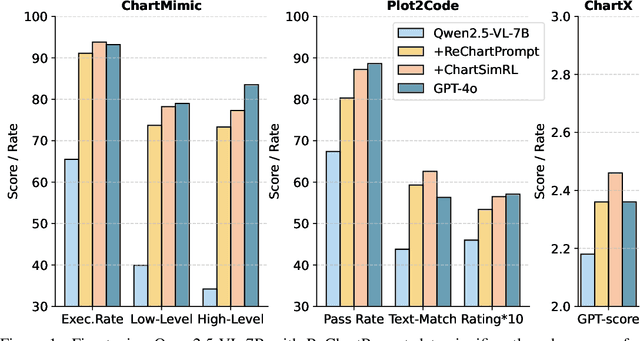
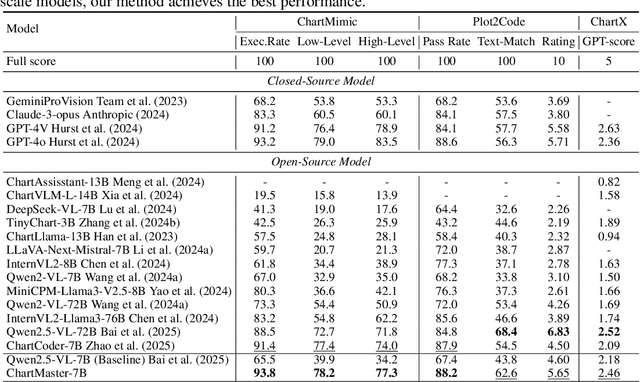
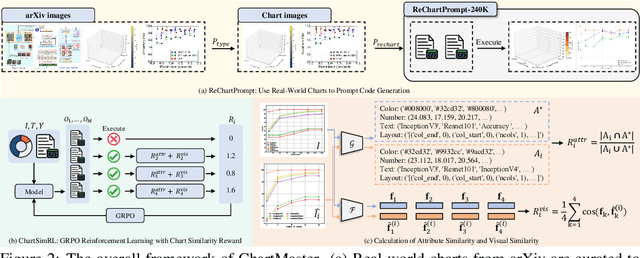
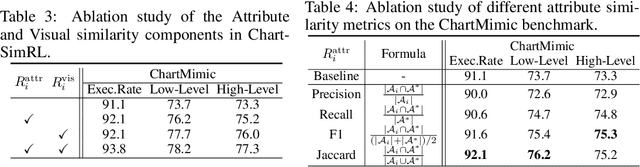
The chart-to-code generation task requires MLLMs to convert chart images into executable code. This task faces two major challenges: limited data diversity and insufficient maintenance of visual consistency between generated and original charts during training. Existing datasets mainly rely on seed data to prompt GPT models for code generation, resulting in homogeneous samples. To address this, we propose ReChartPrompt, which leverages real-world, human-designed charts from arXiv papers as prompts instead of synthetic seeds. Using the diverse styles and rich content of arXiv charts, we construct ReChartPrompt-240K, a large-scale and highly diverse dataset. Another challenge is that although SFT effectively improve code understanding, it often fails to ensure that generated charts are visually consistent with the originals. To address this, we propose ChartSimRL, a GRPO-based reinforcement learning algorithm guided by a novel chart similarity reward. This reward consists of attribute similarity, which measures the overlap of chart attributes such as layout and color between the generated and original charts, and visual similarity, which assesses similarity in texture and other overall visual features using convolutional neural networks. Unlike traditional text-based rewards such as accuracy or format rewards, our reward considers the multimodal nature of the chart-to-code task and effectively enhances the model's ability to accurately reproduce charts. By integrating ReChartPrompt and ChartSimRL, we develop the ChartMaster model, which achieves state-of-the-art results among 7B-parameter models and even rivals GPT-4o on various chart-to-code generation benchmarks. All resources are available at https://github.com/WentaoTan/ChartMaster.
Bilateral Collaboration with Large Vision-Language Models for Open Vocabulary Human-Object Interaction Detection
Jul 09, 2025Open vocabulary Human-Object Interaction (HOI) detection is a challenging task that detects all <human, verb, object> triplets of interest in an image, even those that are not pre-defined in the training set. Existing approaches typically rely on output features generated by large Vision-Language Models (VLMs) to enhance the generalization ability of interaction representations. However, the visual features produced by VLMs are holistic and coarse-grained, which contradicts the nature of detection tasks. To address this issue, we propose a novel Bilateral Collaboration framework for open vocabulary HOI detection (BC-HOI). This framework includes an Attention Bias Guidance (ABG) component, which guides the VLM to produce fine-grained instance-level interaction features according to the attention bias provided by the HOI detector. It also includes a Large Language Model (LLM)-based Supervision Guidance (LSG) component, which provides fine-grained token-level supervision for the HOI detector by the LLM component of the VLM. LSG enhances the ability of ABG to generate high-quality attention bias. We conduct extensive experiments on two popular benchmarks: HICO-DET and V-COCO, consistently achieving superior performance in the open vocabulary and closed settings. The code will be released in Github.
Democratizing High-Fidelity Co-Speech Gesture Video Generation
Jul 09, 2025Co-speech gesture video generation aims to synthesize realistic, audio-aligned videos of speakers, complete with synchronized facial expressions and body gestures. This task presents challenges due to the significant one-to-many mapping between audio and visual content, further complicated by the scarcity of large-scale public datasets and high computational demands. We propose a lightweight framework that utilizes 2D full-body skeletons as an efficient auxiliary condition to bridge audio signals with visual outputs. Our approach introduces a diffusion model conditioned on fine-grained audio segments and a skeleton extracted from the speaker's reference image, predicting skeletal motions through skeleton-audio feature fusion to ensure strict audio coordination and body shape consistency. The generated skeletons are then fed into an off-the-shelf human video generation model with the speaker's reference image to synthesize high-fidelity videos. To democratize research, we present CSG-405-the first public dataset with 405 hours of high-resolution videos across 71 speech types, annotated with 2D skeletons and diverse speaker demographics. Experiments show that our method exceeds state-of-the-art approaches in visual quality and synchronization while generalizing across speakers and contexts.
Guiding Human-Object Interactions with Rich Geometry and Relations
Mar 26, 2025Human-object interaction (HOI) synthesis is crucial for creating immersive and realistic experiences for applications such as virtual reality. Existing methods often rely on simplified object representations, such as the object's centroid or the nearest point to a human, to achieve physically plausible motions. However, these approaches may overlook geometric complexity, resulting in suboptimal interaction fidelity. To address this limitation, we introduce ROG, a novel diffusion-based framework that models the spatiotemporal relationships inherent in HOIs with rich geometric detail. For efficient object representation, we select boundary-focused and fine-detail key points from the object mesh, ensuring a comprehensive depiction of the object's geometry. This representation is used to construct an interactive distance field (IDF), capturing the robust HOI dynamics. Furthermore, we develop a diffusion-based relation model that integrates spatial and temporal attention mechanisms, enabling a better understanding of intricate HOI relationships. This relation model refines the generated motion's IDF, guiding the motion generation process to produce relation-aware and semantically aligned movements. Experimental evaluations demonstrate that ROG significantly outperforms state-of-the-art methods in the realism and semantic accuracy of synthesized HOIs.
Effortless Active Labeling for Long-Term Test-Time Adaptation
Mar 18, 2025Long-term test-time adaptation (TTA) is a challenging task due to error accumulation. Recent approaches tackle this issue by actively labeling a small proportion of samples in each batch, yet the annotation burden quickly grows as the batch number increases. In this paper, we investigate how to achieve effortless active labeling so that a maximum of one sample is selected for annotation in each batch. First, we annotate the most valuable sample in each batch based on the single-step optimization perspective in the TTA context. In this scenario, the samples that border between the source- and target-domain data distributions are considered the most feasible for the model to learn in one iteration. Then, we introduce an efficient strategy to identify these samples using feature perturbation. Second, we discover that the gradient magnitudes produced by the annotated and unannotated samples have significant variations. Therefore, we propose balancing their impact on model optimization using two dynamic weights. Extensive experiments on the popular ImageNet-C, -R, -K, -A and PACS databases demonstrate that our approach consistently outperforms state-of-the-art methods with significantly lower annotation costs.