 Add to Chrome
 Add to Firefox
 Add to Edge
Cbct Artifact Reduction
Papers and Code
Physically-Grounded Manifold Projection Model for Generalizable Metal Artifact Reduction in Dental CBCT
Jan 01, 2026
Metal artifacts in Dental CBCT severely obscure anatomical structures, hindering diagnosis. Current deep learning for Metal Artifact Reduction (MAR) faces limitations: supervised methods suffer from spectral blurring due to "regression-to-the-mean", while unsupervised ones risk structural hallucinations. Denoising Diffusion Models (DDPMs) offer realism but rely on slow, stochastic iterative sampling, unsuitable for clinical use. To resolve this, we propose the Physically-Grounded Manifold Projection (PGMP) framework. First, our Anatomically-Adaptive Physics Simulation (AAPS) pipeline synthesizes high-fidelity training pairs via Monte Carlo spectral modeling and patient-specific digital twins, bridging the synthetic-to-real gap. Second, our DMP-Former adapts the Direct x-Prediction paradigm, reformulating restoration as a deterministic manifold projection to recover clean anatomy in a single forward pass, eliminating stochastic sampling. Finally, a Semantic-Structural Alignment (SSA) module anchors the solution using priors from medical foundation models (MedDINOv3), ensuring clinical plausibility. Experiments on synthetic and multi-center clinical datasets show PGMP outperforms state-of-the-art methods on unseen anatomy, setting new benchmarks in efficiency and diagnostic reliability. Code and data: https://github.com/ricoleehduu/PGMP.

Physically-Grounded Manifold Projection with Foundation Priors for Metal Artifact Reduction in Dental CBCT
Dec 30, 2025Metal artifacts in Dental CBCT severely obscure anatomical structures, hindering diagnosis. Current deep learning for Metal Artifact Reduction (MAR) faces limitations: supervised methods suffer from spectral blurring due to "regression-to-the-mean", while unsupervised ones risk structural hallucinations. Denoising Diffusion Models (DDPMs) offer realism but rely on slow, stochastic iterative sampling, unsuitable for clinical use. To resolve this, we propose the Physically-Grounded Manifold Projection (PGMP) framework. First, our Anatomically-Adaptive Physics Simulation (AAPS) pipeline synthesizes high-fidelity training pairs via Monte Carlo spectral modeling and patient-specific digital twins, bridging the synthetic-to-real gap. Second, our DMP-Former adapts the Direct x-Prediction paradigm, reformulating restoration as a deterministic manifold projection to recover clean anatomy in a single forward pass, eliminating stochastic sampling. Finally, a Semantic-Structural Alignment (SSA) module anchors the solution using priors from medical foundation models (MedDINOv3), ensuring clinical plausibility. Experiments on synthetic and multi-center clinical datasets show PGMP outperforms state-of-the-art methods on unseen anatomy, setting new benchmarks in efficiency and diagnostic reliability. Code and data: https://github.com/ricoleehduu/PGMP
Ultrafast Deep Learning-Based Scatter Estimation in Cone-Beam Computed Tomography
Sep 10, 2025Purpose: Scatter artifacts drastically degrade the image quality of cone-beam computed tomography (CBCT) scans. Although deep learning-based methods show promise in estimating scatter from CBCT measurements, their deployment in mobile CBCT systems or edge devices is still limited due to the large memory footprint of the networks. This study addresses the issue by applying networks at varying resolutions and suggesting an optimal one, based on speed and accuracy. Methods: First, the reconstruction error in down-up sampling of CBCT scatter signal was examined at six resolutions by comparing four interpolation methods. Next, a recent state-of-the-art method was trained across five image resolutions and evaluated for the reductions in floating-point operations (FLOPs), inference times, and GPU memory requirements. Results: Reducing the input size and network parameters achieved a 78-fold reduction in FLOPs compared to the baseline method, while maintaining comarable performance in terms of mean-absolute-percentage-error (MAPE) and mean-square-error (MSE). Specifically, the MAPE decreased to 3.85% compared to 4.42%, and the MSE decreased to 1.34 \times 10^{-2} compared to 2.01 \times 10^{-2}. Inference time and GPU memory usage were reduced by factors of 16 and 12, respectively. Further experiments comparing scatter-corrected reconstructions on a large, simulated dataset and real CBCT scans from water and Sedentex CT phantoms clearly demonstrated the robustness of our method. Conclusion: This study highlights the underappreciated role of downsampling in deep learning-based scatter estimation. The substantial reduction in FLOPs and GPU memory requirements achieved by our method enables scatter correction in resource-constrained environments, such as mobile CBCT and edge devices.
Spatiotemporal Gaussian Optimization for 4D Cone Beam CT Reconstruction from Sparse Projections
Jan 07, 2025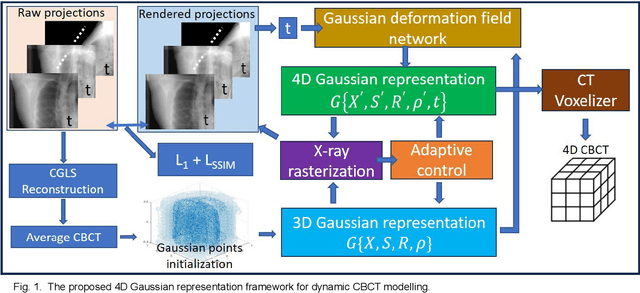
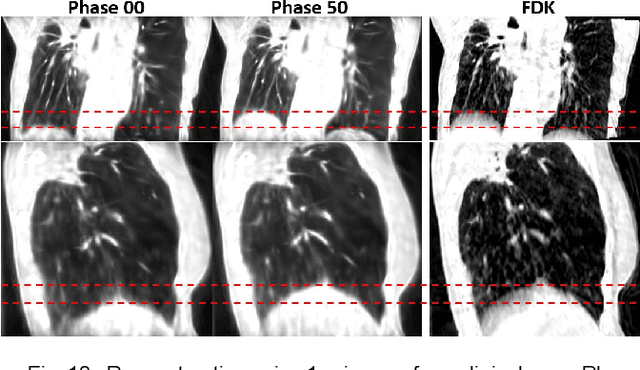


In image-guided radiotherapy (IGRT), four-dimensional cone-beam computed tomography (4D-CBCT) is critical for assessing tumor motion during a patients breathing cycle prior to beam delivery. However, generating 4D-CBCT images with sufficient quality requires significantly more projection images than a standard 3D-CBCT scan, leading to extended scanning times and increased imaging dose to the patient. To address these limitations, there is a strong demand for methods capable of reconstructing high-quality 4D-CBCT images from a 1-minute 3D-CBCT acquisition. The challenge lies in the sparse sampling of projections, which introduces severe streaking artifacts and compromises image quality. This paper introduces a novel framework leveraging spatiotemporal Gaussian representation for 4D-CBCT reconstruction from sparse projections, achieving a balance between streak artifact reduction, dynamic motion preservation, and fine detail restoration. Each Gaussian is characterized by its 3D position, covariance, rotation, and density. Two-dimensional X-ray projection images can be rendered from the Gaussian point cloud representation via X-ray rasterization. The properties of each Gaussian were optimized by minimizing the discrepancy between the measured projections and the rendered X-ray projections. A Gaussian deformation network is jointly optimized to deform these Gaussian properties to obtain a 4D Gaussian representation for dynamic CBCT scene modeling. The final 4D-CBCT images are reconstructed by voxelizing the 4D Gaussians, achieving a high-quality representation that preserves both motion dynamics and spatial detail. The code and reconstruction results can be found at https://github.com/fuyabo/4DGS_for_4DCBCT/tree/main
Unsupervised Multi-Parameter Inverse Solving for Reducing Ring Artifacts in 3D X-Ray CBCT
Dec 08, 2024
Ring artifacts are prevalent in 3D cone-beam computed tomography (CBCT) due to non-ideal responses of X-ray detectors, severely degrading imaging quality and reliability. Current state-of-the-art (SOTA) ring artifact reduction (RAR) algorithms rely on extensive paired CT samples for supervised learning. While effective, these methods do not fully capture the physical characteristics of ring artifacts, leading to pronounced performance drops when applied to out-of-domain data. Moreover, their applications to 3D CBCT are limited by high memory demands. In this work, we introduce \textbf{Riner}, an unsupervised method formulating 3D CBCT RAR as a multi-parameter inverse problem. Our core innovation is parameterizing the X-ray detector responses as solvable variables within a differential physical model. By jointly optimizing a neural field to represent artifact-free CT images and estimating response parameters directly from raw measurements, Riner eliminates the need for external training data. Moreover, it accommodates diverse CT geometries, enhancing practical usability. Empirical results on both simulated and real-world datasets show that Riner surpasses existing SOTA RAR methods in performance.
RSTAR: Rotational Streak Artifact Reduction in 4D CBCT using Separable and Circular Convolutions
Mar 25, 2024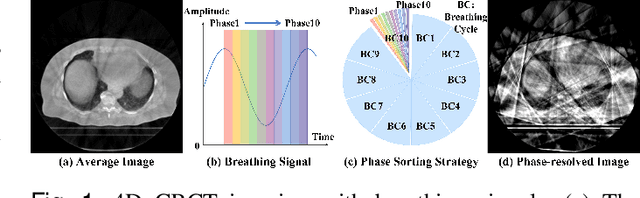

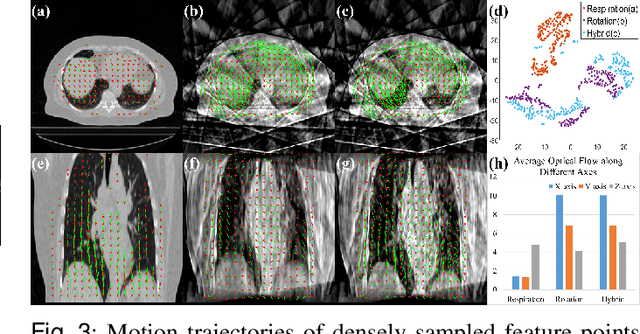
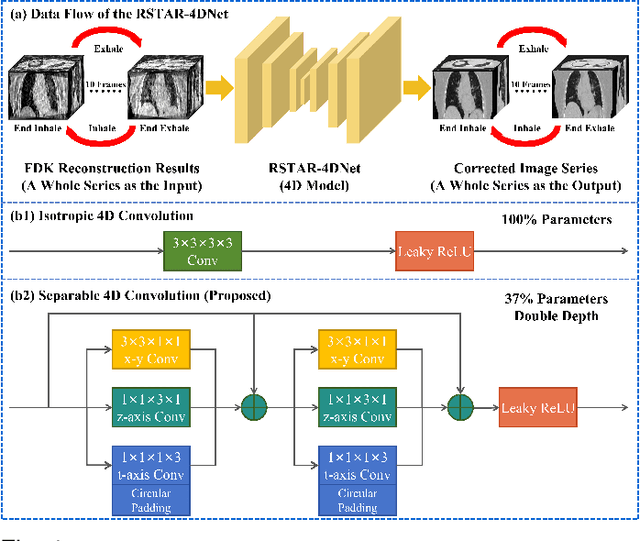
Four-dimensional cone-beam computed tomography (4D CBCT) provides respiration-resolved images and can be used for image-guided radiation therapy. However, the ability to reveal respiratory motion comes at the cost of image artifacts. As raw projection data are sorted into multiple respiratory phases, there is a limited number of cone-beam projections available for image reconstruction. Consequently, the 4D CBCT images are covered by severe streak artifacts. Although several deep learning-based methods have been proposed to address this issue, most algorithms employ ordinary network models, neglecting the intrinsic structural prior within 4D CBCT images. In this paper, we first explore the origin and appearance of streak artifacts in 4D CBCT images.Specifically, we find that streak artifacts exhibit a periodic rotational motion along with the patient's respiration. This unique motion pattern inspires us to distinguish the artifacts from the desired anatomical structures in the spatiotemporal domain. Thereafter, we propose a spatiotemporal neural network named RSTAR-Net with separable and circular convolutions for Rotational Streak Artifact Reduction. The specially designed model effectively encodes dynamic image features, facilitating the recovery of 4D CBCT images. Moreover, RSTAR-Net is also lightweight and computationally efficient. Extensive experiments substantiate the effectiveness of our proposed method, and RSTAR-Net shows superior performance to comparison methods.
Artifact Reduction in 3D and 4D Cone-beam Computed Tomography Images with Deep Learning -- A Review
Mar 27, 2024Deep learning based approaches have been used to improve image quality in cone-beam computed tomography (CBCT), a medical imaging technique often used in applications such as image-guided radiation therapy, implant dentistry or orthopaedics. In particular, while deep learning methods have been applied to reduce various types of CBCT image artifacts arising from motion, metal objects, or low-dose acquisition, a comprehensive review summarizing the successes and shortcomings of these approaches, with a primary focus on the type of artifacts rather than the architecture of neural networks, is lacking in the literature. In this review, the data generation and simulation pipelines, and artifact reduction techniques are specifically investigated for each type of artifact. We provide an overview of deep learning techniques that have successfully been shown to reduce artifacts in 3D, as well as in time-resolved (4D) CBCT through the use of projection- and/or volume-domain optimizations, or by introducing neural networks directly within the CBCT reconstruction algorithms. Research gaps are identified to suggest avenues for future exploration. One of the key findings of this work is an observed trend towards the use of generative models including GANs and score-based or diffusion models, accompanied with the need for more diverse and open training datasets and simulations.
* 16 pages, 4 figures, 1 Table, published in IEEE Access Journal
MARformer: An Efficient Metal Artifact Reduction Transformer for Dental CBCT Images
Nov 16, 2023


Cone Beam Computed Tomography (CBCT) plays a key role in dental diagnosis and surgery. However, the metal teeth implants could bring annoying metal artifacts during the CBCT imaging process, interfering diagnosis and downstream processing such as tooth segmentation. In this paper, we develop an efficient Transformer to perform metal artifacts reduction (MAR) from dental CBCT images. The proposed MAR Transformer (MARformer) reduces computation complexity in the multihead self-attention by a new Dimension-Reduced Self-Attention (DRSA) module, based on that the CBCT images have globally similar structure. A Patch-wise Perceptive Feed Forward Network (P2FFN) is also proposed to perceive local image information for fine-grained restoration. Experimental results on CBCT images with synthetic and real-world metal artifacts show that our MARformer is efficient and outperforms previous MAR methods and two restoration Transformers.
Prior Frequency Guided Diffusion Model for Limited Angle (LA)-CBCT Reconstruction
Apr 09, 2024Cone-beam computed tomography (CBCT) is widely used in image-guided radiotherapy. Reconstructing CBCTs from limited-angle acquisitions (LA-CBCT) is highly desired for improved imaging efficiency, dose reduction, and better mechanical clearance. LA-CBCT reconstruction, however, suffers from severe under-sampling artifacts, making it a highly ill-posed inverse problem. Diffusion models can generate data/images by reversing a data-noising process through learned data distributions; and can be incorporated as a denoiser/regularizer in LA-CBCT reconstruction. In this study, we developed a diffusion model-based framework, prior frequency-guided diffusion model (PFGDM), for robust and structure-preserving LA-CBCT reconstruction. PFGDM uses a conditioned diffusion model as a regularizer for LA-CBCT reconstruction, and the condition is based on high-frequency information extracted from patient-specific prior CT scans which provides a strong anatomical prior for LA-CBCT reconstruction. Specifically, we developed two variants of PFGDM (PFGDM-A and PFGDM-B) with different conditioning schemes. PFGDM-A applies the high-frequency CT information condition until a pre-optimized iteration step, and drops it afterwards to enable both similar and differing CT/CBCT anatomies to be reconstructed. PFGDM-B, on the other hand, continuously applies the prior CT information condition in every reconstruction step, while with a decaying mechanism, to gradually phase out the reconstruction guidance from the prior CT scans. The two variants of PFGDM were tested and compared with current available LA-CBCT reconstruction solutions, via metrics including PSNR and SSIM. PFGDM outperformed all traditional and diffusion model-based methods. PFGDM reconstructs high-quality LA-CBCTs under very-limited gantry angles, allowing faster and more flexible CBCT scans with dose reductions.
Neural Representation-Based Method for Metal-induced Artifact Reduction in Dental CBCT Imaging
Jul 27, 2023This study introduces a novel reconstruction method for dental cone-beam computed tomography (CBCT), focusing on effectively reducing metal-induced artifacts commonly encountered in the presence of prevalent metallic implants. Despite significant progress in metal artifact reduction techniques, challenges persist owing to the intricate physical interactions between polychromatic X-ray beams and metal objects, which are further compounded by the additional effects associated with metal-tooth interactions and factors specific to the dental CBCT data environment. To overcome these limitations, we propose an implicit neural network that generates two distinct and informative tomographic images. One image represents the monochromatic attenuation distribution at a specific energy level, whereas the other captures the nonlinear beam-hardening factor resulting from the polychromatic nature of X-ray beams. In contrast to existing CT reconstruction techniques, the proposed method relies exclusively on the Beer--Lambert law, effectively preventing the generation of metal-induced artifacts during the backprojection process commonly implemented in conventional methods. Extensive experimental evaluations demonstrate that the proposed method effectively reduces metal artifacts while providing high-quality image reconstructions, thus emphasizing the significance of the second image in capturing the nonlinear beam-hardening factor.