 Add to Chrome
 Add to Firefox
 Add to Edge
Dual-domain U-Nets with embedded back projection operators for motion-resolved 4D CBCT reconstruction
Aug 04, 2026
Four-dimensional cone beam CT (4D CBCT) is important for image-guided radiation therapy of thoracic cancers, but its use is limited by long scan times, causing high patient dose and motion/sparse-sampling artifacts. We propose a deep learning method for motion-resolved 4D CBCT reconstruction from conventional free-breathing scans, without a respiratory signal or explicit projection binning. Our CNN takes free-breathing 3D CBCT projections as input and predicts a static volume at maximum inhalation plus ten displacement vector fields (DVFs) spanning a breathing cycle. The network extends U-Net: the encoder acts on filtered projection stacks, the decoder acts in the volume domain, and skip connections are replaced with non-trainable back-projection functions at multiple resolutions to transfer features between domains. The model is trained on simulated CBCT scans and evaluated on 11 unseen simulated patients and 13 clinical free-breathing scans. Two additional models (60 s and 6 s scans) were evaluated by clinical experts on three and two scans, comparing single phases of our 4D reconstruction to reference 3D SART-TV images for tumor and esophagus visibility. Experts preferred our method for tumor visibility (59% vs. 36% no preference, 5% reference) and esophagus visibility (47% vs. 42%, 11%). On simulated data, image quality matched SART-TV (mean RMSE: -1.19 HU, PSNR: +0.09 dB, SSIM: -0.009) while enabling 4D reconstruction. On clinical scans, our method showed sharper dynamic structures (e.g., diaphragm) and fewer motion streak artifacts than traditional reconstruction. This non-patient-specific CNN predicts static volumes and full 4D respiratory motion models from a single free-breathing scan, without a respiratory surrogate or projection binning, reducing motion artifacts while adding motion-modeling capability.

Artifact Reduction in 3D and 4D Cone-beam Computed Tomography Images with Deep Learning -- A Review
Mar 27, 2024Deep learning based approaches have been used to improve image quality in cone-beam computed tomography (CBCT), a medical imaging technique often used in applications such as image-guided radiation therapy, implant dentistry or orthopaedics. In particular, while deep learning methods have been applied to reduce various types of CBCT image artifacts arising from motion, metal objects, or low-dose acquisition, a comprehensive review summarizing the successes and shortcomings of these approaches, with a primary focus on the type of artifacts rather than the architecture of neural networks, is lacking in the literature. In this review, the data generation and simulation pipelines, and artifact reduction techniques are specifically investigated for each type of artifact. We provide an overview of deep learning techniques that have successfully been shown to reduce artifacts in 3D, as well as in time-resolved (4D) CBCT through the use of projection- and/or volume-domain optimizations, or by introducing neural networks directly within the CBCT reconstruction algorithms. Research gaps are identified to suggest avenues for future exploration. One of the key findings of this work is an observed trend towards the use of generative models including GANs and score-based or diffusion models, accompanied with the need for more diverse and open training datasets and simulations.
* 16 pages, 4 figures, 1 Table, published in IEEE Access Journal
Exploration of Spanish Olive Oil Quality with a Miniaturized Low-Cost Fluorescence Sensor and Machine Learning Techniques
Apr 09, 2021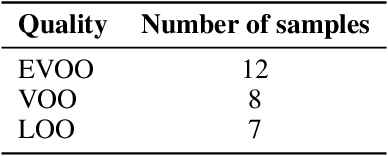
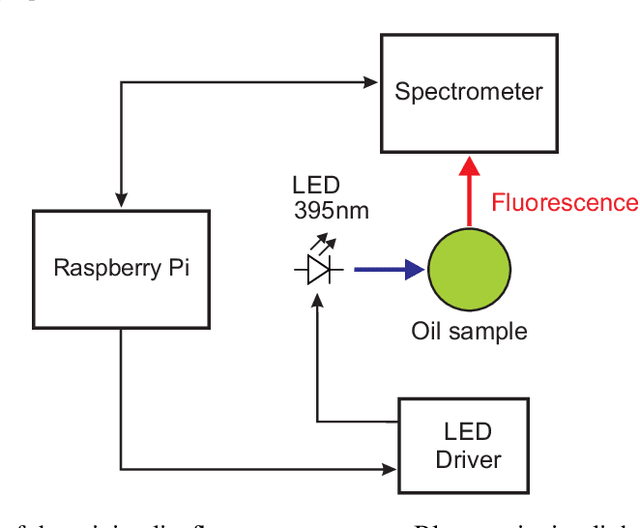
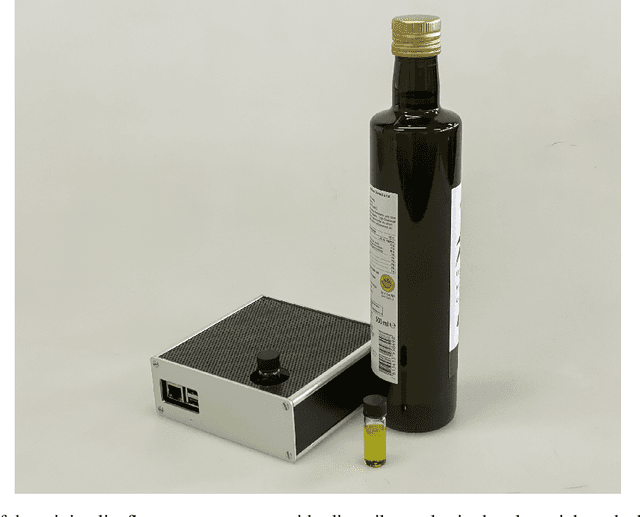
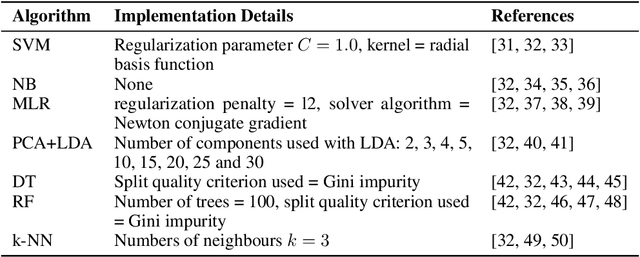
Extra virgin olive oil (EVOO) is the highest quality of olive oil and is characterized by highly beneficial nutritional properties. The large increase in both consumption and fraud, for example through adulteration, creates new challenges and an increasing demand for developing new quality assessment methodologies that are easier and cheaper to perform. As of today, the determination of olive oil quality is performed by producers through chemical analysis and organoleptic evaluation. The chemical analysis requires the advanced equipment and chemical knowledge of certified laboratories, and has therefore a limited accessibility. In this work a minimalist, portable and low-cost sensor is presented, which can perform olive oil quality assessment using fluorescence spectroscopy. The potential of the proposed technology is explored by analyzing several olive oils of different quality levels, EVOO, virgin olive oil (VOO), and lampante olive oil (LOO). The spectral data were analyzed using a large number of machine learning methods, including artificial neural networks. The analysis performed in this work demonstrates the possibility of performing classification of olive oil in the three mentioned classes with an accuracy of 100$\%$. These results confirm that this minimalist low-cost sensor has the potential of substituting expensive and complex chemical analysis.