 Add to Chrome
 Add to Firefox
 Add to Edge
Aspect Sentiment Opinion Triplet Extraction
Papers and Code
Prototype-Regularized Federated Learning for Cross-Domain Aspect Sentiment Triplet Extraction
Apr 10, 2026
Aspect Sentiment Triplet Extraction (ASTE) aims to extract all sentiment triplets of aspect terms, opinion terms, and sentiment polarities from a sentence. Existing methods are typically trained on individual datasets in isolation, failing to jointly capture the common feature representations shared across domains. Moreover, data privacy constraints prevent centralized data aggregation. To address these challenges, we propose Prototype-based Cross-Domain Span Prototype extraction (PCD-SpanProto), a prototype-regularized federated learning framework to enable distributed clients to exchange class-level prototypes instead of full model parameters. Specifically, we design a weighted performance-aware aggregation strategy and a contrastive regularization module to improve the global prototype under domain heterogeneity and the promotion between intra-class compactness and inter-class separability across clients. Extensive experiments on four ASTE datasets demonstrate that our method outperforms baselines and reduces communication costs, validating the effectiveness of prototype-based cross-domain knowledge transfer.

Large Language Models as Automatic Annotators and Annotation Adjudicators for Fine-Grained Opinion Analysis
Jan 23, 2026Fine-grained opinion analysis of text provides a detailed understanding of expressed sentiments, including the addressed entity. Although this level of detail is sound, it requires considerable human effort and substantial cost to annotate opinions in datasets for training models, especially across diverse domains and real-world applications. We explore the feasibility of LLMs as automatic annotators for fine-grained opinion analysis, addressing the shortage of domain-specific labelled datasets. In this work, we use a declarative annotation pipeline. This approach reduces the variability of manual prompt engineering when using LLMs to identify fine-grained opinion spans in text. We also present a novel methodology for an LLM to adjudicate multiple labels and produce final annotations. After trialling the pipeline with models of different sizes for the Aspect Sentiment Triplet Extraction (ASTE) and Aspect-Category-Opinion-Sentiment (ACOS) analysis tasks, we show that LLMs can serve as automatic annotators and adjudicators, achieving high Inter-Annotator Agreement across individual LLM-based annotators. This reduces the cost and human effort needed to create these fine-grained opinion-annotated datasets.
DESS: DeBERTa Enhanced Syntactic-Semantic Aspect Sentiment Triplet Extraction
Nov 13, 2025Fine-grained sentiment analysis faces ongoing challenges in Aspect Sentiment Triple Extraction (ASTE), particularly in accurately capturing the relationships between aspects, opinions, and sentiment polarities. While researchers have made progress using BERT and Graph Neural Networks, the full potential of advanced language models in understanding complex language patterns remains unexplored. We introduce DESS, a new approach that builds upon previous work by integrating DeBERTa's enhanced attention mechanism to better understand context and relationships in text. Our framework maintains a dual-channel structure, where DeBERTa works alongside an LSTM channel to process both meaning and grammatical patterns in text. We have carefully refined how these components work together, paying special attention to how different types of language information interact. When we tested DESS on standard datasets, it showed meaningful improvements over current methods, with F1-score increases of 4.85, 8.36, and 2.42 in identifying aspect opinion pairs and determining sentiment accurately. Looking deeper into the results, we found that DeBERTa's sophisticated attention system helps DESS handle complicated sentence structures better, especially when important words are far apart. Our findings suggest that upgrading to more advanced language models when thoughtfully integrated, can lead to real improvements in how well we can analyze sentiments in text. The implementation of our approach is publicly available at: https://github.com/VishalRepos/DESS.
T-T: Table Transformer for Tagging-based Aspect Sentiment Triplet Extraction
May 08, 2025Aspect sentiment triplet extraction (ASTE) aims to extract triplets composed of aspect terms, opinion terms, and sentiment polarities from given sentences. The table tagging method is a popular approach to addressing this task, which encodes a sentence into a 2-dimensional table, allowing for the tagging of relations between any two words. Previous efforts have focused on designing various downstream relation learning modules to better capture interactions between tokens in the table, revealing that a stronger capability to capture relations can lead to greater improvements in the model. Motivated by this, we attempt to directly utilize transformer layers as downstream relation learning modules. Due to the powerful semantic modeling capability of transformers, it is foreseeable that this will lead to excellent improvement. However, owing to the quadratic relation between the length of the table and the length of the input sentence sequence, using transformers directly faces two challenges: overly long table sequences and unfair local attention interaction. To address these challenges, we propose a novel Table-Transformer (T-T) for the tagging-based ASTE method. Specifically, we introduce a stripe attention mechanism with a loop-shift strategy to tackle these challenges. The former modifies the global attention mechanism to only attend to a 2-dimensional local attention window, while the latter facilitates interaction between different attention windows. Extensive and comprehensive experiments demonstrate that the T-T, as a downstream relation learning module, achieves state-of-the-art performance with lower computational costs.
Boundary-Driven Table-Filling with Cross-Granularity Contrastive Learning for Aspect Sentiment Triplet Extraction
Feb 04, 2025


The Aspect Sentiment Triplet Extraction (ASTE) task aims to extract aspect terms, opinion terms, and their corresponding sentiment polarity from a given sentence. It remains one of the most prominent subtasks in fine-grained sentiment analysis. Most existing approaches frame triplet extraction as a 2D table-filling process in an end-to-end manner, focusing primarily on word-level interactions while often overlooking sentence-level representations. This limitation hampers the model's ability to capture global contextual information, particularly when dealing with multi-word aspect and opinion terms in complex sentences. To address these issues, we propose boundary-driven table-filling with cross-granularity contrastive learning (BTF-CCL) to enhance the semantic consistency between sentence-level representations and word-level representations. By constructing positive and negative sample pairs, the model is forced to learn the associations at both the sentence level and the word level. Additionally, a multi-scale, multi-granularity convolutional method is proposed to capture rich semantic information better. Our approach can capture sentence-level contextual information more effectively while maintaining sensitivity to local details. Experimental results show that the proposed method achieves state-of-the-art performance on public benchmarks according to the F1 score.
Train Once for All: A Transitional Approach for Efficient Aspect Sentiment Triplet Extraction
Nov 29, 2024Aspect-Opinion Pair Extraction (AOPE) and Aspect Sentiment Triplet Extraction (ASTE) have gained significant attention in natural language processing. However, most existing methods are a pipelined framework, which extracts aspects/opinions and identifies their relations separately, leading to a drawback of error propagation and high time complexity. Towards this problem, we propose a transition-based pipeline to mitigate token-level bias and capture position-aware aspect-opinion relations. With the use of a fused dataset and contrastive learning optimization, our model learns robust action patterns and can optimize separate subtasks jointly, often with linear-time complexity. The results show that our model achieves the best performance on both the ASTE and AOPE tasks, outperforming the state-of-the-art methods by at least 6.98\% in the F1 measure. The code is available at https://github.com/Paparare/trans_aste.
Polish-ASTE: Aspect-Sentiment Triplet Extraction Datasets for Polish
Feb 27, 2025Aspect-Sentiment Triplet Extraction (ASTE) is one of the most challenging and complex tasks in sentiment analysis. It concerns the construction of triplets that contain an aspect, its associated sentiment polarity, and an opinion phrase that serves as a rationale for the assigned polarity. Despite the growing popularity of the task and the many machine learning methods being proposed to address it, the number of datasets for ASTE is very limited. In particular, no dataset is available for any of the Slavic languages. In this paper, we present two new datasets for ASTE containing customer opinions about hotels and purchased products expressed in Polish. We also perform experiments with two ASTE techniques combined with two large language models for Polish to investigate their performance and the difficulty of the assembled datasets. The new datasets are available under a permissive licence and have the same file format as the English datasets, facilitating their use in future research.
Prompt Based Tri-Channel Graph Convolution Neural Network for Aspect Sentiment Triplet Extraction
Dec 24, 2023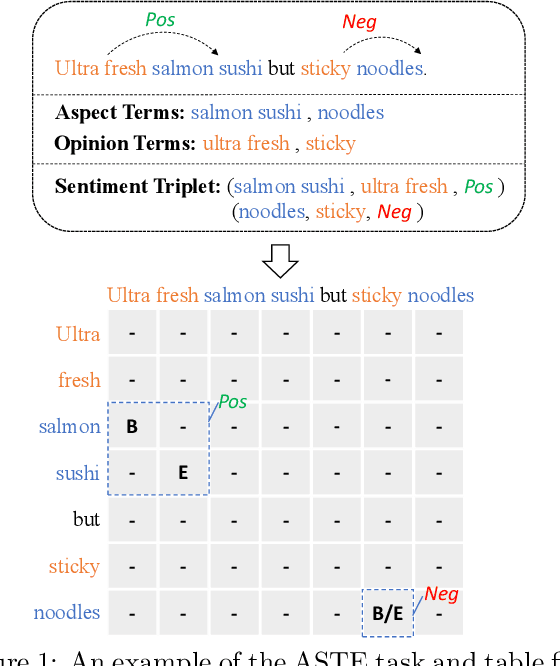
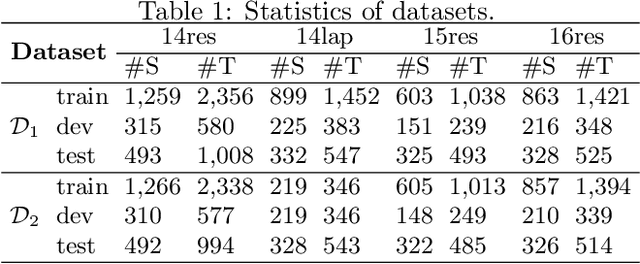
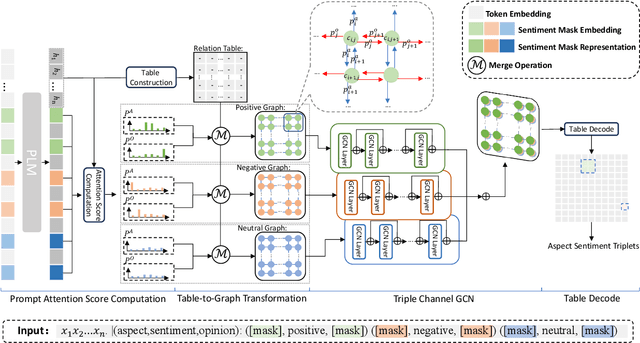
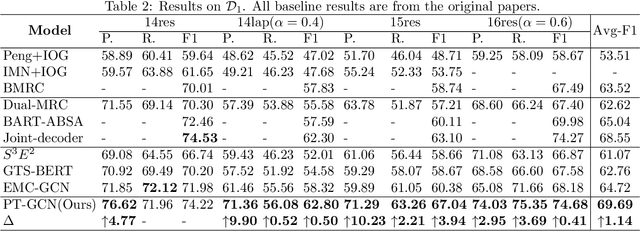
Aspect Sentiment Triplet Extraction (ASTE) is an emerging task to extract a given sentence's triplets, which consist of aspects, opinions, and sentiments. Recent studies tend to address this task with a table-filling paradigm, wherein word relations are encoded in a two-dimensional table, and the process involves clarifying all the individual cells to extract triples. However, these studies ignore the deep interaction between neighbor cells, which we find quite helpful for accurate extraction. To this end, we propose a novel model for the ASTE task, called Prompt-based Tri-Channel Graph Convolution Neural Network (PT-GCN), which converts the relation table into a graph to explore more comprehensive relational information. Specifically, we treat the original table cells as nodes and utilize a prompt attention score computation module to determine the edges' weights. This enables us to construct a target-aware grid-like graph to enhance the overall extraction process. After that, a triple-channel convolution module is conducted to extract precise sentiment knowledge. Extensive experiments on the benchmark datasets show that our model achieves state-of-the-art performance. The code is available at https://github.com/KunPunCN/PT-GCN.
Indo LEGO-ABSA: A Multitask Generative Aspect Based Sentiment Analysis for Indonesian Language
Nov 03, 2023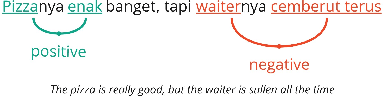
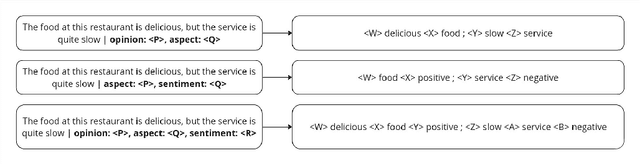

Aspect-based sentiment analysis is a method in natural language processing aimed at identifying and understanding sentiments related to specific aspects of an entity. Aspects are words or phrases that represent an aspect or attribute of a particular entity. Previous research has utilized generative pre-trained language models to perform aspect-based sentiment analysis. LEGO-ABSA is one framework that has successfully employed generative pre-trained language models in aspect-based sentiment analysis, particularly in English. LEGO-ABSA uses a multitask learning and prompting approach to enhance model performance. However, the application of this approach has not been done in the context of Bahasa Indonesia. Therefore, this research aims to implement the multitask learning and prompting approach in aspect-based sentiment analysis for Bahasa Indonesia using generative pre-trained language models. In this study, the Indo LEGO-ABSA model is developed, which is an aspect-based sentiment analysis model utilizing generative pre-trained language models and trained with multitask learning and prompting. Indo LEGO-ABSA is trained with a hotel domain dataset in the Indonesian language. The obtained results include an f1-score of 79.55% for the Aspect Sentiment Triplet Extraction task, 86.09% for Unified Aspect-based Sentiment Analysis, 79.85% for Aspect Opinion Pair Extraction, 87.45% for Aspect Term Extraction, and 88.09% for Opinion Term Extraction. Indo LEGO-ABSA adopts the LEGO-ABSA framework that employs the T5 model, specifically mT5, by applying multitask learning to train all tasks within aspect-based sentiment analysis.
A Pairing Enhancement Approach for Aspect Sentiment Triplet Extraction
Jun 11, 2023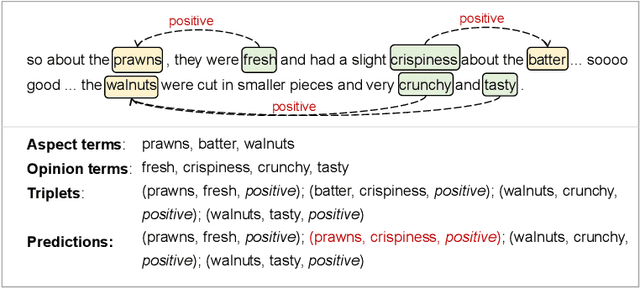
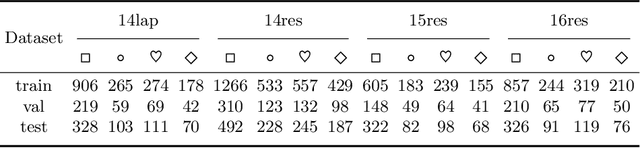
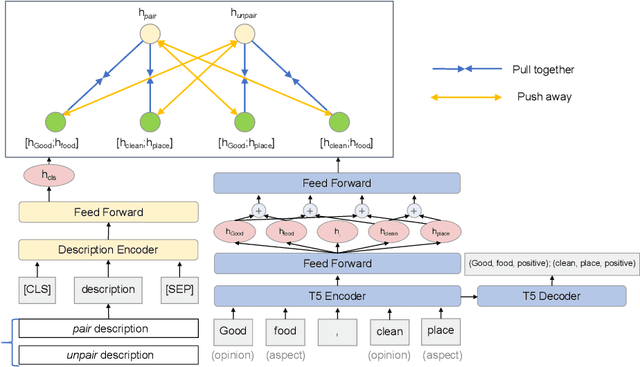
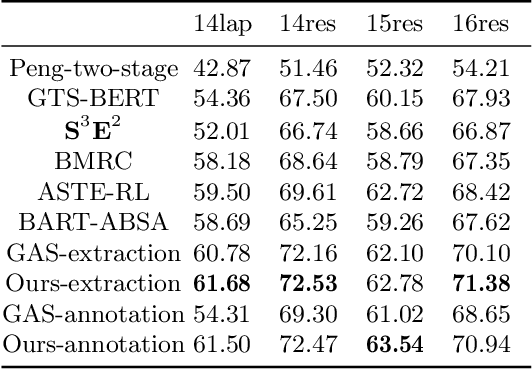
Aspect Sentiment Triplet Extraction (ASTE) aims to extract the triplet of an aspect term, an opinion term, and their corresponding sentiment polarity from the review texts. Due to the complexity of language and the existence of multiple aspect terms and opinion terms in a single sentence, current models often confuse the connections between an aspect term and the opinion term describing it. To address this issue, we propose a pairing enhancement approach for ASTE, which incorporates contrastive learning during the training stage to inject aspect-opinion pairing knowledge into the triplet extraction model. Experimental results demonstrate that our approach performs well on four ASTE datasets (i.e., 14lap, 14res, 15res and 16res) compared to several related classical and state-of-the-art triplet extraction methods. Moreover, ablation studies conduct an analysis and verify the advantage of contrastive learning over other pairing enhancement approaches.