 Add to Chrome
 Add to Firefox
 Add to Edge
Aff Wild
Papers and Code
Team RAS in 10th ABAW Competition: Multimodal Valence and Arousal Estimation Approach
Mar 13, 2026
Continuous emotion recognition in terms of valence and arousal under in-the-wild (ITW) conditions remains a challenging problem due to large variations in appearance, head pose, illumination, occlusions, and subject-specific patterns of affective expression. We present a multimodal method for valence-arousal estimation ITW. Our method combines three complementary modalities: face, behavior, and audio. The face modality relies on GRADA-based frame-level embeddings and Transformer-based temporal regression. We use Qwen3-VL-4B-Instruct to extract behavior-relevant information from video segments, while Mamba is used to model temporal dynamics across segments. The audio modality relies on WavLM-Large with attention-statistics pooling and includes a cross-modal filtering stage to reduce the influence of unreliable or non-speech segments. To fuse modalities, we explore two fusion strategies: a Directed Cross-Modal Mixture-of-Experts Fusion Strategy that learns interactions between modalities with adaptive weighting, and a Reliability-Aware Audio-Visual Fusion Strategy that combines visual features at the frame-level while using audio as complementary context. The results are reported on the Aff-Wild2 dataset following the 10th Affective Behavior Analysis in-the-Wild (ABAW) challenge protocol. Experiments demonstrate that the proposed multimodal fusion strategy achieves a Concordance Correlation Coefficient (CCC) of 0.658 on the Aff-Wild2 development set.

Distance-aware Soft Prompt Learning for Multimodal Valence-Arousal Estimation
Mar 12, 2026Valence-arousal (VA) estimation is crucial for capturing the nuanced nature of human emotions in naturalistic environments. While pre-trained Vision-Language models like CLIP have shown remarkable semantic alignment capabilities, their application in continuous regression tasks is often limited by the discrete nature of text prompts. In this paper, we propose a novel multimodal framework for VA estimation that introduces Distance-aware Soft Prompt Learning to bridge the gap between semantic space and continuous dimensions. Specifically, we partition the VA space into a 3X3 grid, defining nine emotional regions, each associated with distinct textual descriptions. Rather than a hard categorization, we employ a Gaussian kernel to compute soft labels based on the Euclidean distance between the ground truth coordinates and the region centers, allowing the model to learn fine-grained emotional transitions. For multimodal integration, our architecture utilizes a CLIP image encoder and an Audio Spectrogram Transformer (AST) to extract robust spatial and acoustic features. These features are temporally modeled via Gated Recurrent Units (GRUs) and integrated through a hierarchical fusion scheme that sequentially combines cross-modal attention for alignment and gated fusion for adaptive refinement. Experimental results on the Aff-Wild2 dataset demonstrate that our proposed semantic-guided approach significantly enhances the accuracy of VA estimation, achieving competitive performance in unconstrained ``in-the-wild'' scenarios.
Hierarchical Granularity Alignment and State Space Modeling for Robust Multimodal AU Detection in the Wild
Mar 11, 2026Facial Action Unit (AU) detection in in-the-wild environments remains a formidable challenge due to severe spatial-temporal heterogeneity, unconstrained poses, and complex audio-visual dependencies. While recent multimodal approaches have made progress, they often rely on capacity-limited encoders and shallow fusion mechanisms that fail to capture fine-grained semantic shifts and ultra-long temporal contexts. To bridge this gap, we propose a novel multimodal framework driven by Hierarchical Granularity Alignment and State Space Models.Specifically, we leverage powerful foundation models, namely DINOv2 and WavLM, to extract robust and high-fidelity visual and audio representations, effectively replacing traditional feature extractors. To handle extreme facial variations, our Hierarchical Granularity Alignment module dynamically aligns global facial semantics with fine-grained local active patches. Furthermore, we overcome the receptive field limitations of conventional temporal convolutional networks by introducing a Vision-Mamba architecture. This approach enables temporal modeling with O(N) linear complexity, effectively capturing ultra-long-range dynamics without performance degradation. A novel asymmetric cross-attention mechanism is also introduced to deeply synchronize paralinguistic audio cues with subtle visual movements.Extensive experiments on the challenging Aff-Wild2 dataset demonstrate that our approach significantly outperforms existing baselines, achieving state-of-the-art performance. Notably, this framework secured top rankings in the AU Detection track of the 10th Affective Behavior Analysis in-the-wild Competition.
Solution to the 10th ABAW Expression Recognition Challenge: A Robust Multimodal Framework with Safe Cross-Attention and Modality Dropout
Mar 09, 2026Emotion recognition in real-world environments is hindered by partial occlusions, missing modalities, and severe class imbalance. To address these issues, particularly for the Affective Behavior Analysis in-the-wild (ABAW) Expression challenge, we propose a multimodal framework that dynamically fuses visual and audio representations. Our approach uses a dual-branch Transformer architecture featuring a safe cross-attention mechanism and a modality dropout strategy. This design allows the network to rely on audio-based predictions when visual cues are absent. To mitigate the long-tail distribution of the Aff-Wild2 dataset, we apply focal loss optimization, combined with a sliding-window soft voting strategy to capture dynamic emotional transitions and reduce frame-level classification jitter. Experiments demonstrate that our framework effectively handles missing modalities and complex spatiotemporal dependencies, achieving an accuracy of 60.79% and an F1-score of 0.5029 on the Aff-Wild2 validation set.
Interactive Multimodal Fusion with Temporal Modeling
Mar 13, 2025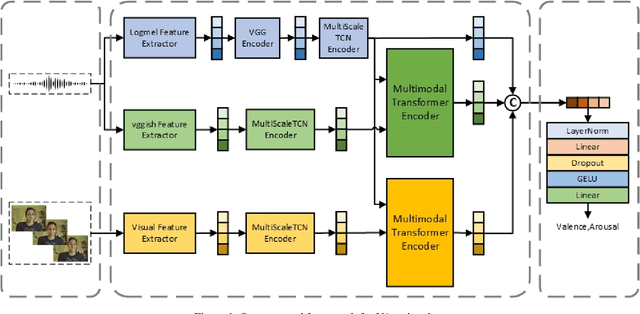
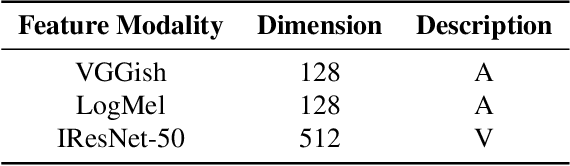
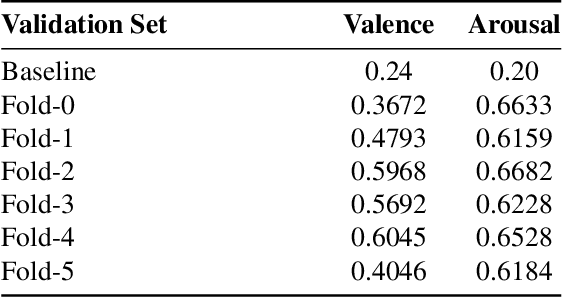
This paper presents our method for the estimation of valence-arousal (VA) in the 8th Affective Behavior Analysis in-the-Wild (ABAW) competition. Our approach integrates visual and audio information through a multimodal framework. The visual branch uses a pre-trained ResNet model to extract spatial features from facial images. The audio branches employ pre-trained VGG models to extract VGGish and LogMel features from speech signals. These features undergo temporal modeling using Temporal Convolutional Networks (TCNs). We then apply cross-modal attention mechanisms, where visual features interact with audio features through query-key-value attention structures. Finally, the features are concatenated and passed through a regression layer to predict valence and arousal. Our method achieves competitive performance on the Aff-Wild2 dataset, demonstrating effective multimodal fusion for VA estimation in-the-wild.
V-NAW: Video-based Noise-aware Adaptive Weighting for Facial Expression Recognition
Mar 20, 2025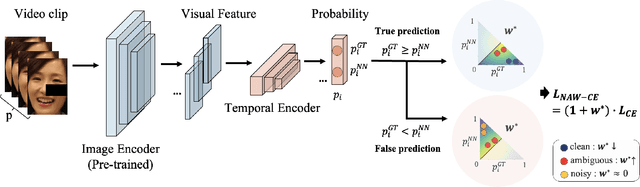


Facial Expression Recognition (FER) plays a crucial role in human affective analysis and has been widely applied in computer vision tasks such as human-computer interaction and psychological assessment. The 8th Affective Behavior Analysis in-the-Wild (ABAW) Challenge aims to assess human emotions using the video-based Aff-Wild2 dataset. This challenge includes various tasks, including the video-based EXPR recognition track, which is our primary focus. In this paper, we demonstrate that addressing label ambiguity and class imbalance, which are known to cause performance degradation, can lead to meaningful performance improvements. Specifically, we propose Video-based Noise-aware Adaptive Weighting (V-NAW), which adaptively assigns importance to each frame in a clip to address label ambiguity and effectively capture temporal variations in facial expressions. Furthermore, we introduce a simple and effective augmentation strategy to reduce redundancy between consecutive frames, which is a primary cause of overfitting. Through extensive experiments, we validate the effectiveness of our approach, demonstrating significant improvements in video-based FER performance.
Emotion Recognition with CLIP and Sequential Learning
Mar 13, 2025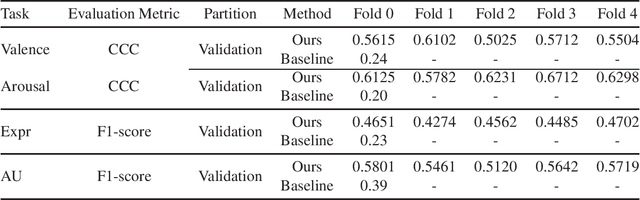
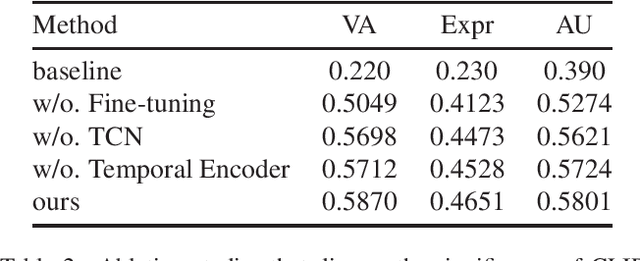
Human emotion recognition plays a crucial role in facilitating seamless interactions between humans and computers. In this paper, we present our innovative methodology for tackling the Valence-Arousal (VA) Estimation Challenge, the Expression Recognition Challenge, and the Action Unit (AU) Detection Challenge, all within the framework of the 8th Workshop and Competition on Affective Behavior Analysis in-the-wild (ABAW). Our approach introduces a novel framework aimed at enhancing continuous emotion recognition. This is achieved by fine-tuning the CLIP model with the aff-wild2 dataset, which provides annotated expression labels. The result is a fine-tuned model that serves as an efficient visual feature extractor, significantly improving its robustness. To further boost the performance of continuous emotion recognition, we incorporate Temporal Convolutional Network (TCN) modules alongside Transformer Encoder modules into our system architecture. The integration of these advanced components allows our model to outperform baseline performance, demonstrating its ability to recognize human emotions with greater accuracy and efficiency.
Solution for 8th Competition on Affective & Behavior Analysis in-the-wild
Mar 14, 2025In this report, we present our solution for the Action Unit (AU) Detection Challenge, in 8th Competition on Affective Behavior Analysis in-the-wild. In order to achieve robust and accurate classification of facial action unit in the wild environment, we introduce an innovative method that leverages audio-visual multimodal data. Our method employs ConvNeXt as the image encoder and uses Whisper to extract Mel spectrogram features. For these features, we utilize a Transformer encoder-based feature fusion module to integrate the affective information embedded in audio and image features. This ensures the provision of rich high-dimensional feature representations for the subsequent multilayer perceptron (MLP) trained on the Aff-Wild2 dataset, enhancing the accuracy of AU detection.
MAVEN: Multi-modal Attention for Valence-Arousal Emotion Network
Mar 16, 2025This paper introduces MAVEN (Multi-modal Attention for Valence-Arousal Emotion Network), a novel architecture for dynamic emotion recognition through dimensional modeling of affect. The model uniquely integrates visual, audio, and textual modalities via a bi-directional cross-modal attention mechanism with six distinct attention pathways, enabling comprehensive interactions between all modality pairs. Our proposed approach employs modality-specific encoders to extract rich feature representations from synchronized video frames, audio segments, and transcripts. The architecture's novelty lies in its cross-modal enhancement strategy, where each modality representation is refined through weighted attention from other modalities, followed by self-attention refinement through modality-specific encoders. Rather than directly predicting valence-arousal values, MAVEN predicts emotions in a polar coordinate form, aligning with psychological models of the emotion circumplex. Experimental evaluation on the Aff-Wild2 dataset demonstrates the effectiveness of our approach, with performance measured using Concordance Correlation Coefficient (CCC). The multi-stage architecture demonstrates superior ability to capture the complex, nuanced nature of emotional expressions in conversational videos, advancing the state-of-the-art (SOTA) in continuous emotion recognition in-the-wild. Code can be found at: https://github.com/Vrushank-Ahire/MAVEN_8th_ABAW.
Affective Behaviour Analysis via Progressive Learning
Jul 26, 2024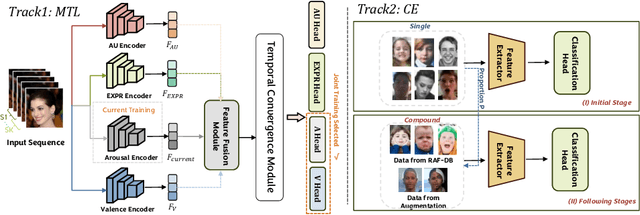

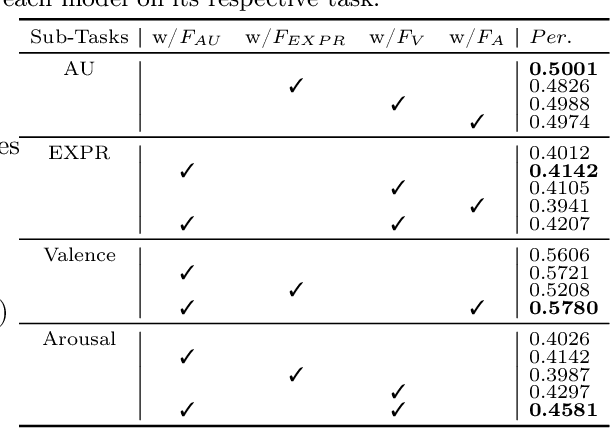

Affective Behavior Analysis aims to develop emotionally intelligent technology that can recognize and respond to human emotions. To advance this, the 7th Affective Behavior Analysis in-the-wild (ABAW) competition establishes two tracks: i.e., the Multi-task Learning (MTL) Challenge and the Compound Expression (CE) challenge based on Aff-Wild2 and C-EXPR-DB datasets. In this paper, we present our methods and experimental results for the two competition tracks. Specifically, it can be summarized in the following four aspects: 1) To attain high-quality facial features, we train a Masked-Auto Encoder in a self-supervised manner. 2) We devise a temporal convergence module to capture the temporal information between video frames and explore the impact of window size and sequence length on each sub-task. 3) To facilitate the joint optimization of various sub-tasks, we explore the impact of sub-task joint training and feature fusion from individual tasks on each task performance improvement. 4) We utilize curriculum learning to transition the model from recognizing single expressions to recognizing compound expressions, thereby improving the accuracy of compound expression recognition. Extensive experiments demonstrate the superiority of our designs.