 Add to Chrome
 Add to Firefox
 Add to Edge
Distilling Temporal Coherence into 2D Networks for Transrectal Ultrasound Prostate Video Segmentation
Jun 30, 2026
Real-time video segmentation of the prostate in Transrectal Ultrasound (TRUS) is essential for image-guided interventions. While conventional 2D methods suffer from inter-frame inconsistencies by disregarding temporal context, 3D architectures incur prohibitive latency. To resolve this dilemma, we present a Temporally Consistent Learning Framework that distills temporal coherence into a 2D network during training, preserving single-frame inference efficiency. Our design is driven by a key clinical observation: the prostate exhibits geometric stability, whereas the surrounding acoustic environment fluctuates due to physiological motion and transducer pressure. Because conventional temporal constraints propagate erroneous gradients from these unstable regions, we introduce a Confidence-Weighted Temporal Consistency objective derived from optical flow warping residuals, selectively attenuating contributions from unreliable regions. Complementing this pixel-wise constraint, a Dual-scale Prototype Alignment Module enforces semantic coherence through contrastive optimization of local boundary and global semantic features. Furthermore, to eliminate the need for dense per-frame video annotations, we employ geometric equivariance-based pseudo-labeling with knowledge distillation from a pretrained teacher. Extensive experiments on SUN-SEG and our newly introduced TRUS-V benchmark (2,679 frames) demonstrate state-of-the-art accuracy and temporal consistency at real-time speed. Code and dataset are available at https://github.com/DYDevelop/DTC-TRUS.

ComPose: When to Trust Hands for Object Pose Tracking
May 22, 2026Reconstructing the motion of objects from videos is a key component for embodied AI and robot manipulation. While diverse approaches to object pose tracking have been studied, they rely heavily on strong external priors, such as depth data or 3D templates, and remain highly vulnerable to severe occlusions by hand grasps despite the use of explicit masks. In this work, we present ComPose, a 6DoF object tracking framework designed for hand-aware object pose estimation from RGB video. Rather than treating the hand purely as an occluder, our method harmonizes hand motions as a \textit{complementary cue} for object tracking. In detail, we recover a variety of object motions over time by combining object and hand cues from foundation models within a unified tracking pipeline. Here, ComPose adaptively selects informative hand joints, combines object- and hand-derived cues for motion estimation, and refines the resulting object motion using visible geometric evidence and a learned correction. We further enforce the temporal consistency over both rotation and translation, yielding stable 3D object trajectories over time without any external smoothing. Extensive experiments show that our method is accurate, efficient, and robust under severe hand occlusion and geometric ambiguity. In addition, the resulting trajectories can also effectively transfer to downstream robot manipulation by enabling robots to reconstruct human actions from online videos.
V-NAW: Video-based Noise-aware Adaptive Weighting for Facial Expression Recognition
Mar 20, 2025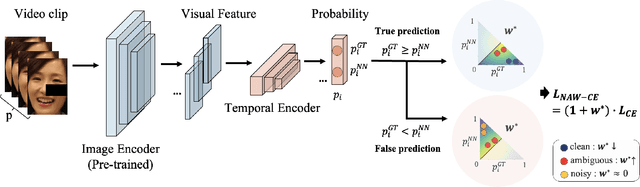


Facial Expression Recognition (FER) plays a crucial role in human affective analysis and has been widely applied in computer vision tasks such as human-computer interaction and psychological assessment. The 8th Affective Behavior Analysis in-the-Wild (ABAW) Challenge aims to assess human emotions using the video-based Aff-Wild2 dataset. This challenge includes various tasks, including the video-based EXPR recognition track, which is our primary focus. In this paper, we demonstrate that addressing label ambiguity and class imbalance, which are known to cause performance degradation, can lead to meaningful performance improvements. Specifically, we propose Video-based Noise-aware Adaptive Weighting (V-NAW), which adaptively assigns importance to each frame in a clip to address label ambiguity and effectively capture temporal variations in facial expressions. Furthermore, we introduce a simple and effective augmentation strategy to reduce redundancy between consecutive frames, which is a primary cause of overfitting. Through extensive experiments, we validate the effectiveness of our approach, demonstrating significant improvements in video-based FER performance.