 Add to Chrome
 Add to Firefox
 Add to Edge
ACE-Brain-0.5: A Unified Embodied Foundational Model for Physical Agentic AI
Jul 05, 2026
Embodied AI is moving from isolated perception or action modules toward physical agents that understand, plan under goals, act through robot bodies, monitor progress, and improve from experience. Existing systems address this loop only in parts: end-to-end policies generate actions but often lack spatial reasoning, planning, and execution assessment, while robot-agent systems orchestrate tools or specialists but do not learn a shared representation. This fragmentation limits general Physical Agentic AI. We present ACE-Brain-0.5, a unified embodied foundation model that organizes robot intelligence into five coupled functions: spatial perception, decision making, embodied interaction, self-monitoring, and self-improvement. Built on ACE-Brain-0, which established spatial intelligence as a shared scaffold across robot platforms, ACE-Brain-0.5 extends an understanding-centric model into a closed-loop foundation model. A single 8B backbone instantiates the first four functions: grounding objects and affordances, reasoning over 3D and egocentric spatial relations, decomposing instructions into subgoals, generating navigation and manipulation actions, and estimating progress for verification and recovery. To unify these capabilities without cross-task interference, we introduce SSR+, which extends Scaffold-Specialize-Reconcile with a Reactivate stage after task-vector merging. The fifth function, self-improvement, is realized by a companion framework that updates external execution state, including task schemas, spatial memory, and failure-recovery cases, from rollouts. Across fifteen benchmarks, ACE-Brain-0.5 improves over ACE-Brain-0 on 14 of 18 spatial perception and grounding benchmarks, achieves competitive navigation and manipulation performance, and provides strong progress estimation in ID and OOD settings. Together, these results mark an early step toward general Physical Agentic AI.

Anchoring Emotions in Text: Robust Multimodal Fusion for Mimicry Intensity Estimation
Mar 16, 2026Estimating Emotional Mimicry Intensity (EMI) in naturalistic environments is a critical yet challenging task in affective computing. The primary difficulty lies in effectively modeling the complex, nonlinear temporal dynamics across highly heterogeneous modalities, especially when physical signals are corrupted or missing. To tackle this, we propose TAEMI (Text-Anchored Emotional Mimicry Intensity estimation), a novel multimodal framework designed for the 10th ABAW Competition. Motivated by the observation that continuous visual and acoustic signals are highly susceptible to transient environmental noise, we break the traditional symmetric fusion paradigm. Instead, we leverage textual transcript--which inherently encode a stable, time-independent semantic prior--as central anchors. Specifically, we introduce a Text-Anchored Dual Cross-Attention mechanism that utilizes these robust textual queries to actively filter out frame-level redundancies and align the noisy physical streams. Furthermore, to prevent catastrophic performance degradation caused by inevitably missing data in unconstrained real-world scenarios, we integrate Learnable Missing-Modality Tokens and a Modality Dropout strategy during training. Extensive experiments on the Hume-Vidmimic2 dataset demonstrate that TAEMI effectively captures fine-grained emotional variations and maintains robust predictive resilience under imperfect conditions. Our framework achieves a state-of-the-art mean Pearson correlation coefficient across six continuous emotional dimensions, significantly outperforming existing baseline methods.
Hierarchical Granularity Alignment and State Space Modeling for Robust Multimodal AU Detection in the Wild
Mar 11, 2026Facial Action Unit (AU) detection in in-the-wild environments remains a formidable challenge due to severe spatial-temporal heterogeneity, unconstrained poses, and complex audio-visual dependencies. While recent multimodal approaches have made progress, they often rely on capacity-limited encoders and shallow fusion mechanisms that fail to capture fine-grained semantic shifts and ultra-long temporal contexts. To bridge this gap, we propose a novel multimodal framework driven by Hierarchical Granularity Alignment and State Space Models.Specifically, we leverage powerful foundation models, namely DINOv2 and WavLM, to extract robust and high-fidelity visual and audio representations, effectively replacing traditional feature extractors. To handle extreme facial variations, our Hierarchical Granularity Alignment module dynamically aligns global facial semantics with fine-grained local active patches. Furthermore, we overcome the receptive field limitations of conventional temporal convolutional networks by introducing a Vision-Mamba architecture. This approach enables temporal modeling with O(N) linear complexity, effectively capturing ultra-long-range dynamics without performance degradation. A novel asymmetric cross-attention mechanism is also introduced to deeply synchronize paralinguistic audio cues with subtle visual movements.Extensive experiments on the challenging Aff-Wild2 dataset demonstrate that our approach significantly outperforms existing baselines, achieving state-of-the-art performance. Notably, this framework secured top rankings in the AU Detection track of the 10th Affective Behavior Analysis in-the-wild Competition.
Solution to the 10th ABAW Expression Recognition Challenge: A Robust Multimodal Framework with Safe Cross-Attention and Modality Dropout
Mar 09, 2026Emotion recognition in real-world environments is hindered by partial occlusions, missing modalities, and severe class imbalance. To address these issues, particularly for the Affective Behavior Analysis in-the-wild (ABAW) Expression challenge, we propose a multimodal framework that dynamically fuses visual and audio representations. Our approach uses a dual-branch Transformer architecture featuring a safe cross-attention mechanism and a modality dropout strategy. This design allows the network to rely on audio-based predictions when visual cues are absent. To mitigate the long-tail distribution of the Aff-Wild2 dataset, we apply focal loss optimization, combined with a sliding-window soft voting strategy to capture dynamic emotional transitions and reduce frame-level classification jitter. Experiments demonstrate that our framework effectively handles missing modalities and complex spatiotemporal dependencies, achieving an accuracy of 60.79% and an F1-score of 0.5029 on the Aff-Wild2 validation set.
Solution for 8th Competition on Affective & Behavior Analysis in-the-wild
Mar 14, 2025In this report, we present our solution for the Action Unit (AU) Detection Challenge, in 8th Competition on Affective Behavior Analysis in-the-wild. In order to achieve robust and accurate classification of facial action unit in the wild environment, we introduce an innovative method that leverages audio-visual multimodal data. Our method employs ConvNeXt as the image encoder and uses Whisper to extract Mel spectrogram features. For these features, we utilize a Transformer encoder-based feature fusion module to integrate the affective information embedded in audio and image features. This ensures the provision of rich high-dimensional feature representations for the subsequent multilayer perceptron (MLP) trained on the Aff-Wild2 dataset, enhancing the accuracy of AU detection.
Dual-Stage Cross-Modal Network with Dynamic Feature Fusion for Emotional Mimicry Intensity Estimation
Mar 13, 2025Emotional Mimicry Intensity (EMI) estimation serves as a critical technology for understanding human social behavior and enhancing human-computer interaction experiences, where the core challenge lies in dynamic correlation modeling and robust fusion of multimodal temporal signals. To address the limitations of existing methods in insufficient exploitation of modal synergistic effects, noise sensitivity, and limited fine-grained alignment capabilities, this paper proposes a dual-stage cross-modal alignment framework. First, we construct vision-text and audio-text contrastive learning networks based on an improved CLIP architecture, achieving preliminary alignment in the feature space through modality-decoupled pre-training. Subsequently, we design a temporal-aware dynamic fusion module that combines Temporal Convolutional Networks (TCN) and gated bidirectional LSTM to respectively capture the macro-evolution patterns of facial expressions and local dynamics of acoustic features. Innovatively, we introduce a quality-guided modality fusion strategy that enables modality compensation under occlusion and noisy scenarios through differentiable weight allocation. Experimental results on the Hume-Vidmimic2 dataset demonstrate that our method achieves an average Pearson correlation coefficient of 0.35 across six emotion dimensions, outperforming the best baseline by 40\%. Ablation studies further validate the effectiveness of the dual-stage training strategy and dynamic fusion mechanism, providing a novel technical pathway for fine-grained emotion analysis in open environments.
DualDiff+: Dual-Branch Diffusion for High-Fidelity Video Generation with Reward Guidance
Mar 05, 2025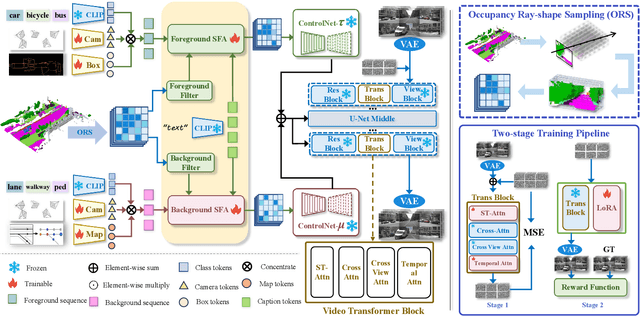

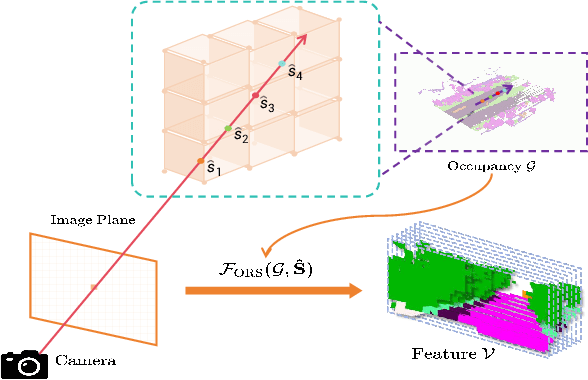
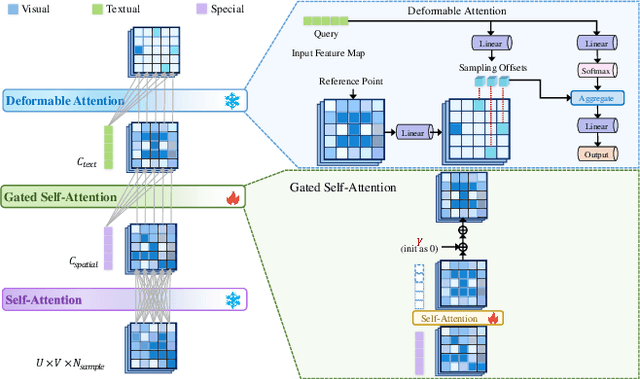
Accurate and high-fidelity driving scene reconstruction demands the effective utilization of comprehensive scene information as conditional inputs. Existing methods predominantly rely on 3D bounding boxes and BEV road maps for foreground and background control, which fail to capture the full complexity of driving scenes and adequately integrate multimodal information. In this work, we present DualDiff, a dual-branch conditional diffusion model designed to enhance driving scene generation across multiple views and video sequences. Specifically, we introduce Occupancy Ray-shape Sampling (ORS) as a conditional input, offering rich foreground and background semantics alongside 3D spatial geometry to precisely control the generation of both elements. To improve the synthesis of fine-grained foreground objects, particularly complex and distant ones, we propose a Foreground-Aware Mask (FGM) denoising loss function. Additionally, we develop the Semantic Fusion Attention (SFA) mechanism to dynamically prioritize relevant information and suppress noise, enabling more effective multimodal fusion. Finally, to ensure high-quality image-to-video generation, we introduce the Reward-Guided Diffusion (RGD) framework, which maintains global consistency and semantic coherence in generated videos. Extensive experiments demonstrate that DualDiff achieves state-of-the-art (SOTA) performance across multiple datasets. On the NuScenes dataset, DualDiff reduces the FID score by 4.09% compared to the best baseline. In downstream tasks, such as BEV segmentation, our method improves vehicle mIoU by 4.50% and road mIoU by 1.70%, while in BEV 3D object detection, the foreground mAP increases by 1.46%. Code will be made available at https://github.com/yangzhaojason/DualDiff.