 Add to Chrome
 Add to Firefox
 Add to Edge
Intuitionistic Fuzzy Graph Embedded Random Vector Functional Link with Multiview Learning
Jul 06, 2026
Random Vector Functional Link (RVFL) networks are popular due to their fast training and universal approximation capabilities. However, RVFL models face challenges in preserving geometric relationships and utilizing multiple feature views effectively. To address these limitations we propose the Intuitionistic Fuzzy Graph Embedded Random Vector Functional Link with Multiview Learning (IFGRVFL-MV) model. The proposed approach comprises three key components: intuitionistic fuzzy sets for uncertainty handling, graph embedding to capture intrinsic geometric structures, and multiview learning to use complementary information from multiple feature spaces. The model assigns intuitionistic fuzzy membership and non-membership values to data points making it robust to outliers. Also, the graph embedding framework preserves topological structures, increasing the generalization performance. We performed experiments on benchmark datasets from UCI and KEEL repositories which concludes that IFGRVFL-MV outperforms existing models in classification accuracy. Our results establish that IFGRVFL-MV is a promising advancement in the domain of uncertainty and multiview environments.

Graph-Guided Universum Learning in Generalized Eigenvalue Proximal SVMs for Alzheimer's Disease Classification
Jun 03, 2026Early and accurate detection of Alzheimer's disease (AD) is important for timely intervention and disease management. Generalized Eigenvalue Proximal Support Vector Machine (GEPSVM) and its Universum-based variants have shown promising results for AD classification. However, existing methods treat Universum samples as independent points and do not consider the geometric relationships among them. This paper proposes two graph-guided Universum learning models, namely UG-GEPSVM and IUG-GEPSVM, for AD versus cognitively normal (CN) classification using structural MRI data. In the proposed framework, mild cognitive impairment (MCI) subjects are used as Universum data to provide intermediate information between AD and CN classes. A graph is constructed over the Universum samples using Gaussian similarity, Minimum Spanning Tree connectivity, and multi-hop propagation. From this graph, a Laplacian matrix is derived that captures the geometric structure of the MCI samples. This Laplacian-based regularization is incorporated into the learning process in place of the conventional independent Universum penalty term. UG-GEPSVM integrates this regularization into the generalized eigenvalue formulation, while IUG-GEPSVM extends the numerically stable improved GEPSVM framework using a standard eigenvalue formulation. Experiments on ADNI MRI dataset variants using ICA- and PCA-based features at five different noise levels show that both proposed models consistently outperform existing GEPSVM and Universum-based methods. UG-GEPSVM achieves the highest average AUC of 88.07% and maintains stable performance under increasing noise levels. Statistical tests further confirm the significance of the observed improvements.
Deep Learning-Based Tracking and Lineage Reconstruction of Ligament Breakup
Apr 09, 2026The disintegration of liquid sheets into ligaments and droplets involves highly transient, multi-scale dynamics that are difficult to quantify from high-speed shadowgraphy images. Identifying droplets, ligaments, and blobs formed during breakup, along with tracking across frames, is essential for spray analysis. However, conventional multi-object tracking frameworks impose strict one-to-one temporal associations and cannot represent one-to-many fragmentation events. In this study, we present a two-stage deep learning framework for object detection and temporal relationship modeling across frames. The framework captures ligament deformation, fragmentation, and parent-child lineage during liquid sheet disintegration. In the first stage, a Faster R-CNN with a ResNet-50 backbone and Feature Pyramid Network detects and classifies ligaments and droplets in high-speed shadowgraphy recordings of an impinging Carbopol gel jet. A morphology-preserving synthetic data generation strategy augments the training set without introducing physically implausible configurations, achieving a held-out F1 score of up to 0.872 across fourteen original-to-synthetic configurations. In the second stage, a Transformer-augmented multilayer perceptron classifies inter-frame associations into continuation, fragmentation (one-to-many), and non-association using physics-informed geometric features. Despite severe class imbalance, the model achieves 86.1% accuracy, 93.2% precision, and perfect recall (1.00) for fragmentation events. Together, the framework enables automated reconstruction of fragmentation trees, preservation of parent-child lineage, and extraction of breakup statistics such as fragment multiplicity and droplet size distributions. By explicitly identifying children droplets formed from ligament fragmentation, the framework provides automated analysis of the primary atomization mode.
MINT: Multimodal Imaging-to-Speech Knowledge Transfer for Early Alzheimer's Screening
Feb 27, 2026Alzheimer's disease is a progressive neurodegenerative disorder in which mild cognitive impairment (MCI) marks a critical transition between aging and dementia. Neuroimaging modalities, such as structural MRI, provide biomarkers of this transition; however, their high costs and infrastructure needs limit their deployment at a population scale. Speech analysis offers a non-invasive alternative, but speech-only classifiers are developed independently of neuroimaging, leaving decision boundaries biologically ungrounded and limiting reliability on the subtle CN-versus-MCI distinction. We propose MINT (Multimodal Imaging-to-Speech Knowledge Transfer), a three-stage cross-modal framework that transfers biomarker structure from MRI into a speech encoder at training time. An MRI teacher, trained on 1,228 subjects, defines a compact neuroimaging embedding space for CN-versus-MCI classification. A residual projection head aligns speech representations to this frozen imaging manifold via a combined geometric loss, adapting speech to the learned biomarker space while preserving imaging encoder fidelity. The frozen MRI classifier, which is never exposed to speech, is applied to aligned embeddings at inference and requires no scanner. Evaluation on ADNI-4 shows aligned speech achieves performance comparable to speech-only baselines (AUC 0.720 vs 0.711) while requiring no imaging at inference, demonstrating that MRI-derived decision boundaries can ground speech representations. Multimodal fusion improves over MRI alone (0.973 vs 0.958). Ablation studies identify dropout regularization and self-supervised pretraining as critical design decisions. To our knowledge, this is the first demonstration of MRI-to-speech knowledge transfer for early Alzheimer's screening, establishing a biologically grounded pathway for population-level cognitive triage without neuroimaging at inference.
A Unified Framework for EEG Seizure Detection Using Universum-Integrated Generalized Eigenvalues Proximal Support Vector Machine
Dec 24, 2025The paper presents novel Universum-enhanced classifiers: the Universum Generalized Eigenvalue Proximal Support Vector Machine (U-GEPSVM) and the Improved U-GEPSVM (IU-GEPSVM) for EEG signal classification. Using the computational efficiency of generalized eigenvalue decomposition and the generalization benefits of Universum learning, the proposed models address critical challenges in EEG analysis: non-stationarity, low signal-to-noise ratio, and limited labeled data. U-GEPSVM extends the GEPSVM framework by incorporating Universum constraints through a ratio-based objective function, while IU-GEPSVM enhances stability through a weighted difference-based formulation that provides independent control over class separation and Universum alignment. The models are evaluated on the Bonn University EEG dataset across two binary classification tasks: (O vs S)-healthy (eyes closed) vs seizure, and (Z vs S)-healthy (eyes open) vs seizure. IU-GEPSVM achieves peak accuracies of 85% (O vs S) and 80% (Z vs S), with mean accuracies of 81.29% and 77.57% respectively, outperforming baseline methods.
MAVEN: Multi-modal Attention for Valence-Arousal Emotion Network
Mar 16, 2025This paper introduces MAVEN (Multi-modal Attention for Valence-Arousal Emotion Network), a novel architecture for dynamic emotion recognition through dimensional modeling of affect. The model uniquely integrates visual, audio, and textual modalities via a bi-directional cross-modal attention mechanism with six distinct attention pathways, enabling comprehensive interactions between all modality pairs. Our proposed approach employs modality-specific encoders to extract rich feature representations from synchronized video frames, audio segments, and transcripts. The architecture's novelty lies in its cross-modal enhancement strategy, where each modality representation is refined through weighted attention from other modalities, followed by self-attention refinement through modality-specific encoders. Rather than directly predicting valence-arousal values, MAVEN predicts emotions in a polar coordinate form, aligning with psychological models of the emotion circumplex. Experimental evaluation on the Aff-Wild2 dataset demonstrates the effectiveness of our approach, with performance measured using Concordance Correlation Coefficient (CCC). The multi-stage architecture demonstrates superior ability to capture the complex, nuanced nature of emotional expressions in conversational videos, advancing the state-of-the-art (SOTA) in continuous emotion recognition in-the-wild. Code can be found at: https://github.com/Vrushank-Ahire/MAVEN_8th_ABAW.
Granular Ball K-Class Twin Support Vector Classifier
Dec 06, 2024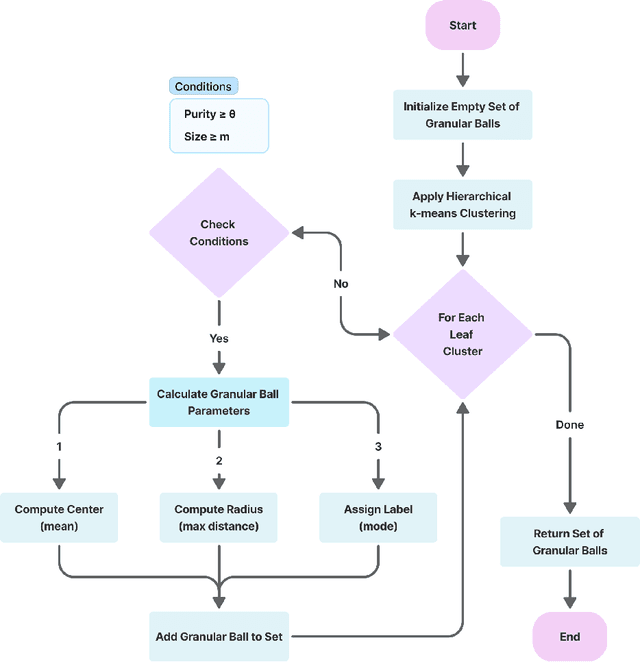
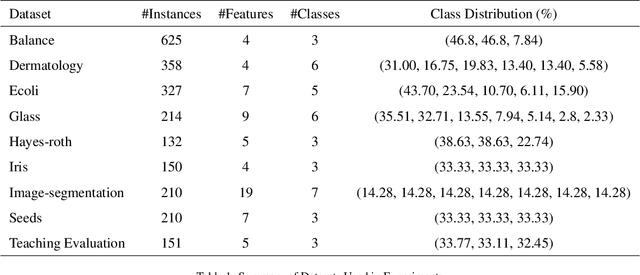
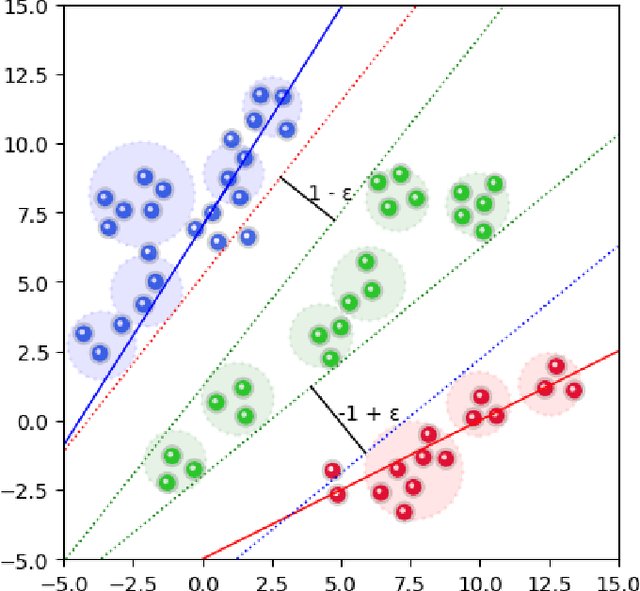
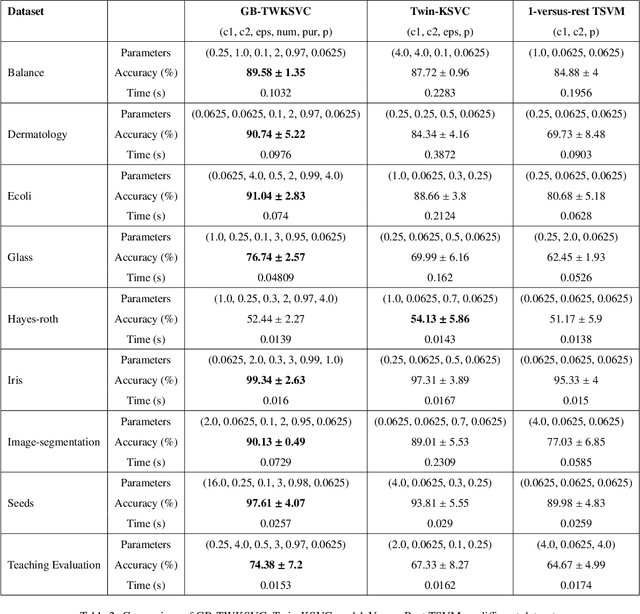
This paper introduces the Granular Ball K-Class Twin Support Vector Classifier (GB-TWKSVC), a novel multi-class classification framework that combines Twin Support Vector Machines (TWSVM) with granular ball computing. The proposed method addresses key challenges in multi-class classification by utilizing granular ball representation for improved noise robustness and TWSVM's non-parallel hyperplane architecture solves two smaller quadratic programming problems, enhancing efficiency. Our approach introduces a novel formulation that effectively handles multi-class scenarios, advancing traditional binary classification methods. Experimental evaluation on diverse benchmark datasets shows that GB-TWKSVC significantly outperforms current state-of-the-art classifiers in both accuracy and computational performance. The method's effectiveness is validated through comprehensive statistical tests and complexity analysis. Our work advances classification algorithms by providing a mathematically sound framework that addresses the scalability and robustness needs of modern machine learning applications. The results demonstrate GB-TWKSVC's broad applicability across domains including pattern recognition, fault diagnosis, and large-scale data analytics, establishing it as a valuable addition to the classification algorithm landscape.