 Add to Chrome
 Add to Firefox
 Add to Edge
Diffusion Model Driven Test-Time Image Adaptation for Robust Skin Lesion Classification
May 18, 2024
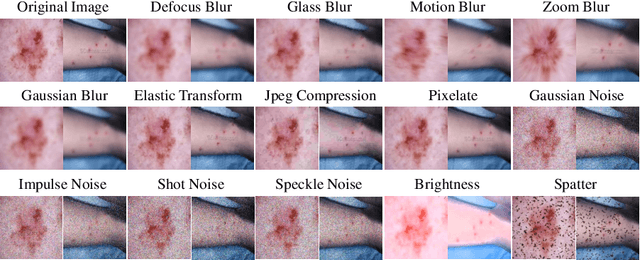
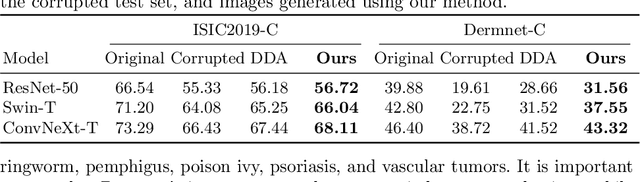
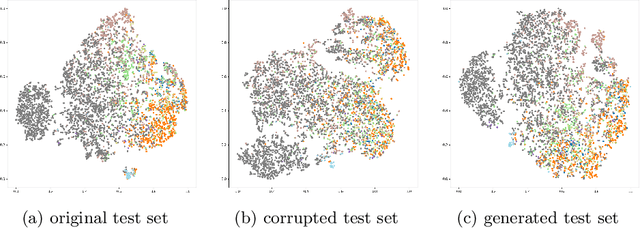
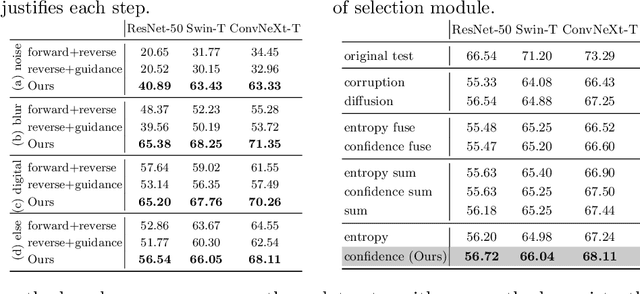
Deep learning-based diagnostic systems have demonstrated potential in skin disease diagnosis. However, their performance can easily degrade on test domains due to distribution shifts caused by input-level corruptions, such as imaging equipment variability, brightness changes, and image blur. This will reduce the reliability of model deployment in real-world scenarios. Most existing solutions focus on adapting the source model through retraining on different target domains. Although effective, this retraining process is sensitive to the amount of data and the hyperparameter configuration for optimization. In this paper, we propose a test-time image adaptation method to enhance the accuracy of the model on test data by simultaneously updating and predicting test images. We modify the target test images by projecting them back to the source domain using a diffusion model. Specifically, we design a structure guidance module that adds refinement operations through low-pass filtering during reverse sampling, regularizing the diffusion to preserve structural information. Additionally, we introduce a self-ensembling scheme automatically adjusts the reliance on adapted and unadapted inputs, enhancing adaptation robustness by rejecting inappropriate generative modeling results. To facilitate this study, we constructed the ISIC2019-C and Dermnet-C corruption robustness evaluation benchmarks. Extensive experiments on the proposed benchmarks demonstrate that our method makes the classifier more robust across various corruptions, architectures, and data regimes. Our datasets and code will be available at \url{https://github.com/minghu0830/Skin-TTA_Diffusion}.

Generalizing CLIP to Unseen Domain via Text-Guided Diverse Novel Feature Synthesis
May 04, 2024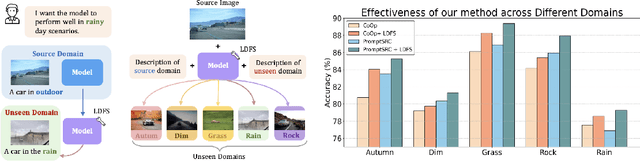
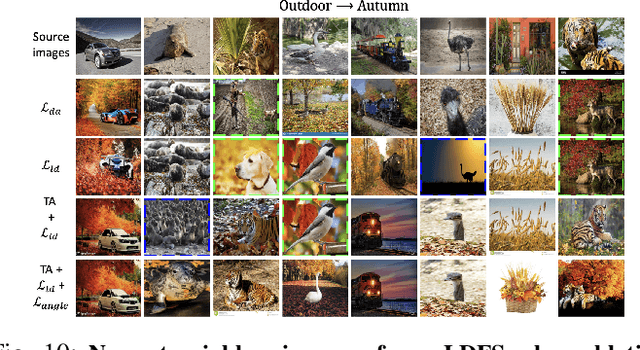
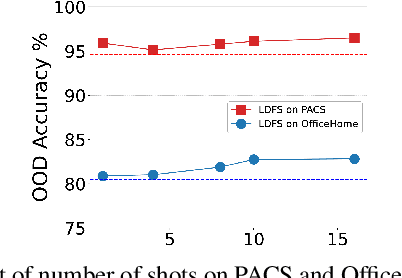
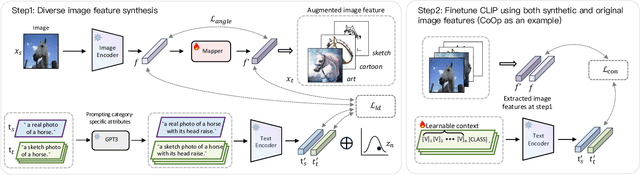
Vision-language foundation models like CLIP have shown impressive zero-shot generalization, but finetuning on downstream datasets can cause overfitting and loss of its generalization ability on unseen domains. Although collecting additional data from new domains of interest is possible, this method is often impractical due to the challenges in obtaining annotated data. To address this, we propose a plug-and-play feature augmentation method called LDFS (Language-Guided Diverse Feature Synthesis) to synthesize new domain features and improve existing CLIP fine-tuning strategies. LDFS has three main contributions: 1) To synthesize novel domain features and promote diversity, we propose an instance-conditional feature augmentation strategy based on a textguided feature augmentation loss. 2) To maintain feature quality after augmenting, we introduce a pairwise regularizer to preserve augmented feature coherence within the CLIP feature space. 3) We propose to use stochastic text feature augmentation to reduce the modality gap and further facilitate the process of text-guided feature synthesis. Extensive experiments show LDFS superiority in improving CLIP generalization ability on unseen domains without collecting data from those domains. The code will be made publicly available.
A Multimodal Feature Distillation with CNN-Transformer Network for Brain Tumor Segmentation with Incomplete Modalities
Apr 22, 2024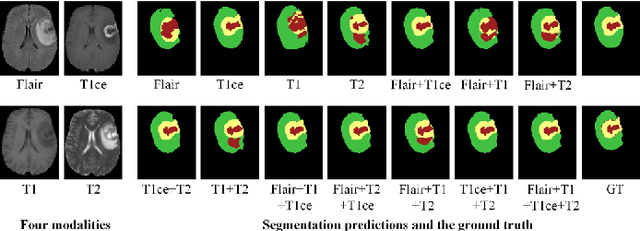
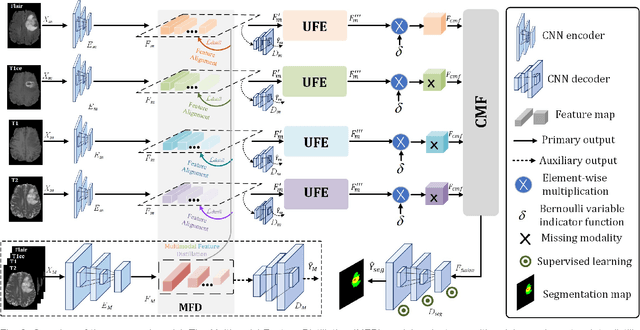
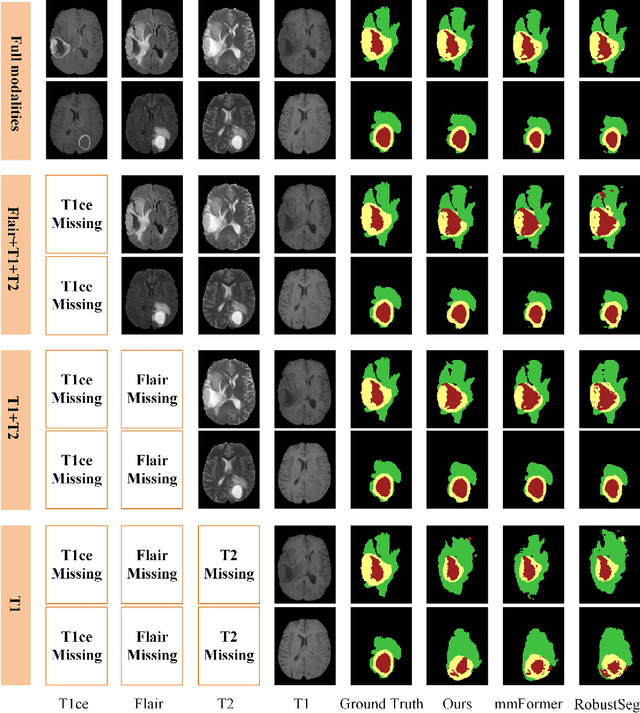
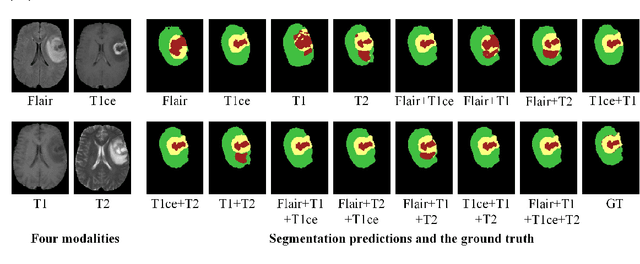
Existing brain tumor segmentation methods usually utilize multiple Magnetic Resonance Imaging (MRI) modalities in brain tumor images for segmentation, which can achieve better segmentation performance. However, in clinical applications, some modalities are missing due to resource constraints, leading to severe degradation in the performance of methods applying complete modality segmentation. In this paper, we propose a Multimodal feature distillation with Convolutional Neural Network (CNN)-Transformer hybrid network (MCTSeg) for accurate brain tumor segmentation with missing modalities. We first design a Multimodal Feature Distillation (MFD) module to distill feature-level multimodal knowledge into different unimodality to extract complete modality information. We further develop a Unimodal Feature Enhancement (UFE) module to model the relationship between global and local information semantically. Finally, we build a Cross-Modal Fusion (CMF) module to explicitly align the global correlations among different modalities even when some modalities are missing. Complementary features within and across different modalities are refined via the CNN-Transformer hybrid architectures in both the UFE and CMF modules, where local and global dependencies are both captured. Our ablation study demonstrates the importance of the proposed modules with CNN-Transformer networks and the convolutional blocks in Transformer for improving the performance of brain tumor segmentation with missing modalities. Extensive experiments on the BraTS2018 and BraTS2020 datasets show that the proposed MCTSeg framework outperforms the state-of-the-art methods in missing modalities cases. Our code is available at: https://github.com/mkang315/MCTSeg.
Diversified and Personalized Multi-rater Medical Image Segmentation
Mar 20, 2024Annotation ambiguity due to inherent data uncertainties such as blurred boundaries in medical scans and different observer expertise and preferences has become a major obstacle for training deep-learning based medical image segmentation models. To address it, the common practice is to gather multiple annotations from different experts, leading to the setting of multi-rater medical image segmentation. Existing works aim to either merge different annotations into the "groundtruth" that is often unattainable in numerous medical contexts, or generate diverse results, or produce personalized results corresponding to individual expert raters. Here, we bring up a more ambitious goal for multi-rater medical image segmentation, i.e., obtaining both diversified and personalized results. Specifically, we propose a two-stage framework named D-Persona (first Diversification and then Personalization). In Stage I, we exploit multiple given annotations to train a Probabilistic U-Net model, with a bound-constrained loss to improve the prediction diversity. In this way, a common latent space is constructed in Stage I, where different latent codes denote diversified expert opinions. Then, in Stage II, we design multiple attention-based projection heads to adaptively query the corresponding expert prompts from the shared latent space, and then perform the personalized medical image segmentation. We evaluated the proposed model on our in-house Nasopharyngeal Carcinoma dataset and the public lung nodule dataset (i.e., LIDC-IDRI). Extensive experiments demonstrated our D-Persona can provide diversified and personalized results at the same time, achieving new SOTA performance for multi-rater medical image segmentation. Our code will be released at https://github.com/ycwu1997/D-Persona.
EventRPG: Event Data Augmentation with Relevance Propagation Guidance
Mar 14, 2024



Event camera, a novel bio-inspired vision sensor, has drawn a lot of attention for its low latency, low power consumption, and high dynamic range. Currently, overfitting remains a critical problem in event-based classification tasks for Spiking Neural Network (SNN) due to its relatively weak spatial representation capability. Data augmentation is a simple but efficient method to alleviate overfitting and improve the generalization ability of neural networks, and saliency-based augmentation methods are proven to be effective in the image processing field. However, there is no approach available for extracting saliency maps from SNNs. Therefore, for the first time, we present Spiking Layer-Time-wise Relevance Propagation rule (SLTRP) and Spiking Layer-wise Relevance Propagation rule (SLRP) in order for SNN to generate stable and accurate CAMs and saliency maps. Based on this, we propose EventRPG, which leverages relevance propagation on the spiking neural network for more efficient augmentation. Our proposed method has been evaluated on several SNN structures, achieving state-of-the-art performance in object recognition tasks including N-Caltech101, CIFAR10-DVS, with accuracies of 85.62% and 85.55%, as well as action recognition task SL-Animals with an accuracy of 91.59%. Our code is available at https://github.com/myuansun/EventRPG.
Hunting Attributes: Context Prototype-Aware Learning for Weakly Supervised Semantic Segmentation
Mar 12, 2024Recent weakly supervised semantic segmentation (WSSS) methods strive to incorporate contextual knowledge to improve the completeness of class activation maps (CAM). In this work, we argue that the knowledge bias between instances and contexts affects the capability of the prototype to sufficiently understand instance semantics. Inspired by prototype learning theory, we propose leveraging prototype awareness to capture diverse and fine-grained feature attributes of instances. The hypothesis is that contextual prototypes might erroneously activate similar and frequently co-occurring object categories due to this knowledge bias. Therefore, we propose to enhance the prototype representation ability by mitigating the bias to better capture spatial coverage in semantic object regions. With this goal, we present a Context Prototype-Aware Learning (CPAL) strategy, which leverages semantic context to enrich instance comprehension. The core of this method is to accurately capture intra-class variations in object features through context-aware prototypes, facilitating the adaptation to the semantic attributes of various instances. We design feature distribution alignment to optimize prototype awareness, aligning instance feature distributions with dense features. In addition, a unified training framework is proposed to combine label-guided classification supervision and prototypes-guided self-supervision. Experimental results on PASCAL VOC 2012 and MS COCO 2014 show that CPAL significantly improves off-the-shelf methods and achieves state-of-the-art performance. The project is available at https://github.com/Barrett-python/CPAL.
Prompt-driven Latent Domain Generalization for Medical Image Classification
Jan 05, 2024
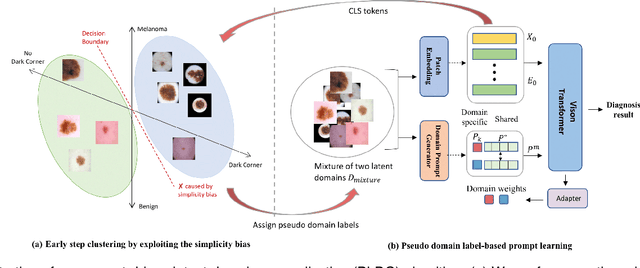


Deep learning models for medical image analysis easily suffer from distribution shifts caused by dataset artifacts bias, camera variations, differences in the imaging station, etc., leading to unreliable diagnoses in real-world clinical settings. Domain generalization (DG) methods, which aim to train models on multiple domains to perform well on unseen domains, offer a promising direction to solve the problem. However, existing DG methods assume domain labels of each image are available and accurate, which is typically feasible for only a limited number of medical datasets. To address these challenges, we propose a novel DG framework for medical image classification without relying on domain labels, called Prompt-driven Latent Domain Generalization (PLDG). PLDG consists of unsupervised domain discovery and prompt learning. This framework first discovers pseudo domain labels by clustering the bias-associated style features, then leverages collaborative domain prompts to guide a Vision Transformer to learn knowledge from discovered diverse domains. To facilitate cross-domain knowledge learning between different prompts, we introduce a domain prompt generator that enables knowledge sharing between domain prompts and a shared prompt. A domain mixup strategy is additionally employed for more flexible decision margins and mitigates the risk of incorrect domain assignments. Extensive experiments on three medical image classification tasks and one debiasing task demonstrate that our method can achieve comparable or even superior performance than conventional DG algorithms without relying on domain labels. Our code will be publicly available upon the paper is accepted.
Part to Whole: Collaborative Prompting for Surgical Instrument Segmentation
Dec 22, 2023Foundation models like the Segment Anything Model (SAM) have demonstrated promise in generic object segmentation. However, directly applying SAM to surgical instrument segmentation presents key challenges. First, SAM relies on per-frame point-or-box prompts which complicate surgeon-computer interaction. Also, SAM yields suboptimal performance on segmenting surgical instruments, owing to insufficient surgical data in its pre-training as well as the complex structure and fine-grained details of various surgical instruments. To address these challenges, in this paper, we investigate text promptable surgical instrument segmentation and propose SP-SAM (SurgicalPart-SAM), a novel efficient-tuning approach that integrates surgical instrument structure knowledge with the generic segmentation knowledge of SAM. Specifically, we achieve this by proposing (1) collaborative prompts in the text form "[part name] of [instrument category name]" that decompose instruments into fine-grained parts; (2) a Cross-Modal Prompt Encoder that encodes text prompts jointly with visual embeddings into discriminative part-level representations; and (3) a Part-to-Whole Selective Fusion and a Hierarchical Decoding strategy that selectively assemble the part-level representations into a whole for accurate instrument segmentation. Built upon them, SP-SAM acquires a better capability to comprehend surgical instrument structures and distinguish between various categories. Extensive experiments on both the EndoVis2018 and EndoVis2017 datasets demonstrate SP-SAM's state-of-the-art performance with minimal tunable parameters. Code is at https://github.com/wenxi-yue/SurgicalPart-SAM.
HGCLIP: Exploring Vision-Language Models with Graph Representations for Hierarchical Understanding
Nov 23, 2023
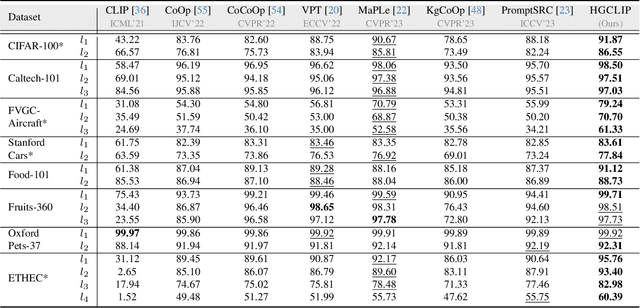

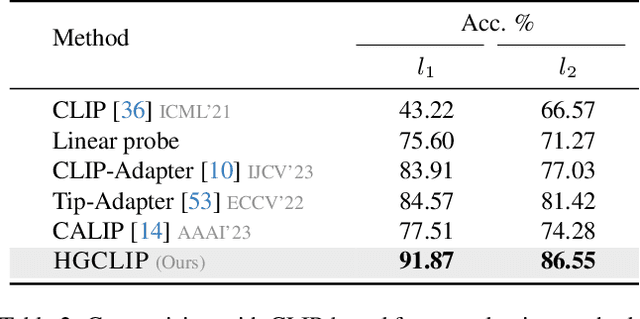
Object categories are typically organized into a multi-granularity taxonomic hierarchy. When classifying categories at different hierarchy levels, traditional uni-modal approaches focus primarily on image features, revealing limitations in complex scenarios. Recent studies integrating Vision-Language Models (VLMs) with class hierarchies have shown promise, yet they fall short of fully exploiting the hierarchical relationships. These efforts are constrained by their inability to perform effectively across varied granularity of categories. To tackle this issue, we propose a novel framework (HGCLIP) that effectively combines CLIP with a deeper exploitation of the Hierarchical class structure via Graph representation learning. We explore constructing the class hierarchy into a graph, with its nodes representing the textual or image features of each category. After passing through a graph encoder, the textual features incorporate hierarchical structure information, while the image features emphasize class-aware features derived from prototypes through the attention mechanism. Our approach demonstrates significant improvements on both generic and fine-grained visual recognition benchmarks. Our codes are fully available at https://github.com/richard-peng-xia/HGCLIP.
Revamping AI Models in Dermatology: Overcoming Critical Challenges for Enhanced Skin Lesion Diagnosis
Nov 02, 2023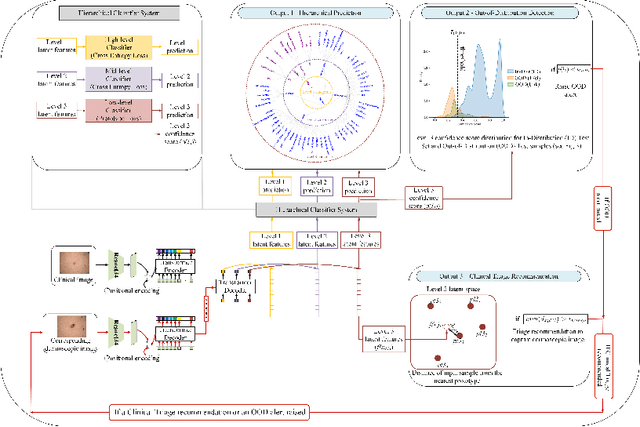
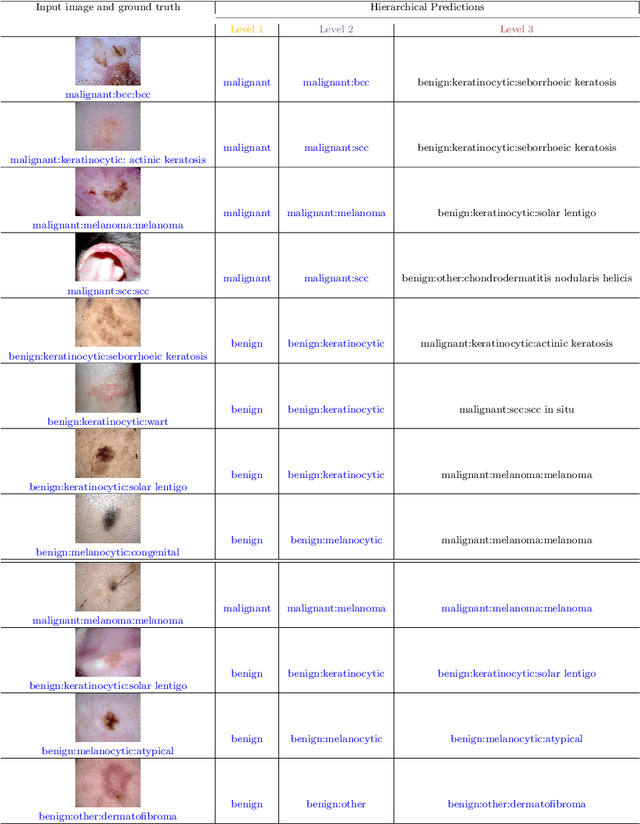
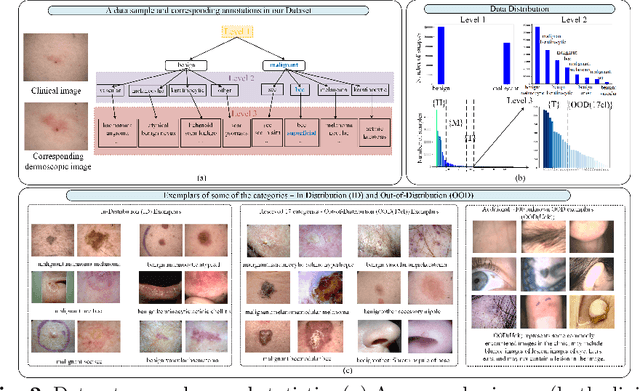
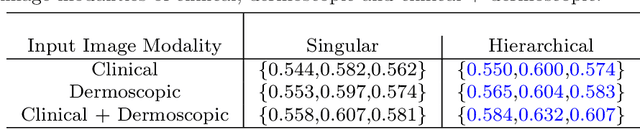
The surge in developing deep learning models for diagnosing skin lesions through image analysis is notable, yet their clinical black faces challenges. Current dermatology AI models have limitations: limited number of possible diagnostic outputs, lack of real-world testing on uncommon skin lesions, inability to detect out-of-distribution images, and over-reliance on dermoscopic images. To address these, we present an All-In-One \textbf{H}ierarchical-\textbf{O}ut of Distribution-\textbf{C}linical Triage (HOT) model. For a clinical image, our model generates three outputs: a hierarchical prediction, an alert for out-of-distribution images, and a recommendation for dermoscopy if clinical image alone is insufficient for diagnosis. When the recommendation is pursued, it integrates both clinical and dermoscopic images to deliver final diagnosis. Extensive experiments on a representative cutaneous lesion dataset demonstrate the effectiveness and synergy of each component within our framework. Our versatile model provides valuable decision support for lesion diagnosis and sets a promising precedent for medical AI applications.