 Add to Chrome
 Add to Firefox
 Add to Edge
Dynamic Execution Commitment of Vision-Language-Action Models
May 12, 2026
Vision-Language-Action (VLA) models predominantly adopt action chunking, i.e., predicting and committing to a short horizon of consecutive low-level actions in a single forward pass, to amortize the inference cost of large-scale backbones and reduce per-step latency. However, committing these multi-step predictions to real-world execution requires balancing success rate against inference efficiency, a decision typically governed by fixed execution horizons tuned per task. Such heuristics ignore the state-dependent nature of predictive reliability, leading to brittle performance in dynamic or out-of-distribution settings. In this paper, we introduce A3, an Adaptive Action Acceptance mechanism that reframes dynamic execution commitment as a self-speculative prefix verification problem. A3 first computes a trajectory-wise consensus score of actions via group sampling, then selects a representative draft and prioritizes downstream verification. Specifically, it enforces: (1) consensus-ordered conditional invariance, which validates low-consensus actions by judging whether they remain consistent when re-decoded conditioned on high-consensus actions; and (2) prefix-closed sequential consistency, which guarantees physical rollout integrity by accepting only the longest continuous sequence of verified actions starting from the beginning. Consequently, the execution horizon emerges as the longest verifiable prefix satisfying both internal model logic and sequential execution constraints. Experiments across diverse VLA models and benchmarks demonstrate that A3 eliminates the need for manual horizon tuning while achieving a superior trade-off between execution robustness and inference throughput.

AdamFlow: Adam-based Wasserstein Gradient Flows for Surface Registration in Medical Imaging
Apr 02, 2026Surface registration plays an important role for anatomical shape analysis in medical imaging. Existing surface registration methods often face a trade-off between efficiency and robustness. Local point matching methods are computationally efficient, but vulnerable to noise and initialisation. Methods designed for global point set alignment tend to incur a high computational cost. To address the challenge, here we present a fast surface registration method, which formulates surface meshes as probability measures and surface registration as a distributional optimisation problem. The discrepancy between two meshes is measured using an efficient sliced Wasserstein distance with log-linear computational complexity. We propose a novel optimisation method, AdamFlow, which generalises the well-known Adam optimisation method from the Euclidean space to the probability space for minimising the sliced Wasserstein distance. We theoretically analyse the asymptotic convergence of AdamFlow and empirically demonstrate its superior performance in both affine and non-rigid surface registration across various anatomical structures.
Learning a dynamic four-chamber shape model of the human heart for 95,695 UK Biobank participants
Mar 30, 2026The human heart is a sophisticated system composed of four cardiac chambers with distinct shapes, which function in a coordinated manner. Existing shape models of the heart mainly focus on the ventricular chambers and they are derived from relatively small datasets. Here, we present a spatio-temporal (3D+t) statistical shape model of all four cardiac chambers, learnt from a large population of nearly 100,000 participants from the UK Biobank. A deep learning-based pipeline is developed to reconstruct 3D+t four-chamber meshes from the cardiac magnetic resonance images of the UK Biobank imaging population. Based on the reconstructed meshes, a 3D+t statistical shape model is learnt to characterise the shape variations and motion patterns of the four cardiac chambers. We reveal the associations of the four-chamber shape model with demographics, anthropometrics, cardiovascular risk factors, and cardiac diseases. Compared to conventional image-derived phenotypes, we validate that the four-chamber shape-derived phenotypes significantly enhance the performance in downstream tasks, including cardiovascular disease classification and heart age prediction. Furthermore, we demonstrate the effectiveness of shape-derived phenotypes in novel applications such as heart shape retrieval and heart re-identification from longitudinal data. To facilitate future research, we will release the learning-based mesh reconstruction pipeline, the four-chamber cardiac shape model, and return all derived four-chamber meshes to the UK Biobank.
Project Imaging-X: A Survey of 1000+ Open-Access Medical Imaging Datasets for Foundation Model Development
Mar 29, 2026Foundation models have demonstrated remarkable success across diverse domains and tasks, primarily due to the thrive of large-scale, diverse, and high-quality datasets. However, in the field of medical imaging, the curation and assembling of such medical datasets are highly challenging due to the reliance on clinical expertise and strict ethical and privacy constraints, resulting in a scarcity of large-scale unified medical datasets and hindering the development of powerful medical foundation models. In this work, we present the largest survey to date of medical image datasets, covering over 1,000 open-access datasets with a systematic catalog of their modalities, tasks, anatomies, annotations, limitations, and potential for integration. Our analysis exposes a landscape that is modest in scale, fragmented across narrowly scoped tasks, and unevenly distributed across organs and modalities, which in turn limits the utility of existing medical image datasets for developing versatile and robust medical foundation models. To turn fragmentation into scale, we propose a metadata-driven fusion paradigm (MDFP) that integrates public datasets with shared modalities or tasks, thereby transforming multiple small data silos into larger, more coherent resources. Building on MDFP, we release an interactive discovery portal that enables end-to-end, automated medical image dataset integration, and compile all surveyed datasets into a unified, structured table that clearly summarizes their key characteristics and provides reference links, offering the community an accessible and comprehensive repository. By charting the current terrain and offering a principled path to dataset consolidation, our survey provides a practical roadmap for scaling medical imaging corpora, supporting faster data discovery, more principled dataset creation, and more capable medical foundation models.
SegRap2025: A Benchmark of Gross Tumor Volume and Lymph Node Clinical Target Volume Segmentation for Radiotherapy Planning of Nasopharyngeal Carcinoma
Jan 28, 2026Accurate delineation of Gross Tumor Volume (GTV), Lymph Node Clinical Target Volume (LN CTV), and Organ-at-Risk (OAR) from Computed Tomography (CT) scans is essential for precise radiotherapy planning in Nasopharyngeal Carcinoma (NPC). Building upon SegRap2023, which focused on OAR and GTV segmentation using single-center paired non-contrast CT (ncCT) and contrast-enhanced CT (ceCT) scans, the SegRap2025 challenge aims to enhance the generalizability and robustness of segmentation models across imaging centers and modalities. SegRap2025 comprises two tasks: Task01 addresses GTV segmentation using paired CT from the SegRap2023 dataset, with an additional external testing set to evaluate cross-center generalization, and Task02 focuses on LN CTV segmentation using multi-center training data and an unseen external testing set, where each case contains paired CT scans or a single modality, emphasizing both cross-center and cross-modality robustness. This paper presents the challenge setup and provides a comprehensive analysis of the solutions submitted by ten participating teams. For GTV segmentation task, the top-performing models achieved average Dice Similarity Coefficient (DSC) of 74.61% and 56.79% on the internal and external testing cohorts, respectively. For LN CTV segmentation task, the highest average DSC values reached 60.24%, 60.50%, and 57.23% on paired CT, ceCT-only, and ncCT-only subsets, respectively. SegRap2025 establishes a large-scale multi-center, multi-modality benchmark for evaluating the generalization and robustness in radiotherapy target segmentation, providing valuable insights toward clinically applicable automated radiotherapy planning systems. The benchmark is available at: https://hilab-git.github.io/SegRap2025_Challenge.
PAINT: Pathology-Aware Integrated Next-Scale Transformation for Virtual Immunohistochemistry
Jan 22, 2026Virtual immunohistochemistry (IHC) aims to computationally synthesize molecular staining patterns from routine Hematoxylin and Eosin (H\&E) images, offering a cost-effective and tissue-efficient alternative to traditional physical staining. However, this task is particularly challenging: H\&E morphology provides ambiguous cues about protein expression, and similar tissue structures may correspond to distinct molecular states. Most existing methods focus on direct appearance synthesis to implicitly achieve cross-modal generation, often resulting in semantic inconsistencies due to insufficient structural priors. In this paper, we propose Pathology-Aware Integrated Next-Scale Transformation (PAINT), a visual autoregressive framework that reformulates the synthesis process as a structure-first conditional generation task. Unlike direct image translation, PAINT enforces a causal order by resolving molecular details conditioned on a global structural layout. Central to this approach is the introduction of a Spatial Structural Start Map (3S-Map), which grounds the autoregressive initialization in observed morphology, ensuring deterministic, spatially aligned synthesis. Experiments on the IHC4BC and MIST datasets demonstrate that PAINT outperforms state-of-the-art methods in structural fidelity and clinical downstream tasks, validating the potential of structure-guided autoregressive modeling.
SAM-aware Test-time Adaptation for Universal Medical Image Segmentation
Jun 05, 2025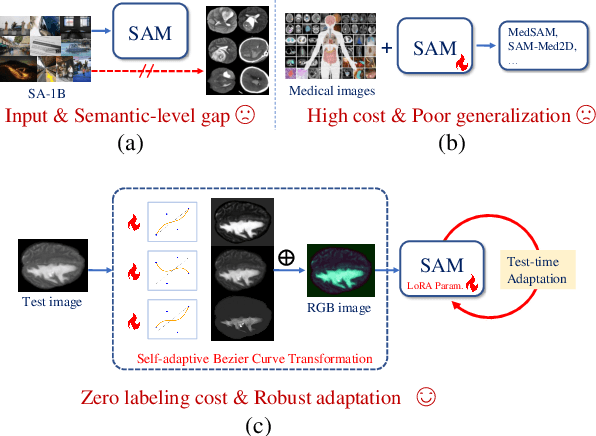
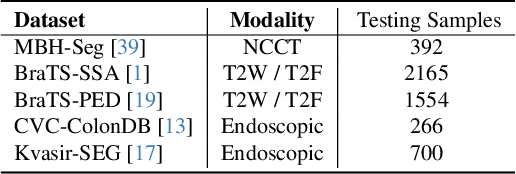
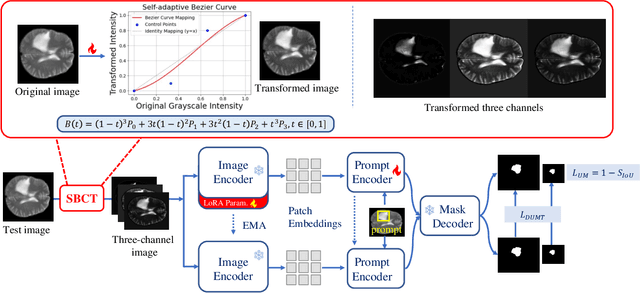
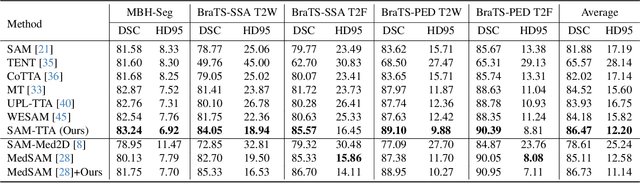
Universal medical image segmentation using the Segment Anything Model (SAM) remains challenging due to its limited adaptability to medical domains. Existing adaptations, such as MedSAM, enhance SAM's performance in medical imaging but at the cost of reduced generalization to unseen data. Therefore, in this paper, we propose SAM-aware Test-Time Adaptation (SAM-TTA), a fundamentally different pipeline that preserves the generalization of SAM while improving its segmentation performance in medical imaging via a test-time framework. SAM-TTA tackles two key challenges: (1) input-level discrepancies caused by differences in image acquisition between natural and medical images and (2) semantic-level discrepancies due to fundamental differences in object definition between natural and medical domains (e.g., clear boundaries vs. ambiguous structures). Specifically, our SAM-TTA framework comprises (1) Self-adaptive Bezier Curve-based Transformation (SBCT), which adaptively converts single-channel medical images into three-channel SAM-compatible inputs while maintaining structural integrity, to mitigate the input gap between medical and natural images, and (2) Dual-scale Uncertainty-driven Mean Teacher adaptation (DUMT), which employs consistency learning to align SAM's internal representations to medical semantics, enabling efficient adaptation without auxiliary supervision or expensive retraining. Extensive experiments on five public datasets demonstrate that our SAM-TTA outperforms existing TTA approaches and even surpasses fully fine-tuned models such as MedSAM in certain scenarios, establishing a new paradigm for universal medical image segmentation. Code can be found at https://github.com/JianghaoWu/SAM-TTA.
CodeBrain: Impute Any Brain MRI via Instance-specific Scalar-quantized Codes
Jan 30, 2025MRI imputation aims to synthesize the missing modality from one or more available ones, which is highly desirable since it reduces scanning costs and delivers comprehensive MRI information to enhance clinical diagnosis. In this paper, we propose a unified model, CodeBrain, designed to adapt to various brain MRI imputation scenarios. The core design lies in casting various inter-modality transformations as a full-modality code prediction task. To this end, CodeBrain is trained in two stages: Reconstruction and Code Prediction. First, in the Reconstruction stage, we reconstruct each MRI modality, which is mapped into a shared latent space followed by a scalar quantization. Since such quantization is lossy and the code is low dimensional, another MRI modality belonging to the same subject is randomly selected to generate common features to supplement the code and boost the target reconstruction. In the second stage, we train another encoder by a customized grading loss to predict the full-modality codes from randomly masked MRI samples, supervised by the corresponding quantized codes generated from the first stage. In this way, the inter-modality transformation is achieved by mapping the instance-specific codes in a finite scalar space. We evaluated the proposed CodeBrain model on two public brain MRI datasets (i.e., IXI and BraTS 2023). Extensive experiments demonstrate that our CodeBrain model achieves superior imputation performance compared to four existing methods, establishing a new state of the art for unified brain MRI imputation. Codes will be released.
Cycle-Consistent Bridge Diffusion Model for Accelerated MRI Reconstruction
Dec 13, 2024


Accelerated MRI reconstruction techniques aim to reduce examination time while maintaining high image fidelity, which is highly desirable in clinical settings for improving patient comfort and hospital efficiency. Existing deep learning methods typically reconstruct images from under-sampled data with traditional reconstruction approaches, but they still struggle to provide high-fidelity results. Diffusion models show great potential to improve fidelity of generated images in recent years. However, their inference process starting with a random Gaussian noise introduces instability into the results and usually requires thousands of sampling steps, resulting in sub-optimal reconstruction quality and low efficiency. To address these challenges, we propose Cycle-Consistent Bridge Diffusion Model (CBDM). CBDM employs two bridge diffusion models to construct a cycle-consistent diffusion process with a consistency loss, enhancing the fine-grained details of reconstructed images and reducing the number of diffusion steps. Moreover, CBDM incorporates a Contourlet Decomposition Embedding Module (CDEM) which captures multi-scale structural texture knowledge in images through frequency domain decomposition pyramids and directional filter banks to improve structural fidelity. Extensive experiments demonstrate the superiority of our model by higher reconstruction quality and fewer training iterations, achieving a new state of the art for accelerated MRI reconstruction in both fastMRI and IXI datasets.
Cross Group Attention and Group-wise Rolling for Multimodal Medical Image Synthesis
Nov 22, 2024Multimodal MR image synthesis aims to generate missing modality image by fusing and mapping a few available MRI data. Most existing approaches typically adopt an image-to-image translation scheme. However, these methods often suffer from sub-optimal performance due to the spatial misalignment between different modalities while they are typically treated as input channels. Therefore, in this paper, we propose an Adaptive Group-wise Interaction Network (AGI-Net) that explores both inter-modality and intra-modality relationships for multimodal MR image synthesis. Specifically, groups are first pre-defined along the channel dimension and then we perform an adaptive rolling for the standard convolutional kernel to capture inter-modality spatial correspondences. At the same time, a cross-group attention module is introduced to fuse information across different channel groups, leading to better feature representation. We evaluated the effectiveness of our model on the publicly available IXI and BraTS2023 datasets, where the AGI-Net achieved state-of-the-art performance for multimodal MR image synthesis. Code will be released.