 Add to Chrome
 Add to Firefox
 Add to Edge
TradingMoE: Routing the Right Experts in Evolving Markets
Aug 12, 2026
Large language models (LLMs) have shown strong potential for financial analysis and trading, but direct trading remains challenging because the predictive capabilities required can vary across assets, decision fields, and market conditions. Existing LLM-based trading systems either coordinate human-defined external experts or adopt conventional internal Mixture-of-Experts (MoE) routers that do not directly evaluate how individual experts contribute to trading decisions. Moreover, these routers receive no direct signal indicating when an inactive expert has become more suitable as market conditions change. We find that native router scores poorly reflect how much individual experts improve trading decisions, frequently leaving better alternatives unselected. We further reveal that token-specific expert usefulness exhibits a compact low-dimensional structure. Based on these findings, we propose TradingMoE, a trading-oriented sparse MoE that augments a frozen dense LLM with lightweight residual experts. We introduce a Query-Key router that represents the expertise required by each token under the current market context as a low-dimensional query and matches it with learnable expert keys. We further propose a sparse expert selection update mechanism that samples a few inactive experts during training and estimates whether they should replace the weakest expert in the current Top-k route. This mechanism enables the router to update expert selection as market conditions change while preserving sparse computation. Experiments against 22 baselines on stock and cryptocurrency markets show that TradingMoE improves cumulative return over the best-performing baselines by 30.89% and 30.7%, respectively. Rolling paper-trading experiments further demonstrate that its advantage persists under forward-only deployment.

Dynamic Graph Prompting via Topology-Routed Mixed-Curvature Experts
Aug 06, 2026Dynamic graph prompting freezes a pre-trained temporal backbone and adapts it to label-scarce downstream tasks using lightweight prompts. However, existing methods operate within a single, fixed embedding space. In this work, we reveal that temporal shifts in local clustering and degree heterogeneity actively reorganize the edge curvature spectrum---indicating that the optimal representation geometry dynamically evolves with local topology over time. We formalize this unaddressed mismatch as geometry under-adaptation. To overcome this limitation, we propose CurvPrompt, a topology-routed geometry prompting framework for dynamic graphs. Instead of relying on a single space, CurvPrompt maintains a bank of curvature-diverse Riemannian experts, each paired with a learnable prompt. A topology-aware gate dynamically routes each node--time instance to a sparse subset of experts, constructing a personalized mixed-curvature representation. To ensure parameter efficiency and training stability under extreme label scarcity, CurvPrompt employs soft routing during pre-training to build a continuous topology--geometry mapping, and transitions to hard Top-K routing with uniform weights during downstream adaptation. Extensive experiments across four benchmark datasets show that CurvPrompt significantly advances few-shot link prediction while delivering strong, consistent performance on node classification tasks, validating the necessity of geometry-adaptive prompting.
HyperClaim: Fine-Grained Cross-Modal Hypergraph Reasoning for Video Misinformation Detection
Jul 30, 2026Video misinformation detection is often approached through global multimodal fusion or free-form multimodal reasoning. Both paradigms can under-represent localized authenticity cues that arise from coupled interactions among query phrases, contextual text, and short temporal spans of frames. Because such interactions are inherently higher-order, pairwise graph formulations are insufficient to capture multi-way cross-modal dependencies, whereas hypergraphs offer a suitable representation for these relations. We propose HyperClaim, a discriminative temporal hypergraph framework for sample-level authenticity classification. Using the title or benchmark-provided paired text as a claim-like query, HyperClaim constructs a sparse heterogeneous hypergraph over query tokens, evidence tokens, and sampled frames; applies confidence-aware filtering and source budgeting to form compact text-frame and short-range temporal evidence units; performs adaptive soft-incidence reasoning with residual text-video calibration; and aggregates textual, visual, and hyperedge states through a discrepancy-aware readout. Without relying on generated rationales or external tool calls, HyperClaim preserves fine-grained cross-modal and temporal structure that global fusion tends to flatten. Under the FactGuard temporal protocol, it achieves 83.7%, 82.0%, and 87.3% accuracy on FakeSV, FakeTT, and FakeVV, respectively, outperforming strong discriminative and reasoning-centric baselines. Learned incidence and attention weights further reveal token- and frame-level structure.
Clustering as Reasoning: A $k$-Means Interpretation of Chain-of-Thought Graph Learning
May 24, 2026Chain-of-Thought (CoT) prompting has shown promise in enhancing the reasoning capabilities of large language models (LLMs) on text-attributed graphs (TAGs). This work reframes CoT-based graph learning through the principle of clustering as reasoning, offering a $k$-means interpretation of how iterative reasoning operates over graph-structured data. We observe that existing graph CoT methods rely on disjoint architectures and fixed graph representations, limiting step-by-step semantic-topological interaction and interpretability. To overcome this limitation, we propose a unified framework named KCoT that integrates CoT reasoning with graph representation learning. Our key theoretical result reveals a formal mathematical correspondence between a Transformer block and the $k$-means algorithm, allowing reasoning to be interpreted as iterative assignment and update steps. Based on this insight, we introduce a Semantic Discriminating Prompt that explicitly formulates these steps as structured CoT reasoning, together with a structure-grounded alignment strategy to fuse topological priors with evolving thought-conditioned representations. Experiments on standard benchmarks demonstrate consistent improvements over state-of-the-art methods, validating clustering as a principled mechanism for CoT-based graph learning.
PrimeKG-CL: A Continual Graph Learning Benchmark on Evolving Biomedical Knowledge Graphs
May 11, 2026Biomedical knowledge graphs underwrite drug repurposing and clinical decision support, yet the upstream ontologies they depend on update on independent cycles that add millions of edges and deprecate hundreds of thousands more between releases. Yet existing continual graph learning has been studied almost exclusively on synthetic random splits of static, generic KGs, a regime that cannot reproduce the asynchronous, structured evolution real biomedical KGs undergo. To this end, we introduce PrimeKG-CL, a CGL benchmark built from nine authoritative biomedical databases (129K+ nodes, 8.1M+ edges, 10 node types, 30 relation types) with two genuine temporal snapshots (June 2021, July 2023; 5.83M edges added, 889K removed, 7.21M persistent), 10 entity-type-grouped tasks, multimodal node features, and a per-task persistent/added/removed test stratification. On three tasks (biomedical relationship prediction, entity classification, KGQA), we evaluate six CL strategies across four KGE decoders, plus LKGE, an LLM-RAG agent, and CMKL. We find that decoder choice and continual learning strategy interact strongly: no single strategy performs best across all decoders, and mismatched combinations can significantly degrade performance. Moreover, only DistMult exhibits a clear separation between persistent and deprecated knowledge, indicating that standard metrics conflate retention of still-valid facts with failure to forget outdated ones; this effect is absent under RotatE. In addition, multimodal features improve entity-level tasks by up to 60%, and a recent CKGE framework (IncDE) failed to scale to our 5.67M-triple base task across five attempts up to 350GB RAM. Data, pipeline, baselines, and the stratified split are released openly. Dataset:huggingface.co/datasets/yradwan147/PrimeKGCL|Code:github.com/yradwan147/primekg-cl-neurips2026
UrbanGraphEmbeddings: Learning and Evaluating Spatially Grounded Multimodal Embeddings for Urban Science
Feb 09, 2026Learning transferable multimodal embeddings for urban environments is challenging because urban understanding is inherently spatial, yet existing datasets and benchmarks lack explicit alignment between street-view images and urban structure. We introduce UGData, a spatially grounded dataset that anchors street-view images to structured spatial graphs and provides graph-aligned supervision via spatial reasoning paths and spatial context captions, exposing distance, directionality, connectivity, and neighborhood context beyond image content. Building on UGData, we propose UGE, a two-stage training strategy that progressively and stably aligns images, text, and spatial structures by combining instruction-guided contrastive learning with graph-based spatial encoding. We finally introduce UGBench, a comprehensive benchmark to evaluate how spatially grounded embeddings support diverse urban understanding tasks -- including geolocation ranking, image retrieval, urban perception, and spatial grounding. We develop UGE on multiple state-of-the-art VLM backbones, including Qwen2-VL, Qwen2.5-VL, Phi-3-Vision, and LLaVA1.6-Mistral, and train fixed-dimensional spatial embeddings with LoRA tuning. UGE built upon Qwen2.5-VL-7B backbone achieves up to 44% improvement in image retrieval and 30% in geolocation ranking on training cities, and over 30% and 22% gains respectively on held-out cities, demonstrating the effectiveness of explicit spatial grounding for spatially intensive urban tasks.
MolGA: Molecular Graph Adaptation with Pre-trained 2D Graph Encoder
Oct 08, 2025Molecular graph representation learning is widely used in chemical and biomedical research. While pre-trained 2D graph encoders have demonstrated strong performance, they overlook the rich molecular domain knowledge associated with submolecular instances (atoms and bonds). While molecular pre-training approaches incorporate such knowledge into their pre-training objectives, they typically employ designs tailored to a specific type of knowledge, lacking the flexibility to integrate diverse knowledge present in molecules. Hence, reusing widely available and well-validated pre-trained 2D encoders, while incorporating molecular domain knowledge during downstream adaptation, offers a more practical alternative. In this work, we propose MolGA, which adapts pre-trained 2D graph encoders to downstream molecular applications by flexibly incorporating diverse molecular domain knowledge. First, we propose a molecular alignment strategy that bridge the gap between pre-trained topological representations with domain-knowledge representations. Second, we introduce a conditional adaptation mechanism that generates instance-specific tokens to enable fine-grained integration of molecular domain knowledge for downstream tasks. Finally, we conduct extensive experiments on eleven public datasets, demonstrating the effectiveness of MolGA.
Taming Recommendation Bias with Causal Intervention on Evolving Personal Popularity
May 20, 2025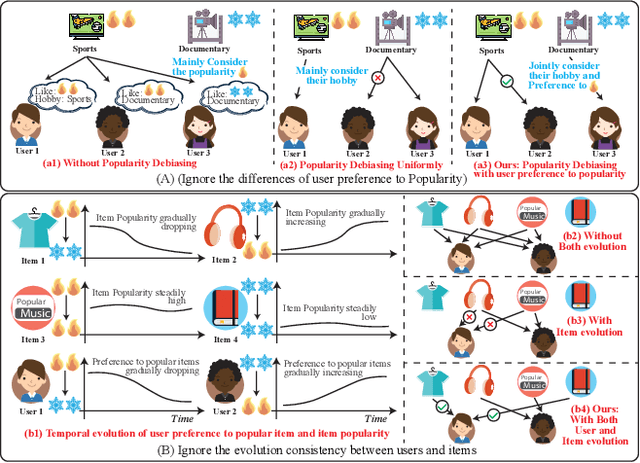
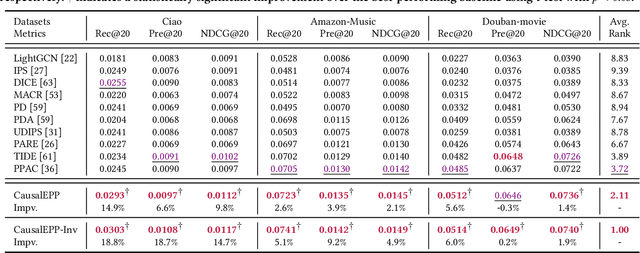
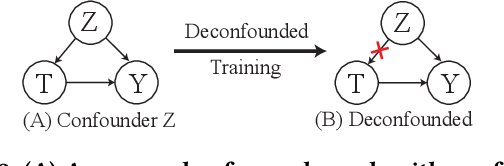
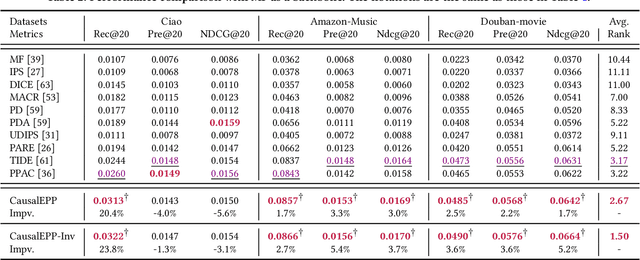
Popularity bias occurs when popular items are recommended far more frequently than they should be, negatively impacting both user experience and recommendation accuracy. Existing debiasing methods mitigate popularity bias often uniformly across all users and only partially consider the time evolution of users or items. However, users have different levels of preference for item popularity, and this preference is evolving over time. To address these issues, we propose a novel method called CausalEPP (Causal Intervention on Evolving Personal Popularity) for taming recommendation bias, which accounts for the evolving personal popularity of users. Specifically, we first introduce a metric called {Evolving Personal Popularity} to quantify each user's preference for popular items. Then, we design a causal graph that integrates evolving personal popularity into the conformity effect, and apply deconfounded training to mitigate the popularity bias of the causal graph. During inference, we consider the evolution consistency between users and items to achieve a better recommendation. Empirical studies demonstrate that CausalEPP outperforms baseline methods in reducing popularity bias while improving recommendation accuracy.
GCoT: Chain-of-Thought Prompt Learning for Graphs
Feb 12, 2025Chain-of-thought (CoT) prompting has achieved remarkable success in natural language processing (NLP). However, its vast potential remains largely unexplored for graphs. This raises an interesting question: How can we design CoT prompting for graphs to guide graph models to learn step by step? On one hand, unlike natural languages, graphs are non-linear and characterized by complex topological structures. On the other hand, many graphs lack textual data, making it difficult to formulate language-based CoT prompting. In this work, we propose the first CoT prompt learning framework for text-free graphs, GCoT. Specifically, we decompose the adaptation process for each downstream task into a series of inference steps, with each step consisting of prompt-based inference, ``thought'' generation, and thought-conditioned prompt learning. While the steps mimic CoT prompting in NLP, the exact mechanism differs significantly. Specifically, at each step, an input graph, along with a prompt, is first fed into a pre-trained graph encoder for prompt-based inference. We then aggregate the hidden layers of the encoder to construct a ``thought'', which captures the working state of each node in the current step. Conditioned on this thought, we learn a prompt specific to each node based on the current state. These prompts are fed into the next inference step, repeating the cycle. To evaluate and analyze the effectiveness of GCoT, we conduct comprehensive experiments on eight public datasets, which demonstrate the advantage of our approach.
SAMGPT: Text-free Graph Foundation Model for Multi-domain Pre-training and Cross-domain Adaptation
Feb 08, 2025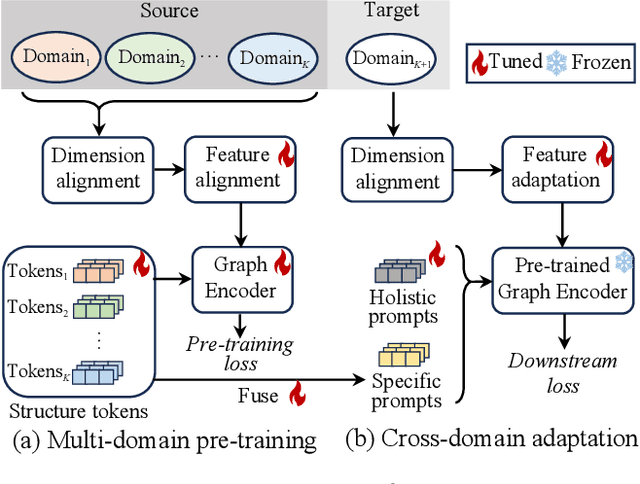
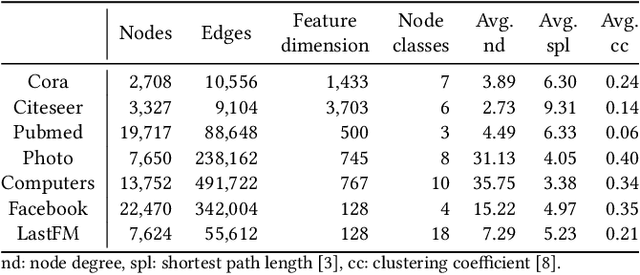
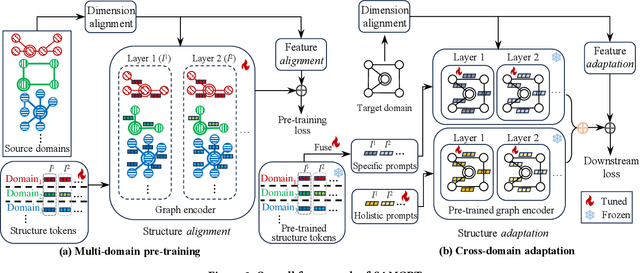
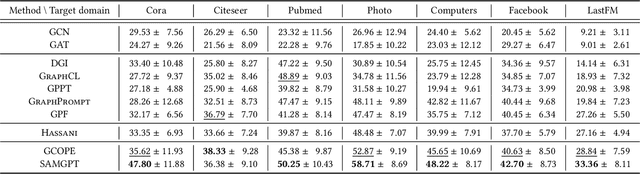
Graphs are able to model interconnected entities in many online services, supporting a wide range of applications on the Web. This raises an important question: How can we train a graph foundational model on multiple source domains and adapt to an unseen target domain? A major obstacle is that graphs from different domains often exhibit divergent characteristics. Some studies leverage large language models to align multiple domains based on textual descriptions associated with the graphs, limiting their applicability to text-attributed graphs. For text-free graphs, a few recent works attempt to align different feature distributions across domains, while generally neglecting structural differences. In this work, we propose a novel Structure Alignment framework for text-free Multi-domain Graph Pre-Training and cross-domain adaptation (SAMGPT). It is designed to learn multi-domain knowledge from graphs originating in multiple source domains, which can then be adapted to address applications in an unseen target domain. Specifically, we introduce a set of structure tokens to harmonize structure-based aggregation across source domains during the pre-training phase. Next, for cross-domain adaptation, we design dual prompts, namely, holistic prompts and specific prompts, which adapt unified multi-domain structural knowledge and fine-grained, domain-specific information, respectively, to a target domain. Finally, we conduct comprehensive experiments on seven public datasets to evaluate and analyze the effectiveness of SAMGPT.