 Add to Chrome
 Add to Firefox
 Add to Edge
SpikingMOT: A Spike-Driven Multi-Object Tracker
Jul 22, 2026
Multi-object tracking (MOT) plays a fundamental role in visual perception, where accurate trajectory prediction is essential for reliable target association under complex motion patterns. Recent trackers have improved motion modeling with densely activated artificial neural networks, yet they largely overlook whether such dense responses are necessary for trajectory prediction. In this paper, we formulate activation sparsity preference (ASP) by tackling two key questions: 1. How can we identify a model architecture that appropriately and formally explains ASP, and 2. How can we translate this explanation into competitive tracking performance. Theoretical analysis shows that sparse gating is no worse than state-independent dropout under the same activation rate. Based on this insight, SpikingMOT is proposed as a spike-driven tracker that adaptively models sparse trajectory dynamics with spiking neural networks (SNNs). Specifically, SpikingMOT decomposes each trajectory state into pseudo-trajectory bases and uses the current prediction error to calibrate the posterior for next-frame prediction. With this brain-inspired loop, SpikingMOT achieves state-of-the-art performance in extensive experiments, 74.9 HOTA on SportsMOT and 56.5 HOTA on DanceTrack, while reducing the parameters and energy by 72% and 86.7%, respectively. These results bring SNNs into MOT, opening a promising direction for efficient tracking.

MVP-Tac: A Miniaturized Dual-Modal Vision and Photoelastic Tactile Sensor for Robot-Assisted Minimally Invasive Surgery
Jul 21, 2026Robot-assisted minimally invasive surgery (RMIS) offers major benefits over open and conventional laparoscopic procedures, yet it still lacks tactile feedback for palpation while operating under strict requirements to preserve reliable vision for navigation and safety. In practice, visual feedback is indispensable, and tactile solutions that cannot coexist with vision are difficult to translate into RMIS tools. To address both needs, we introduce MVP-Tac, a compact, vision-based tactile sensor that provides co-located vision and tactile sensing. MVP-Tac uses reflective photoelastic imaging: a thin photoelastic elastomer produces stress-dependent interferograms under contact that are captured by an embedded camera through a miniaturized reflective polariscope. A semi-transparent membrane and controllable illumination enable switching between visual mode and tactile mode, enabling tactile perception without sacrificing vision. We validate MVP-Tac through force calibration in the 0 to 2 N range and demonstrate its potential for tumor palpation via video-based hardness classification on tissue phantoms, achieving 97% accuracy for exposed-tumor classification and 92% accuracy for subdermal-tumor classification. Finally, we conduct a simulated colonoscopy to validate both visual and tactile modalities in a constrained lumen, including vision-guided 3D photomapping of the luminal wall and in situ hardness classification of localized nodules. Overall, MVP-Tac provides a practical path toward restoring clinically useful palpation in RMIS while maintaining essential visual feedback. The design, fabrication, and firmware of MVP-Tac are open-sourced at https://mvp-tac.github.io/
Error Amplification Limits ANN-to-SNN Conversion in Continuous Control
Jan 29, 2026Spiking Neural Networks (SNNs) can achieve competitive performance by converting already existing well-trained Artificial Neural Networks (ANNs), avoiding further costly training. This property is particularly attractive in Reinforcement Learning (RL), where training through environment interaction is expensive and potentially unsafe. However, existing conversion methods perform poorly in continuous control, where suitable baselines are largely absent. We identify error amplification as the key cause: small action approximation errors become temporally correlated across decision steps, inducing cumulative state distribution shift and severe performance degradation. To address this issue, we propose Cross-Step Residual Potential Initialization (CRPI), a lightweight training-free mechanism that carries over residual membrane potentials across decision steps to suppress temporally correlated errors. Experiments on continuous control benchmarks with both vector and visual observations demonstrate that CRPI can be integrated into existing conversion pipelines and substantially recovers lost performance. Our results highlight continuous control as a critical and challenging benchmark for ANN-to-SNN conversion, where small errors can be strongly amplified and impact performance.
General Self-Prediction Enhancement for Spiking Neurons
Jan 29, 2026Spiking Neural Networks (SNNs) are highly energy-efficient due to event-driven, sparse computation, but their training is challenged by spike non-differentiability and trade-offs among performance, efficiency, and biological plausibility. Crucially, mainstream SNNs ignore predictive coding, a core cortical mechanism where the brain predicts inputs and encodes errors for efficient perception. Inspired by this, we propose a self-prediction enhanced spiking neuron method that generates an internal prediction current from its input-output history to modulate membrane potential. This design offers dual advantages, it creates a continuous gradient path that alleviates vanishing gradients and boosts training stability and accuracy, while also aligning with biological principles, which resembles distal dendritic modulation and error-driven synaptic plasticity. Experiments show consistent performance gains across diverse architectures, neuron types, time steps, and tasks demonstrating broad applicability for enhancing SNNs.
Unlearning of Knowledge Graph Embedding via Preference Optimization
Jul 28, 2025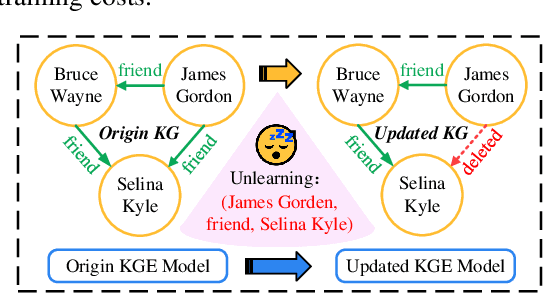
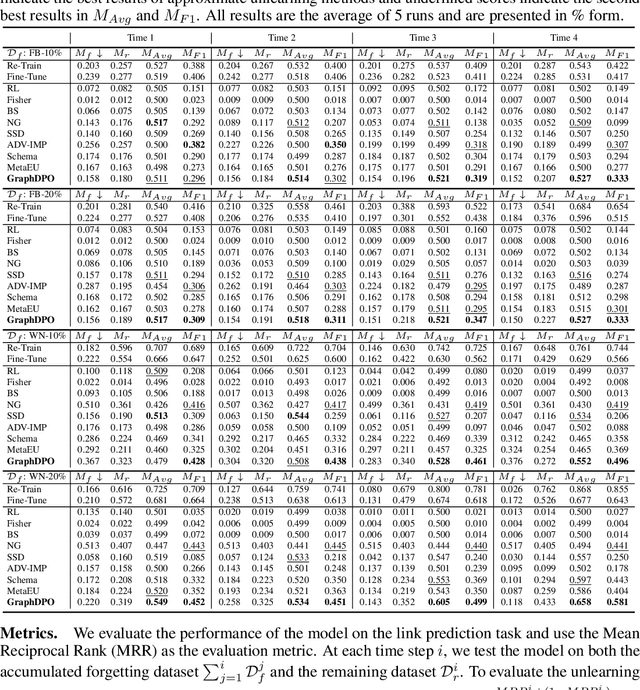
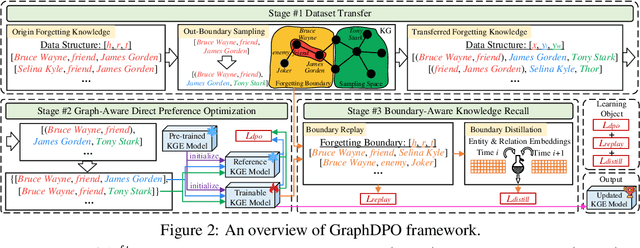
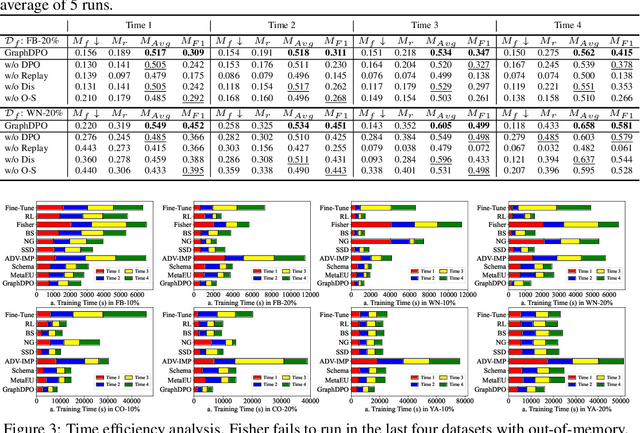
Existing knowledge graphs (KGs) inevitably contain outdated or erroneous knowledge that needs to be removed from knowledge graph embedding (KGE) models. To address this challenge, knowledge unlearning can be applied to eliminate specific information while preserving the integrity of the remaining knowledge in KGs. Existing unlearning methods can generally be categorized into exact unlearning and approximate unlearning. However, exact unlearning requires high training costs while approximate unlearning faces two issues when applied to KGs due to the inherent connectivity of triples: (1) It fails to fully remove targeted information, as forgetting triples can still be inferred from remaining ones. (2) It focuses on local data for specific removal, which weakens the remaining knowledge in the forgetting boundary. To address these issues, we propose GraphDPO, a novel approximate unlearning framework based on direct preference optimization (DPO). Firstly, to effectively remove forgetting triples, we reframe unlearning as a preference optimization problem, where the model is trained by DPO to prefer reconstructed alternatives over the original forgetting triples. This formulation penalizes reliance on forgettable knowledge, mitigating incomplete forgetting caused by KG connectivity. Moreover, we introduce an out-boundary sampling strategy to construct preference pairs with minimal semantic overlap, weakening the connection between forgetting and retained knowledge. Secondly, to preserve boundary knowledge, we introduce a boundary recall mechanism that replays and distills relevant information both within and across time steps. We construct eight unlearning datasets across four popular KGs with varying unlearning rates. Experiments show that GraphDPO outperforms state-of-the-art baselines by up to 10.1% in MRR_Avg and 14.0% in MRR_F1.
Proxy Target: Bridging the Gap Between Discrete Spiking Neural Networks and Continuous Control
May 30, 2025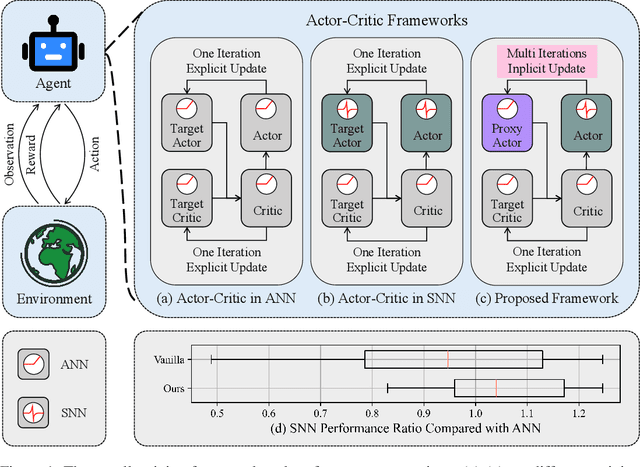
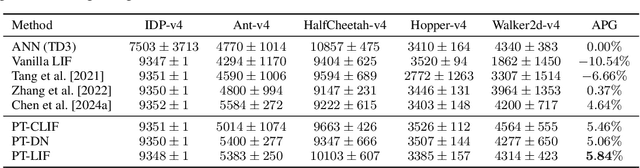
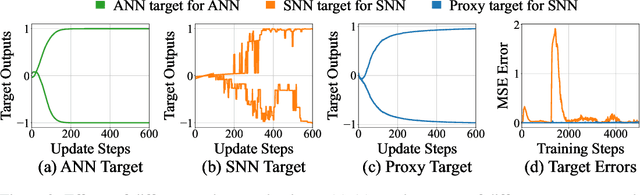

Spiking Neural Networks (SNNs) offer low-latency and energy-efficient decision making through neuromorphic hardware, making them compelling for Reinforcement Learning (RL) in resource-constrained edge devices. Recent studies in this field directly replace Artificial Neural Networks (ANNs) by SNNs in existing RL frameworks, overlooking whether the RL algorithm is suitable for SNNs. However, most RL algorithms in continuous control are designed tailored to ANNs, including the target network soft updates mechanism, which conflict with the discrete, non-differentiable dynamics of SNN spikes. We identify that this mismatch destabilizes SNN training in continuous control tasks. To bridge this gap between discrete SNN and continuous control, we propose a novel proxy target framework. The continuous and differentiable dynamics of the proxy target enable smooth updates, bypassing the incompatibility of SNN spikes, stabilizing the RL algorithms. Since the proxy network operates only during training, the SNN retains its energy efficiency during deployment without inference overhead. Extensive experiments on continuous control benchmarks demonstrate that compared to vanilla SNNs, the proxy target framework enables SNNs to achieve up to 32% higher performance across different spiking neurons. Notably, we are the first to surpass ANN performance in continuous control with simple Leaky-Integrate-and-Fire (LIF) neurons. This work motivates a new class of SNN-friendly RL algorithms tailored to SNN's characteristics, paving the way for neuromorphic agents that combine high performance with low power consumption.
Comprehensive Online Training and Deployment for Spiking Neural Networks
Oct 10, 2024Spiking Neural Networks (SNNs) are considered to have enormous potential in the future development of Artificial Intelligence (AI) due to their brain-inspired and energy-efficient properties. In the current supervised learning domain of SNNs, compared to vanilla Spatial-Temporal Back-propagation (STBP) training, online training can effectively overcome the risk of GPU memory explosion and has received widespread academic attention. However, the current proposed online training methods cannot tackle the inseparability problem of temporal dependent gradients and merely aim to optimize the training memory, resulting in no performance advantages compared to the STBP training models in the inference phase. To address the aforementioned challenges, we propose Efficient Multi-Precision Firing (EM-PF) model, which is a family of advanced spiking models based on floating-point spikes and binary synaptic weights. We point out that EM-PF model can effectively separate temporal gradients and achieve full-stage optimization towards computation speed and memory footprint. Experimental results have demonstrated that EM-PF model can be flexibly combined with various techniques including random back-propagation, parallel computation and channel attention mechanism, to achieve state-of-the-art performance with extremely low computational overhead in the field of online learning.
Fast and Continual Knowledge Graph Embedding via Incremental LoRA
Jul 08, 2024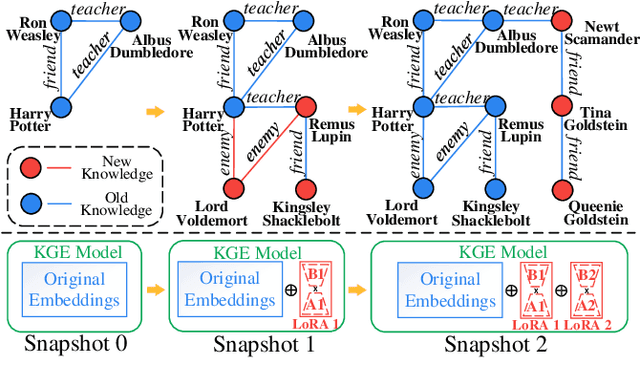
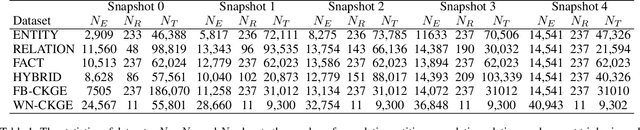


Continual Knowledge Graph Embedding (CKGE) aims to efficiently learn new knowledge and simultaneously preserve old knowledge. Dominant approaches primarily focus on alleviating catastrophic forgetting of old knowledge but neglect efficient learning for the emergence of new knowledge. However, in real-world scenarios, knowledge graphs (KGs) are continuously growing, which brings a significant challenge to fine-tuning KGE models efficiently. To address this issue, we propose a fast CKGE framework (\model), incorporating an incremental low-rank adapter (\mec) mechanism to efficiently acquire new knowledge while preserving old knowledge. Specifically, to mitigate catastrophic forgetting, \model\ isolates and allocates new knowledge to specific layers based on the fine-grained influence between old and new KGs. Subsequently, to accelerate fine-tuning, \model\ devises an efficient \mec\ mechanism, which embeds the specific layers into incremental low-rank adapters with fewer training parameters. Moreover, \mec\ introduces adaptive rank allocation, which makes the LoRA aware of the importance of entities and adjusts its rank scale adaptively. We conduct experiments on four public datasets and two new datasets with a larger initial scale. Experimental results demonstrate that \model\ can reduce training time by 34\%-49\% while still achieving competitive link prediction performance against state-of-the-art models on four public datasets (average MRR score of 21.0\% vs. 21.1\%).Meanwhile, on two newly constructed datasets, \model\ saves 51\%-68\% training time and improves link prediction performance by 1.5\%.
STBench: Assessing the Ability of Large Language Models in Spatio-Temporal Analysis
Jun 27, 2024

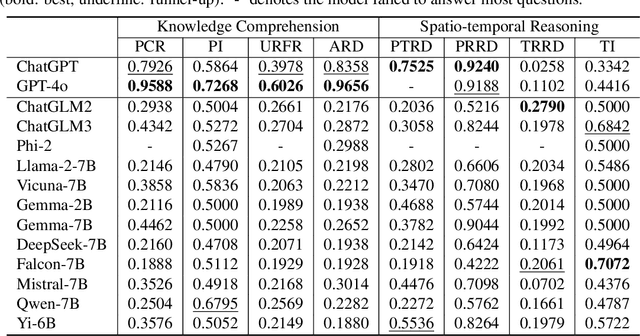

The rapid evolution of large language models (LLMs) holds promise for reforming the methodology of spatio-temporal data mining. However, current works for evaluating the spatio-temporal understanding capability of LLMs are somewhat limited and biased. These works either fail to incorporate the latest language models or only focus on assessing the memorized spatio-temporal knowledge. To address this gap, this paper dissects LLMs' capability of spatio-temporal data into four distinct dimensions: knowledge comprehension, spatio-temporal reasoning, accurate computation, and downstream applications. We curate several natural language question-answer tasks for each category and build the benchmark dataset, namely STBench, containing 13 distinct tasks and over 60,000 QA pairs. Moreover, we have assessed the capabilities of 13 LLMs, such as GPT-4o, Gemma and Mistral. Experimental results reveal that existing LLMs show remarkable performance on knowledge comprehension and spatio-temporal reasoning tasks, with potential for further enhancement on other tasks through in-context learning, chain-of-though prompting, and fine-tuning. The code and datasets of STBench are released on https://github.com/LwbXc/STBench.
Meta In-Context Learning Makes Large Language Models Better Zero and Few-Shot Relation Extractors
Apr 27, 2024


Relation extraction (RE) is an important task that aims to identify the relationships between entities in texts. While large language models (LLMs) have revealed remarkable in-context learning (ICL) capability for general zero and few-shot learning, recent studies indicate that current LLMs still struggle with zero and few-shot RE. Previous studies are mainly dedicated to design prompt formats and select good examples for improving ICL-based RE. Although both factors are vital for ICL, if one can fundamentally boost the ICL capability of LLMs in RE, the zero and few-shot RE performance via ICL would be significantly improved. To this end, we introduce \textsc{Micre} (\textbf{M}eta \textbf{I}n-\textbf{C}ontext learning of LLMs for \textbf{R}elation \textbf{E}xtraction), a new meta-training framework for zero and few-shot RE where an LLM is tuned to do ICL on a diverse collection of RE datasets (i.e., learning to learn in context for RE). Through meta-training, the model becomes more effectively to learn a new RE task in context by conditioning on a few training examples with no parameter updates or task-specific templates at inference time, enabling better zero and few-shot task generalization. We experiment \textsc{Micre} on various LLMs with different model scales and 12 public RE datasets, and then evaluate it on unseen RE benchmarks under zero and few-shot settings. \textsc{Micre} delivers comparable or superior performance compared to a range of baselines including supervised fine-tuning and typical in-context learning methods. We find that the gains are particular significant for larger model scales, and using a diverse set of the meta-training RE datasets is key to improvements. Empirically, we show that \textsc{Micre} can transfer the relation semantic knowledge via relation label name during inference on target RE datasets.