 Add to Chrome
 Add to Firefox
 Add to Edge
MVP-Tac: A Miniaturized Dual-Modal Vision and Photoelastic Tactile Sensor for Robot-Assisted Minimally Invasive Surgery
Jul 21, 2026
Robot-assisted minimally invasive surgery (RMIS) offers major benefits over open and conventional laparoscopic procedures, yet it still lacks tactile feedback for palpation while operating under strict requirements to preserve reliable vision for navigation and safety. In practice, visual feedback is indispensable, and tactile solutions that cannot coexist with vision are difficult to translate into RMIS tools. To address both needs, we introduce MVP-Tac, a compact, vision-based tactile sensor that provides co-located vision and tactile sensing. MVP-Tac uses reflective photoelastic imaging: a thin photoelastic elastomer produces stress-dependent interferograms under contact that are captured by an embedded camera through a miniaturized reflective polariscope. A semi-transparent membrane and controllable illumination enable switching between visual mode and tactile mode, enabling tactile perception without sacrificing vision. We validate MVP-Tac through force calibration in the 0 to 2 N range and demonstrate its potential for tumor palpation via video-based hardness classification on tissue phantoms, achieving 97% accuracy for exposed-tumor classification and 92% accuracy for subdermal-tumor classification. Finally, we conduct a simulated colonoscopy to validate both visual and tactile modalities in a constrained lumen, including vision-guided 3D photomapping of the luminal wall and in situ hardness classification of localized nodules. Overall, MVP-Tac provides a practical path toward restoring clinically useful palpation in RMIS while maintaining essential visual feedback. The design, fabrication, and firmware of MVP-Tac are open-sourced at https://mvp-tac.github.io/

SMARTmBOT: A ROS2-based Low-cost and Open-source Mobile Robot Platform
Mar 16, 2022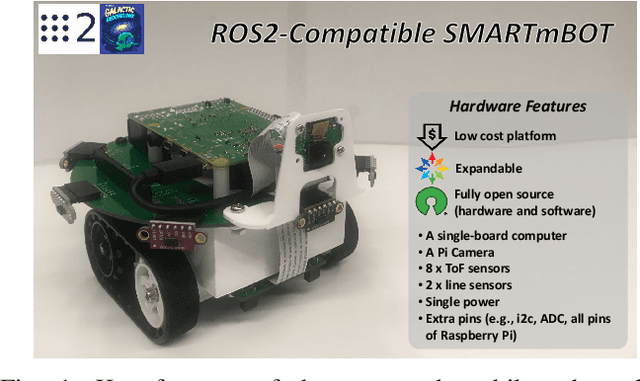
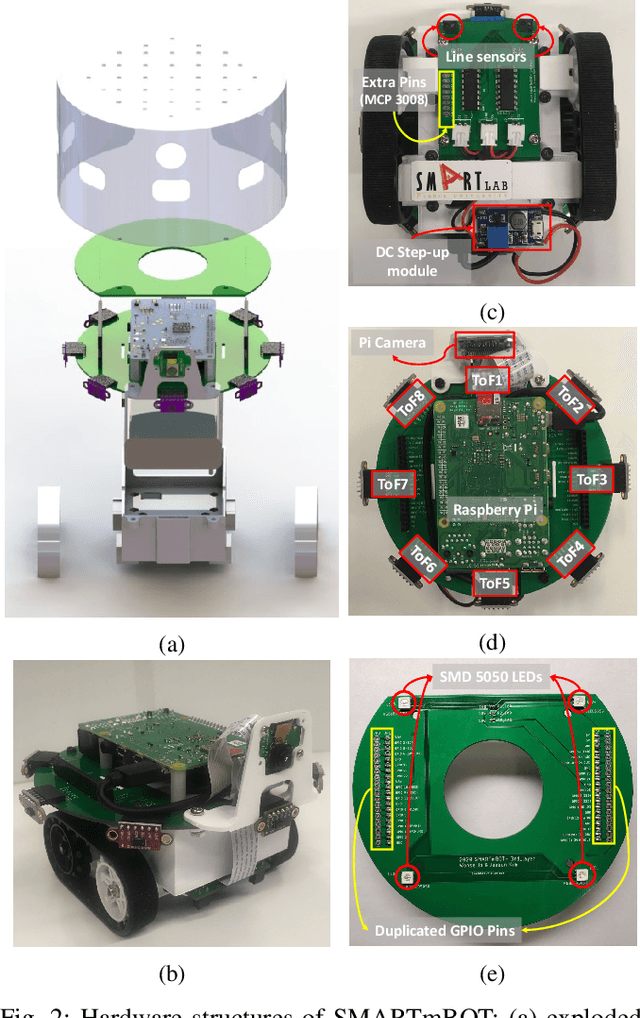
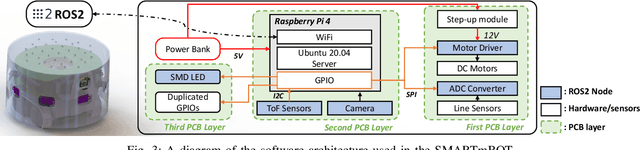
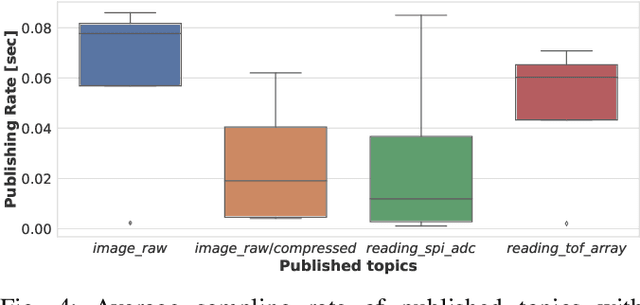
This paper introduces SMARTmBOT, an open-source mobile robot platform based on Robot Operating System 2 (ROS2). The characteristics of the SMARTmBOT, including low-cost, modular-typed, customizable and expandable design, make it an easily achievable and effective robot platform to support broad robotics research and education involving either single-robot or multi-robot systems. The total cost per robot is approximately $210, and most hardware components can be fabricated by a generic 3D printer, hence allowing users to build the robots or replace any broken parts conveniently. The SMARTmBot is also equipped with a rich range of sensors, making it competent for general task scenarios, such as point-to-point navigation and obstacle avoidance. We validated the mobility and function of SMARTmBOT through various robot navigation experiments and applications with tasks including go-to-goal, pure-pursuit, line following, and swarming. All source code necessary for reading sensors, streaming from an embedded camera, and controlling the robot including robot navigation controllers is available through an online repository that can be found at https://github.com/SMARTlab-Purdue/SMARTmBOT.
Toward a Wearable Biosensor Ecosystem on ROS 2 for Real-time Human-Robot Interaction Systems
Oct 08, 2021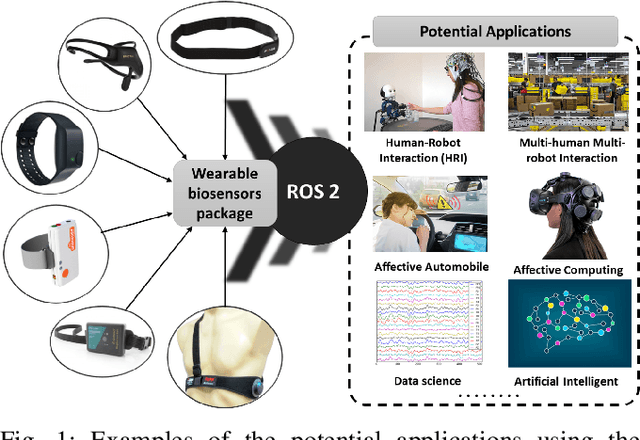
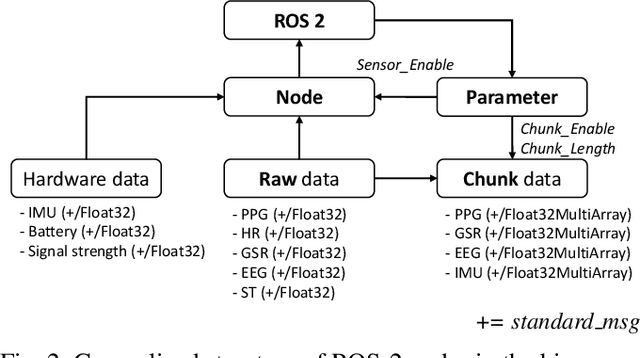
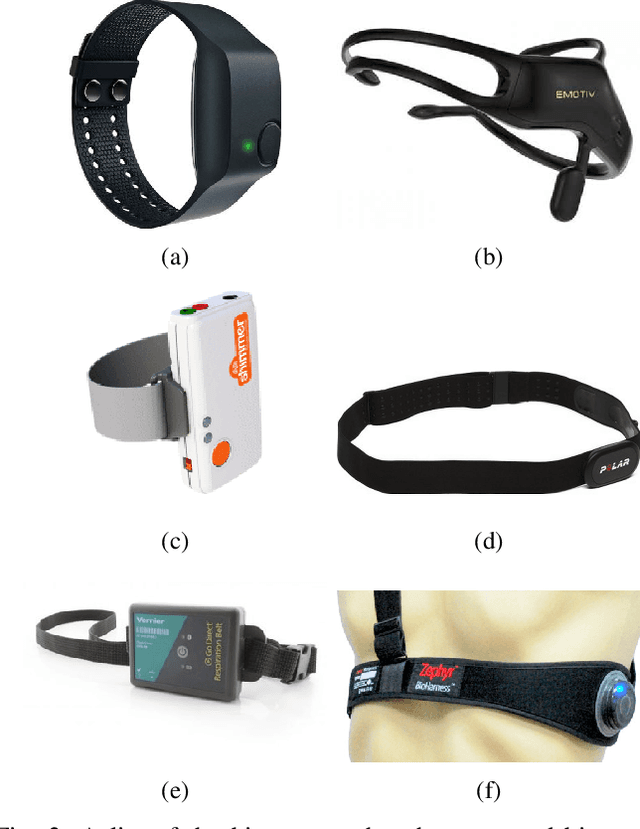
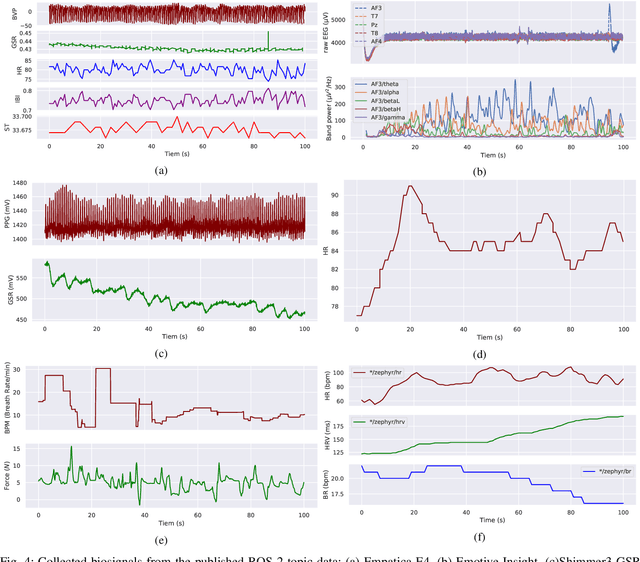
Wearable biosensors can enable continuous human data capture, facilitating development of real-world Human-Robot Interaction (HRI) systems. However, a lack of standardized libraries and implementations adds extraneous complexity to HRI system designs, and precludes collaboration across disciplines and institutions. Here, we introduce a novel wearable biosensor package for the Robot Operating System 2 (ROS 2) system. The ROS2 officially supports real-time computing and multi-robot systems, and thus provides easy-to-use and reliable streaming data from multiple nodes. The package standardizes biosensor HRI integration, lowers the technical barrier of entry, and expands the biosensor ecosystem into the robotics field. Each biosensor package node follows a generalized node and topic structure concentrated on ease of use. Current package capabilities, listed by biosensor, highlight package standardization. Collected example data demonstrate a full integration of each biosensor into ROS2. We expect that standardization of this biosensors package for ROS2 will greatly simplify use and cross-collaboration across many disciplines. The wearable biosensor package is made publicly available on GitHub at \https://github.com/SMARTlab-Purdue/ros2-foxy-wearable-biosensors.