 Add to Chrome
 Add to Firefox
 Add to Edge
CENTILE: A Telemetry Foundation Model Evaluated by the Decisions It Drives
Aug 03, 2026
Modern computing and networking infrastructure emits telemetry continuously, yet operators convert it into decisions with a separate predictor per task, entity, and horizon. One generative model, pretrained once over an operator's own event streams, could replace this fleet, an approach that already scales to high-cardinality streams in recommendation systems. However, point-forecast error on operational telemetry saturates near simple last-value baselines, so lower error alone need not improve the decisions it feeds. To close this gap, we present \sys, a generative foundation model for network and systems telemetry, evaluated by replaying the decisions its calibrated conditional quantiles drive. \sys treats heterogeneous telemetry as event-driven, irregularly timed entity streams and serves flexible forecast horizons in a single pass, requiring no future timestamps. To our knowledge, \sys is the first pretrained telemetry model to improve both HPC scheduling and network provisioning decisions under replay, its runtime estimator transferring zero-shot across months and its pretrained weights across domains from hours of target data. Extensive experiments on HPC job logs and network traffic confirm that \sys lowers the mean bounded slowdown of backfilling by up to approximately $77\%$ over deployed user estimates and roughly halves the deployed rule's violation rate. Our code is available at https://github.com/ZzZTripleZzZ/all-in-one.

Securing Autonomous Vehicle Systems via Twin-Aware Federated Reinforcement Learning
Jul 09, 2026Federated reinforcement learning (FRL) is crucial for enabling collaborative learning across multiple agents without sharing raw data, thereby enhancing privacy and scalability in the decision-making process within dynamic vehicular environments. However, poisoning attacks pose a significant threat to the security and reliability of FRL-based systems, particularly in safety-critical autonomous driving, where this vulnerability remains largely unexplored. These attacks can compromise the global control model by subtly injecting malicious system parameters, leading to potential hazards. To counter these challenges, we present \alg (\underline{Sec}ure \underline{A}ggregation with \underline{p}oisoning-\underline{p}revention and historical reinforcement) as a defensive framework aimed at enhancing the robustness of FRL systems designed for safety-critical driving scenarios. \alg strategically integrates digital twins for rehearsal-based learning and leverages historical aggregated model parameters along with a selected central gradient to ensure that only benign data is aggregated, effectively mitigating the influence of malicious agents. Theoretical guarantees are provided for the convergence performance of \alg in the presence of poisoning attacks. We also validate the effectiveness of \alg using developed digital twins that model realistic highway environments to evaluate the control of autonomous vehicles under adversarial conditions.
Customized Generative AI Agent for Transportation Engineering Practice: A Development and Continued Pre-training Guideline
Jun 27, 2026Recent advancements in generative artificial intelligence (AI) and large language models (LLMs) have shown significant promise in automating complex reasoning, summarization, and question-answering tasks. However, the effectiveness of general-purpose LLMs in specialized engineering domains remains limited due to insufficient exposure to technical standards, engineering terminology, and domain-specific semantics. This study proposes a systematic approach to developing a customized generative AI agent for transportation engineering applications. A curated corpus of U.S. transportation manuals, design guidelines, and regulatory documents is used to conduct continued pretraining of six state-of-the-art LLMs through a unified low-rank adaptation (LoRA) framework. The training process is monitored to ensure convergence and model stability. Performance is evaluated using standard natural language processing metrics, including BLEU-4 and ROUGE, with Qwen2.5-7B and LLaMA-3.1-8B demonstrating the highest domain alignment and response quality. Results validate the effectiveness of LoRA-based adaptation in improving LLM performance on technical content interpretation and context-specific reasoning. This work contributes a reproducible development framework for constructing domain-specialized generative AI agents, supporting broader deployment in transportation research, design, planning, and policy analysis.
Credit Where It is Due: Cross-Modality Connectivity Drives Precise Reinforcement Learning for MLLM Reasoning
Feb 12, 2026Reinforcement Learning with Verifiable Rewards (RLVR) has significantly advanced the reasoning capabilities of Multimodal Large Language Models (MLLMs), yet how visual evidence is integrated during reasoning remains poorly understood. We explore multimodal RLVR through the lens of cross-modal attention connectivity and find that only a small fraction of tokens (approximately 15%) exhibit strong visual-textual coupling. These high-connectivity tokens act as anchors that ground reasoning in the image, while the majority follow linguistic patterns. During RLVR training, credit assignment naturally concentrates on these anchors, sharpening their visual grounding over time. Building on this insight, we propose Anchor-Token Reinforcement Learning (AT-RL), a lightweight framework that selectively reinforces high-connectivity tokens via graph-based clustering of attention topology. Evaluated across the series (3B-32B), AT-RL introduces only 1.2% overhead yet enables the 32B model to surpass the 72B-Instruct baseline on MathVista (80.2), with consistent gains observed across STEM, video and general tasks. Conversely, training solely on low-connectivity tokens causes severe degradation, confirming that effective multimodal RL hinges on precise credit assignment to visual anchors. Our work reveals that reasoning quality is governed not by token quantity but by the fidelity of cross-modal anchoring.
Socratic-Geo: Synthetic Data Generation and Geometric Reasoning via Multi-Agent Interaction
Feb 03, 2026Multimodal Large Language Models (MLLMs) have significantly advanced vision-language understanding. However, even state-of-the-art models struggle with geometric reasoning, revealing a critical bottleneck: the extreme scarcity of high-quality image-text pairs. Human annotation is prohibitively expensive, while automated methods fail to ensure fidelity and training effectiveness. Existing approaches either passively adapt to available images or employ inefficient random exploration with filtering, decoupling generation from learning needs. We propose Socratic-Geo, a fully autonomous framework that dynamically couples data synthesis with model learning through multi-agent interaction. The Teacher agent generates parameterized Python scripts with reflective feedback (Reflect for solvability, RePI for visual validity), ensuring image-text pair purity. The Solver agent optimizes reasoning through preference learning, with failure paths guiding Teacher's targeted augmentation. Independently, the Generator learns image generation capabilities on accumulated "image-code-instruction" triplets, distilling programmatic drawing intelligence into visual generation. Starting from only 108 seed problems, Socratic-Solver achieves 49.11 on six benchmarks using one-quarter of baseline data, surpassing strong baselines by 2.43 points. Socratic-Generator achieves 42.4% on GenExam, establishing new state-of-the-art for open-source models, surpassing Seedream-4.0 (39.8%) and approaching Gemini-2.5-Flash-Image (43.1%).
Agentic Proposing: Enhancing Large Language Model Reasoning via Compositional Skill Synthesis
Feb 03, 2026Advancing complex reasoning in large language models relies on high-quality, verifiable datasets, yet human annotation remains cost-prohibitive and difficult to scale. Current synthesis paradigms often face a recurring trade-off: maintaining structural validity typically restricts problem complexity, while relaxing constraints to increase difficulty frequently leads to inconsistent or unsolvable instances. To address this, we propose Agentic Proposing, a framework that models problem synthesis as a goal-driven sequential decision process where a specialized agent dynamically selects and composes modular reasoning skills. Through an iterative workflow of internal reflection and tool-use, we develop the Agentic-Proposer-4B using Multi-Granularity Policy Optimization (MGPO) to generate high-precision, verifiable training trajectories across mathematics, coding, and science. Empirical results demonstrate that downstream solvers trained on agent-synthesized data significantly outperform leading baselines and exhibit robust cross-domain generalization. Notably, a 30B solver trained on only 11,000 synthesized trajectories achieves a state-of-the-art 91.6% accuracy on AIME25, rivaling frontier-scale proprietary models such as GPT-5 and proving that a small volume of high-quality synthetic signals can effectively substitute for massive human-curated datasets.
Policy of Thoughts: Scaling LLM Reasoning via Test-time Policy Evolution
Jan 28, 2026Large language models (LLMs) struggle with complex, long-horizon reasoning due to instability caused by their frozen policy assumption. Current test-time scaling methods treat execution feedback merely as an external signal for filtering or rewriting trajectories, without internalizing it to improve the underlying reasoning strategy. Inspired by Popper's epistemology of "conjectures and refutations," we argue that intelligence requires real-time evolution of the model's policy through learning from failed attempts. We introduce Policy of Thoughts (PoT), a framework that recasts reasoning as a within-instance online optimization process. PoT first generates diverse candidate solutions via an efficient exploration mechanism, then uses Group Relative Policy Optimization (GRPO) to update a transient LoRA adapter based on execution feedback. This closed-loop design enables dynamic, instance-specific refinement of the model's reasoning priors. Experiments show that PoT dramatically boosts performance: a 4B model achieves 49.71% accuracy on LiveCodeBench, outperforming GPT-4o and DeepSeek-V3 despite being over 50 smaller.
Synergizing AI and Digital Twins for Next-Generation Network Optimization, Forecasting, and Security
Mar 08, 2025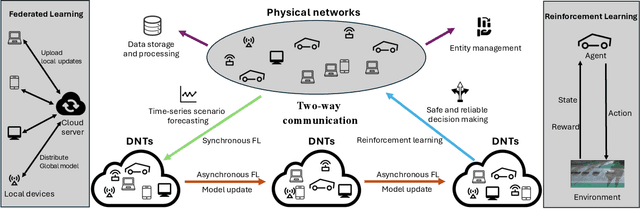
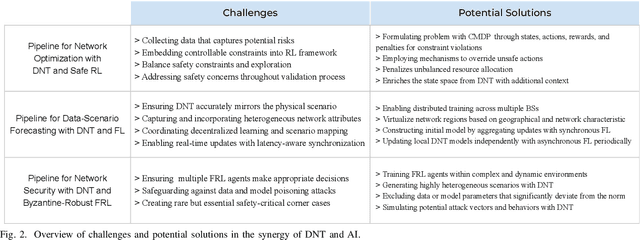
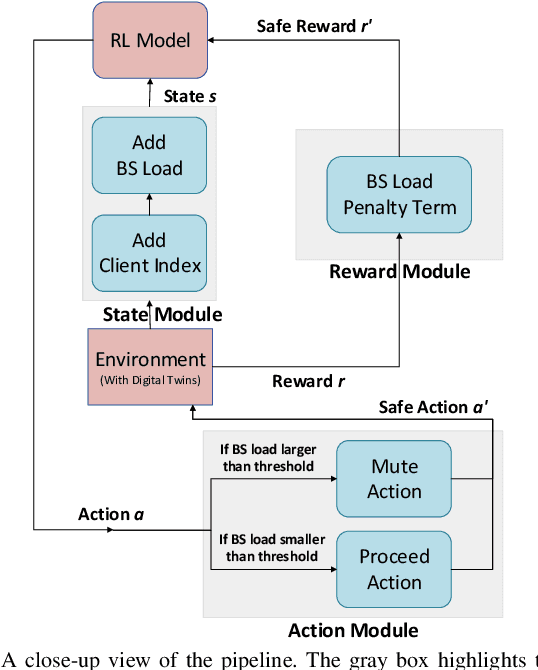
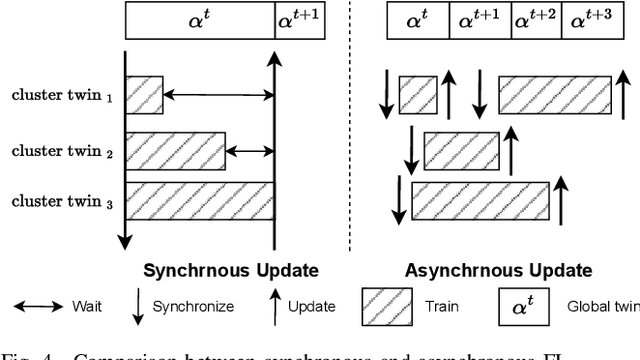
Digital network twins (DNTs) are virtual representations of physical networks, designed to enable real-time monitoring, simulation, and optimization of network performance. When integrated with machine learning (ML) techniques, particularly federated learning (FL) and reinforcement learning (RL), DNTs emerge as powerful solutions for managing the complexities of network operations. This article presents a comprehensive analysis of the synergy of DNTs, FL, and RL techniques, showcasing their collective potential to address critical challenges in 6G networks. We highlight key technical challenges that need to be addressed, such as ensuring network reliability, achieving joint data-scenario forecasting, and maintaining security in high-risk environments. Additionally, we propose several pipelines that integrate DNT and ML within coherent frameworks to enhance network optimization and security. Case studies demonstrate the practical applications of our proposed pipelines in edge caching and vehicular networks. In edge caching, the pipeline achieves over 80% cache hit rates while balancing base station loads. In autonomous vehicular system, it ensure a 100% no-collision rate, showcasing its reliability in safety-critical scenarios. By exploring these synergies, we offer insights into the future of intelligent and adaptive network systems that automate decision-making and problem-solving.
Poisoning Attacks and Defenses to Federated Unlearning
Jan 29, 2025
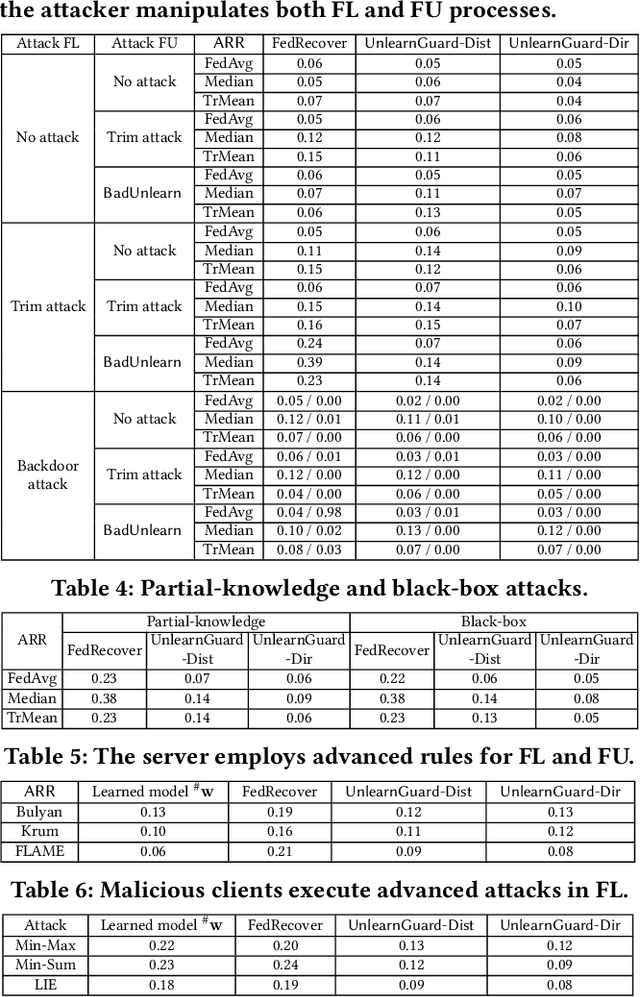

Federated learning allows multiple clients to collaboratively train a global model with the assistance of a server. However, its distributed nature makes it susceptible to poisoning attacks, where malicious clients can compromise the global model by sending harmful local model updates to the server. To unlearn an accurate global model from a poisoned one after identifying malicious clients, federated unlearning has been introduced. Yet, current research on federated unlearning has primarily concentrated on its effectiveness and efficiency, overlooking the security challenges it presents. In this work, we bridge the gap via proposing BadUnlearn, the first poisoning attacks targeting federated unlearning. In BadUnlearn, malicious clients send specifically designed local model updates to the server during the unlearning process, aiming to ensure that the resulting unlearned model remains poisoned. To mitigate these threats, we propose UnlearnGuard, a robust federated unlearning framework that is provably robust against both existing poisoning attacks and our BadUnlearn. The core concept of UnlearnGuard is for the server to estimate the clients' local model updates during the unlearning process and employ a filtering strategy to verify the accuracy of these estimations. Theoretically, we prove that the model unlearned through UnlearnGuard closely resembles one obtained by train-from-scratch. Empirically, we show that BadUnlearn can effectively corrupt existing federated unlearning methods, while UnlearnGuard remains secure against poisoning attacks.
Digital Twin-Assisted Data-Driven Optimization for Reliable Edge Caching in Wireless Networks
Jun 29, 2024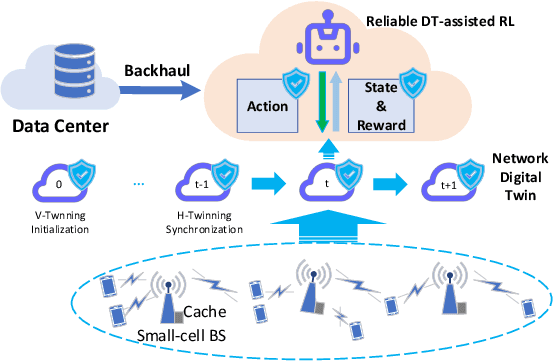
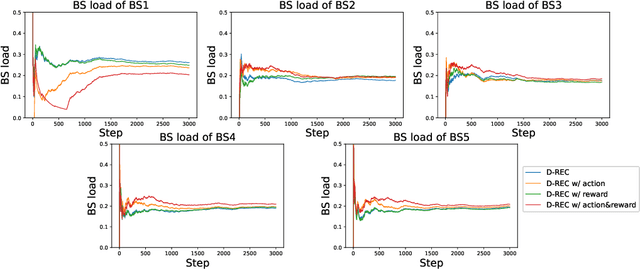

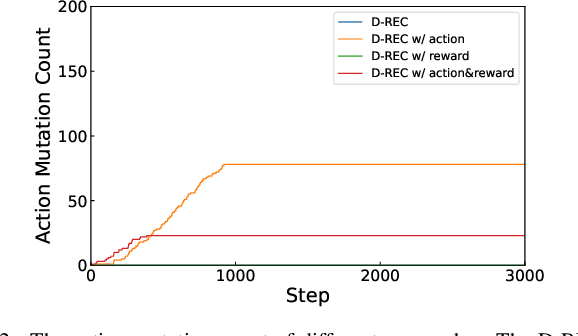
Optimizing edge caching is crucial for the advancement of next-generation (nextG) wireless networks, ensuring high-speed and low-latency services for mobile users. Existing data-driven optimization approaches often lack awareness of the distribution of random data variables and focus solely on optimizing cache hit rates, neglecting potential reliability concerns, such as base station overload and unbalanced cache issues. This oversight can result in system crashes and degraded user experience. To bridge this gap, we introduce a novel digital twin-assisted optimization framework, called D-REC, which integrates reinforcement learning (RL) with diverse intervention modules to ensure reliable caching in nextG wireless networks. We first develop a joint vertical and horizontal twinning approach to efficiently create network digital twins, which are then employed by D-REC as RL optimizers and safeguards, providing ample datasets for training and predictive evaluation of our cache replacement policy. By incorporating reliability modules into a constrained Markov decision process, D-REC can adaptively adjust actions, rewards, and states to comply with advantageous constraints, minimizing the risk of network failures. Theoretical analysis demonstrates comparable convergence rates between D-REC and vanilla data-driven methods without compromising caching performance. Extensive experiments validate that D-REC outperforms conventional approaches in cache hit rate and load balancing while effectively enforcing predetermined reliability intervention modules.