 Add to Chrome
 Add to Firefox
 Add to Edge
CENTILE: A Telemetry Foundation Model Evaluated by the Decisions It Drives
Aug 03, 2026
Modern computing and networking infrastructure emits telemetry continuously, yet operators convert it into decisions with a separate predictor per task, entity, and horizon. One generative model, pretrained once over an operator's own event streams, could replace this fleet, an approach that already scales to high-cardinality streams in recommendation systems. However, point-forecast error on operational telemetry saturates near simple last-value baselines, so lower error alone need not improve the decisions it feeds. To close this gap, we present \sys, a generative foundation model for network and systems telemetry, evaluated by replaying the decisions its calibrated conditional quantiles drive. \sys treats heterogeneous telemetry as event-driven, irregularly timed entity streams and serves flexible forecast horizons in a single pass, requiring no future timestamps. To our knowledge, \sys is the first pretrained telemetry model to improve both HPC scheduling and network provisioning decisions under replay, its runtime estimator transferring zero-shot across months and its pretrained weights across domains from hours of target data. Extensive experiments on HPC job logs and network traffic confirm that \sys lowers the mean bounded slowdown of backfilling by up to approximately $77\%$ over deployed user estimates and roughly halves the deployed rule's violation rate. Our code is available at https://github.com/ZzZTripleZzZ/all-in-one.

Post-hoc Interpretability Illumination for Scientific Interaction Discovery
Dec 20, 2024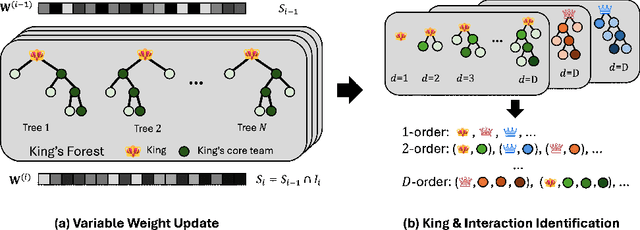
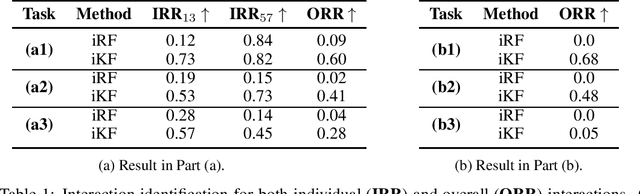
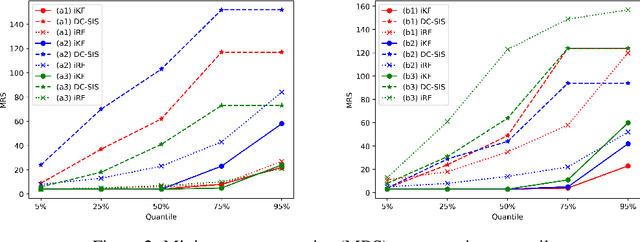
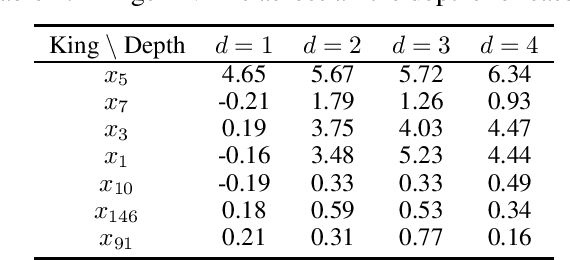
Model interpretability and explainability have garnered substantial attention in recent years, particularly in decision-making applications. However, existing interpretability tools often fall short in delivering satisfactory performance due to limited capabilities or efficiency issues. To address these challenges, we propose a novel post-hoc method: Iterative Kings' Forests (iKF), designed to uncover complex multi-order interactions among variables. iKF iteratively selects the next most important variable, the "King", and constructs King's Forests by placing it at the root node of each tree to identify variables that interact with the "King". It then generates ranked short lists of important variables and interactions of varying orders. Additionally, iKF provides inference metrics to analyze the patterns of the selected interactions and classify them into one of three interaction types: Accompanied Interaction, Synergistic Interaction, and Hierarchical Interaction. Extensive experiments demonstrate the strong interpretive power of our proposed iKF, highlighting its great potential for explainable modeling and scientific discovery across diverse scientific fields.