 Add to Chrome
 Add to Firefox
 Add to Edge
Securing Autonomous Vehicle Systems via Twin-Aware Federated Reinforcement Learning
Jul 09, 2026
Federated reinforcement learning (FRL) is crucial for enabling collaborative learning across multiple agents without sharing raw data, thereby enhancing privacy and scalability in the decision-making process within dynamic vehicular environments. However, poisoning attacks pose a significant threat to the security and reliability of FRL-based systems, particularly in safety-critical autonomous driving, where this vulnerability remains largely unexplored. These attacks can compromise the global control model by subtly injecting malicious system parameters, leading to potential hazards. To counter these challenges, we present \alg (\underline{Sec}ure \underline{A}ggregation with \underline{p}oisoning-\underline{p}revention and historical reinforcement) as a defensive framework aimed at enhancing the robustness of FRL systems designed for safety-critical driving scenarios. \alg strategically integrates digital twins for rehearsal-based learning and leverages historical aggregated model parameters along with a selected central gradient to ensure that only benign data is aggregated, effectively mitigating the influence of malicious agents. Theoretical guarantees are provided for the convergence performance of \alg in the presence of poisoning attacks. We also validate the effectiveness of \alg using developed digital twins that model realistic highway environments to evaluate the control of autonomous vehicles under adversarial conditions.

Benchmarking LLMs on the Semantic Overlap Summarization Task
Feb 26, 2024
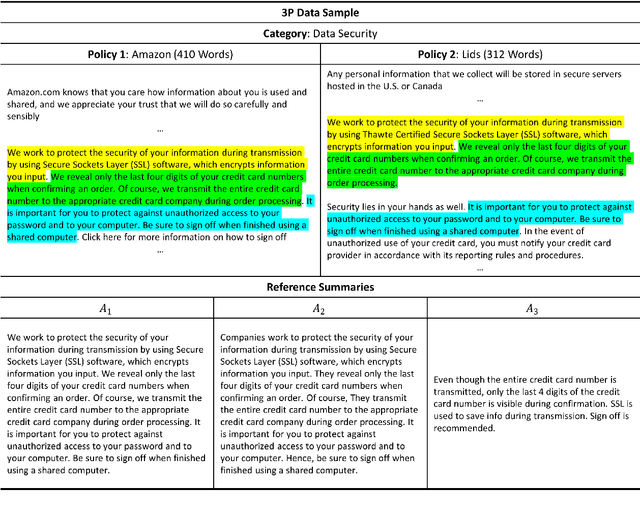
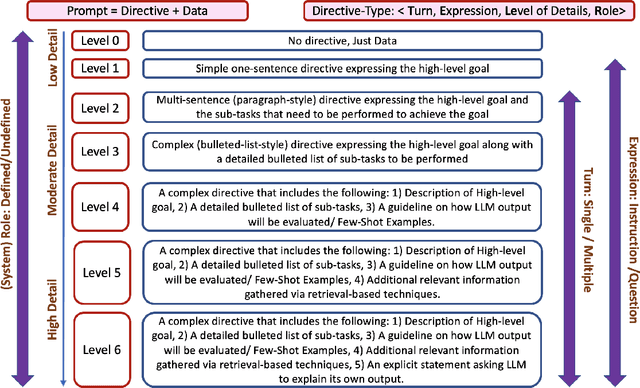
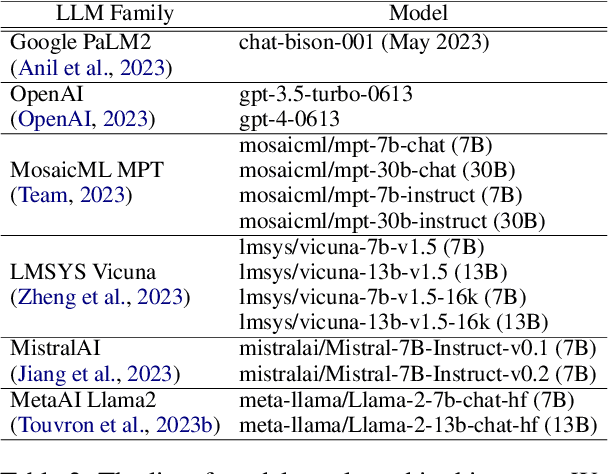
Semantic Overlap Summarization (SOS) is a constrained multi-document summarization task, where the constraint is to capture the common/overlapping information between two alternative narratives. While recent advancements in Large Language Models (LLMs) have achieved superior performance in numerous summarization tasks, a benchmarking study of the SOS task using LLMs is yet to be performed. As LLMs' responses are sensitive to slight variations in prompt design, a major challenge in conducting such a benchmarking study is to systematically explore a variety of prompts before drawing a reliable conclusion. Fortunately, very recently, the TELeR taxonomy has been proposed which can be used to design and explore various prompts for LLMs. Using this TELeR taxonomy and 15 popular LLMs, this paper comprehensively evaluates LLMs on the SOS Task, assessing their ability to summarize overlapping information from multiple alternative narratives. For evaluation, we report well-established metrics like ROUGE, BERTscore, and SEM-F1$ on two different datasets of alternative narratives. We conclude the paper by analyzing the strengths and limitations of various LLMs in terms of their capabilities in capturing overlapping information The code and datasets used to conduct this study are available at https://anonymous.4open.science/r/llm_eval-E16D.
MetaMorphosis: Task-oriented Privacy Cognizant Feature Generation for Multi-task Learning
May 13, 2023With the growth of computer vision applications, deep learning, and edge computing contribute to ensuring practical collaborative intelligence (CI) by distributing the workload among edge devices and the cloud. However, running separate single-task models on edge devices is inefficient regarding the required computational resource and time. In this context, multi-task learning allows leveraging a single deep learning model for performing multiple tasks, such as semantic segmentation and depth estimation on incoming video frames. This single processing pipeline generates common deep features that are shared among multi-task modules. However, in a collaborative intelligence scenario, generating common deep features has two major issues. First, the deep features may inadvertently contain input information exposed to the downstream modules (violating input privacy). Second, the generated universal features expose a piece of collective information than what is intended for a certain task, in which features for one task can be utilized to perform another task (violating task privacy). This paper proposes a novel deep learning-based privacy-cognizant feature generation process called MetaMorphosis that limits inference capability to specific tasks at hand. To achieve this, we propose a channel squeeze-excitation based feature metamorphosis module, Cross-SEC, to achieve distinct attention of all tasks and a de-correlation loss function with differential-privacy to train a deep learning model that produces distinct privacy-aware features as an output for the respective tasks. With extensive experimentation on four datasets consisting of diverse images related to scene understanding and facial attributes, we show that MetaMorphosis outperforms recent adversarial learning and universal feature generation methods by guaranteeing privacy requirements in an efficient way for image and video analytics.