 Add to Chrome
 Add to Firefox
 Add to Edge
Ride the Wave: Precision-Allocated Sparse Attention for Smooth Video Generation
Apr 14, 2026
Video Diffusion Transformers have revolutionized high-fidelity video generation but suffer from the massive computational burden of self-attention. While sparse attention provides a promising acceleration solution, existing methods frequently provoke severe visual flickering caused by static sparsity patterns and deterministic block routing. To resolve these limitations, we propose Precision-Allocated Sparse Attention (PASA), a training-free framework designed for highly efficient and temporally smooth video generation. First, we implement a curvature-aware dynamic budgeting mechanism. By profiling the generation trajectory acceleration across timesteps, we elastically allocate the exact-computation budget to secure high-precision processing strictly during critical semantic transitions. Second, we replace global homogenizing estimations with hardware-aligned grouped approximations, successfully capturing fine-grained local variations while maintaining peak compute throughput. Finally, we incorporate a stochastic selection bias into the attention routing mechanism. This probabilistic approach softens rigid selection boundaries and eliminates selection oscillation, effectively eradicating the localized computational starvation that drives temporal flickering. Extensive evaluations on leading video diffusion models demonstrate that PASA achieves substantial inference acceleration while consistently producing remarkably fluid and structurally stable video sequences.

Not Search, But Scan: Benchmarking MLLMs on Scan-Oriented Academic Paper Reasoning
Mar 27, 2026With the rapid progress of multimodal large language models (MLLMs), AI already performs well at literature retrieval and certain reasoning tasks, serving as a capable assistant to human researchers, yet it remains far from autonomous research. The fundamental reason is that current work on academic paper reasoning is largely confined to a search-oriented paradigm centered on pre-specified targets, with reasoning grounded in relevance retrieval, which struggles to support researcher-style full-document understanding, reasoning, and verification. To bridge this gap, we propose \textbf{ScholScan}, a new benchmark for academic paper reasoning. ScholScan introduces a scan-oriented task setting that asks models to read and cross-check entire papers like human researchers, scanning the document to identify consistency issues. The benchmark comprises 1,800 carefully annotated questions drawn from nine error categories across 13 natural-science domains and 715 papers, and provides detailed annotations for evidence localization and reasoning traces, together with a unified evaluation protocol. We assessed 15 models across 24 input configurations and conducted a fine-grained analysis of MLLM capabilities for all error categories. Across the board, retrieval-augmented generation (RAG) methods yield no significant improvements, revealing systematic deficiencies of current MLLMs on scan-oriented tasks and underscoring the challenge posed by ScholScan. We expect ScholScan to be the leading and representative work of the scan-oriented task paradigm.
THEMIS: Towards Holistic Evaluation of MLLMs for Scientific Paper Fraud Forensics
Mar 26, 2026We present THEMIS, a novel multi-task benchmark designed to comprehensively evaluate multimodal large language models (MLLMs) on visual fraud reasoning within real-world academic scenarios. Compared to existing benchmarks, THEMIS introduces three major advances. (1) Real-World Scenarios and Complexity: Our benchmark comprises over 4,000 questions spanning seven scenarios, derived from authentic retracted-paper cases and carefully curated multimodal synthetic data. With 60.47% complex-texture images, THEMIS bridges the critical gap between existing benchmarks and the complexity of real-world academic fraud. (2) Fraud-Type Diversity and Granularity: THEMIS systematically covers five challenging fraud types and introduces 16 fine-grained manipulation operations. On average, each sample undergoes multiple stacked manipulation operations, with the diversity and difficulty of these manipulations demanding a high level of visual fraud reasoning from the models. (3) Multi-Dimensional Capability Evaluation: We establish a mapping from fraud types to five core visual fraud reasoning capabilities, thereby enabling an evaluation that reveals the distinct strengths and specific weaknesses of different models across these core capabilities. Experiments on 16 leading MLLMs show that even the best-performing model, GPT-5, achieves an overall performance of only 56.15%, demonstrating that our benchmark presents a stringent test. We expect THEMIS to advance the development of MLLMs for complex, real-world fraud reasoning tasks.
TokenSplat: Token-aligned 3D Gaussian Splatting for Feed-forward Pose-free Reconstruction
Feb 28, 2026We present TokenSplat, a feed-forward framework for joint 3D Gaussian reconstruction and camera pose estimation from unposed multi-view images. At its core, TokenSplat introduces a Token-aligned Gaussian Prediction module that aligns semantically corresponding information across views directly in the feature space. Guided by coarse token positions and fusion confidence, it aggregates multi-scale contextual features to enable long-range cross-view reasoning and reduce redundancy from overlapping Gaussians. To further enhance pose robustness and disentangle viewpoint cues from scene semantics, TokenSplat employs learnable camera tokens and an Asymmetric Dual-Flow Decoder (ADF-Decoder) that enforces directionally constrained communication between camera and image tokens. This maintains clean factorization within a feed-forward architecture, enabling coherent reconstruction and stable pose estimation without iterative refinement. Extensive experiments demonstrate that TokenSplat achieves higher reconstruction fidelity and novel-view synthesis quality in pose-free settings, and significantly improves pose estimation accuracy compared to prior pose-free methods. Project page: https://kidleyh.github.io/tokensplat/.
FinMMDocR: Benchmarking Financial Multimodal Reasoning with Scenario Awareness, Document Understanding, and Multi-Step Computation
Dec 31, 2025We introduce FinMMDocR, a novel bilingual multimodal benchmark for evaluating multimodal large language models (MLLMs) on real-world financial numerical reasoning. Compared to existing benchmarks, our work delivers three major advancements. (1) Scenario Awareness: 57.9% of 1,200 expert-annotated problems incorporate 12 types of implicit financial scenarios (e.g., Portfolio Management), challenging models to perform expert-level reasoning based on assumptions; (2) Document Understanding: 837 Chinese/English documents spanning 9 types (e.g., Company Research) average 50.8 pages with rich visual elements, significantly surpassing existing benchmarks in both breadth and depth of financial documents; (3) Multi-Step Computation: Problems demand 11-step reasoning on average (5.3 extraction + 5.7 calculation steps), with 65.0% requiring cross-page evidence (2.4 pages average). The best-performing MLLM achieves only 58.0% accuracy, and different retrieval-augmented generation (RAG) methods show significant performance variations on this task. We expect FinMMDocR to drive improvements in MLLMs and reasoning-enhanced methods on complex multimodal reasoning tasks in real-world scenarios.
FinMMR: Make Financial Numerical Reasoning More Multimodal, Comprehensive, and Challenging
Aug 06, 2025We present FinMMR, a novel bilingual multimodal benchmark tailored to evaluate the reasoning capabilities of multimodal large language models (MLLMs) in financial numerical reasoning tasks. Compared to existing benchmarks, our work introduces three significant advancements. (1) Multimodality: We meticulously transform existing financial reasoning benchmarks, and construct novel questions from the latest Chinese financial research reports. FinMMR comprises 4.3K questions and 8.7K images spanning 14 categories, including tables, bar charts, and ownership structure charts. (2) Comprehensiveness: FinMMR encompasses 14 financial subdomains, including corporate finance, banking, and industry analysis, significantly exceeding existing benchmarks in financial domain knowledge breadth. (3) Challenge: Models are required to perform multi-step precise numerical reasoning by integrating financial knowledge with the understanding of complex financial images and text. The best-performing MLLM achieves only 53.0% accuracy on Hard problems. We believe that FinMMR will drive advancements in enhancing the reasoning capabilities of MLLMs in real-world scenarios.
FinanceReasoning: Benchmarking Financial Numerical Reasoning More Credible, Comprehensive and Challenging
Jun 06, 2025We introduce FinanceReasoning, a novel benchmark designed to evaluate the reasoning capabilities of large reasoning models (LRMs) in financial numerical reasoning problems. Compared to existing benchmarks, our work provides three key advancements. (1) Credibility: We update 15.6% of the questions from four public datasets, annotating 908 new questions with detailed Python solutions and rigorously refining evaluation standards. This enables an accurate assessment of the reasoning improvements of LRMs. (2) Comprehensiveness: FinanceReasoning covers 67.8% of financial concepts and formulas, significantly surpassing existing datasets. Additionally, we construct 3,133 Python-formatted functions, which enhances LRMs' financial reasoning capabilities through refined knowledge (e.g., 83.2% $\rightarrow$ 91.6% for GPT-4o). (3) Challenge: Models are required to apply multiple financial formulas for precise numerical reasoning on 238 Hard problems. The best-performing model (i.e., OpenAI o1 with PoT) achieves 89.1% accuracy, yet LRMs still face challenges in numerical precision. We demonstrate that combining Reasoner and Programmer models can effectively enhance LRMs' performance (e.g., 83.2% $\rightarrow$ 87.8% for DeepSeek-R1). Our work paves the way for future research on evaluating and improving LRMs in domain-specific complex reasoning tasks.
GaussianIP: Identity-Preserving Realistic 3D Human Generation via Human-Centric Diffusion Prior
Mar 14, 2025Text-guided 3D human generation has advanced with the development of efficient 3D representations and 2D-lifting methods like Score Distillation Sampling (SDS). However, current methods suffer from prolonged training times and often produce results that lack fine facial and garment details. In this paper, we propose GaussianIP, an effective two-stage framework for generating identity-preserving realistic 3D humans from text and image prompts. Our core insight is to leverage human-centric knowledge to facilitate the generation process. In stage 1, we propose a novel Adaptive Human Distillation Sampling (AHDS) method to rapidly generate a 3D human that maintains high identity consistency with the image prompt and achieves a realistic appearance. Compared to traditional SDS methods, AHDS better aligns with the human-centric generation process, enhancing visual quality with notably fewer training steps. To further improve the visual quality of the face and clothes regions, we design a View-Consistent Refinement (VCR) strategy in stage 2. Specifically, it produces detail-enhanced results of the multi-view images from stage 1 iteratively, ensuring the 3D texture consistency across views via mutual attention and distance-guided attention fusion. Then a polished version of the 3D human can be achieved by directly perform reconstruction with the refined images. Extensive experiments demonstrate that GaussianIP outperforms existing methods in both visual quality and training efficiency, particularly in generating identity-preserving results. Our code is available at: https://github.com/silence-tang/GaussianIP.
3D$^2$-Actor: Learning Pose-Conditioned 3D-Aware Denoiser for Realistic Gaussian Avatar Modeling
Dec 16, 2024
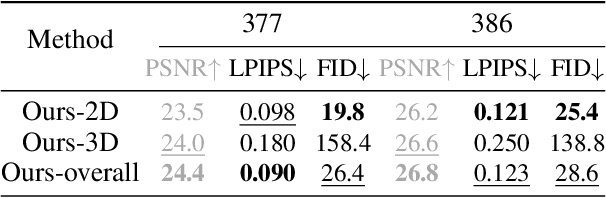
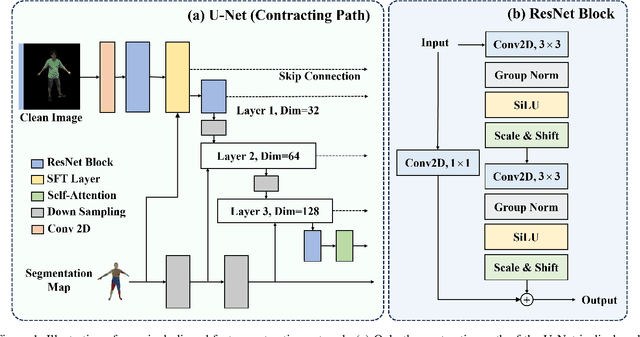

Advancements in neural implicit representations and differentiable rendering have markedly improved the ability to learn animatable 3D avatars from sparse multi-view RGB videos. However, current methods that map observation space to canonical space often face challenges in capturing pose-dependent details and generalizing to novel poses. While diffusion models have demonstrated remarkable zero-shot capabilities in 2D image generation, their potential for creating animatable 3D avatars from 2D inputs remains underexplored. In this work, we introduce 3D$^2$-Actor, a novel approach featuring a pose-conditioned 3D-aware human modeling pipeline that integrates iterative 2D denoising and 3D rectifying steps. The 2D denoiser, guided by pose cues, generates detailed multi-view images that provide the rich feature set necessary for high-fidelity 3D reconstruction and pose rendering. Complementing this, our Gaussian-based 3D rectifier renders images with enhanced 3D consistency through a two-stage projection strategy and a novel local coordinate representation. Additionally, we propose an innovative sampling strategy to ensure smooth temporal continuity across frames in video synthesis. Our method effectively addresses the limitations of traditional numerical solutions in handling ill-posed mappings, producing realistic and animatable 3D human avatars. Experimental results demonstrate that 3D$^2$-Actor excels in high-fidelity avatar modeling and robustly generalizes to novel poses. Code is available at: https://github.com/silence-tang/GaussianActor.
Bandwidth-Aware and Overlap-Weighted Compression for Communication-Efficient Federated Learning
Aug 27, 2024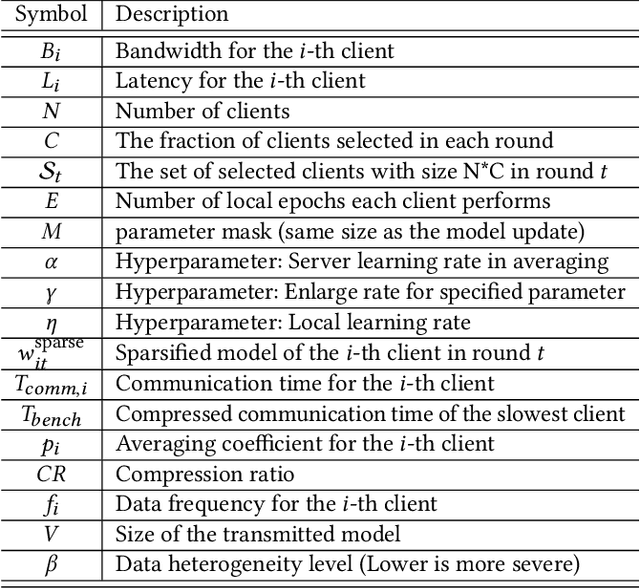
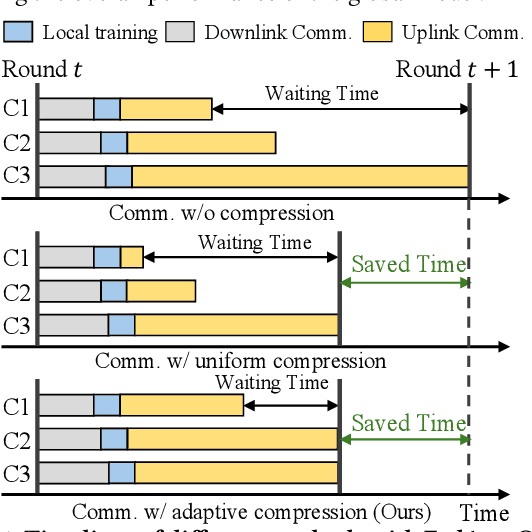
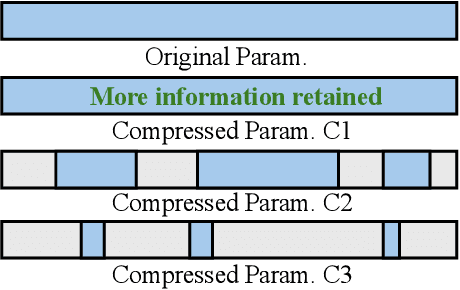
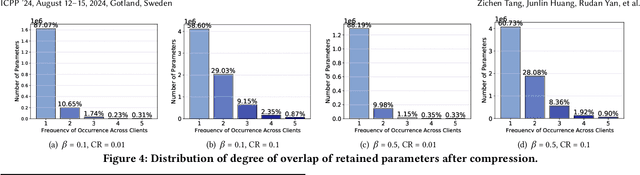
Current data compression methods, such as sparsification in Federated Averaging (FedAvg), effectively enhance the communication efficiency of Federated Learning (FL). However, these methods encounter challenges such as the straggler problem and diminished model performance due to heterogeneous bandwidth and non-IID (Independently and Identically Distributed) data. To address these issues, we introduce a bandwidth-aware compression framework for FL, aimed at improving communication efficiency while mitigating the problems associated with non-IID data. First, our strategy dynamically adjusts compression ratios according to bandwidth, enabling clients to upload their models at a close pace, thus exploiting the otherwise wasted time to transmit more data. Second, we identify the non-overlapped pattern of retained parameters after compression, which results in diminished client update signals due to uniformly averaged weights. Based on this finding, we propose a parameter mask to adjust the client-averaging coefficients at the parameter level, thereby more closely approximating the original updates, and improving the training convergence under heterogeneous environments. Our evaluations reveal that our method significantly boosts model accuracy, with a maximum improvement of 13% over the uncompressed FedAvg. Moreover, it achieves a $3.37\times$ speedup in reaching the target accuracy compared to FedAvg with a Top-K compressor, demonstrating its effectiveness in accelerating convergence with compression. The integration of common compression techniques into our framework further establishes its potential as a versatile foundation for future cross-device, communication-efficient FL research, addressing critical challenges in FL and advancing the field of distributed machine learning.