 Add to Chrome
 Add to Firefox
 Add to Edge
DialectS2S: End-to-End Speech Dialogue Modeling for Low-Resource Chinese Dialects
Aug 08, 2026
Current end-to-end speech dialogue models are primarily optimized for mainstream languages and remain limited in low-resource dialect scenarios due to the scarcity of dialect speech data. Moreover, during dialect adaptation, the semantic representation space of speech dialogue models continuously evolves, while conventional speech supervision remains unchanged, leading to semantic inconsistency between hidden representations and speech targets and degrading speech stability and naturalness. To address these issues, we propose DialectS2S, an end-to-end speech dialogue model for Chinese dialects. We first develop a scalable dialect speech dialogue synthesis pipeline for efficient data construction. We further introduce a two-stage post-training strategy with self-aligned speech supervision, which aligns the semantic content of speech supervision with the evolved semantic representations of the model to improve dialect speech generation quality. Experimental results show that DialectS2S consistently outperforms existing baselines across multiple Chinese dialects in speech dialogue, achieving substantial improvements in dialect consistency, response quality, and speech intelligibility. Our work provides an efficient and scalable solution for end-to-end speech dialogue modeling in low-resource dialect scenarios. To facilitate future research and practical applications, we fully open-source the DialectS2S framework, including model checkpoints, training datasets, and fine-tuning code.

SPREG: Structured Plan Repair with Entropy-Guided Test-Time Intervention for Large Language Model Reasoning
Apr 20, 2026Large Language Models (LLMs) are prone to logical hallucinations and stochastic drifts during long-chain reasoning. While Classifier-Free Guidance (CFG) can improve instruction adherence, standard static implementations often cause semantic dilution and linguistic degradation. We propose SPREG (Structured Plan-guided Real-time Entropy Gating), a lightweight inference-time framework for surgical error rectification. SPREG employs an adaptive dual-threshold mechanism to monitor real-time entropy, identifying sudden ``entropy spikes'' as reliable indicators of logical failure. Upon detection, it triggers a dynamic repair by replacing uninformative null-priors with reference distributions synthesized from historical high-confidence states. By modulating guidance intensity according to structured reasoning stages (e.g., Action, Observation), SPREG steers the model back to a stable manifold without compromising fluency. Our experiments demonstrate significant gains, notably a 20.0% absolute accuracy improvement on AIME25, while effectively suppressing uncontrolled entropy drift in complex tasks.
THEMIS: Towards Holistic Evaluation of MLLMs for Scientific Paper Fraud Forensics
Mar 26, 2026We present THEMIS, a novel multi-task benchmark designed to comprehensively evaluate multimodal large language models (MLLMs) on visual fraud reasoning within real-world academic scenarios. Compared to existing benchmarks, THEMIS introduces three major advances. (1) Real-World Scenarios and Complexity: Our benchmark comprises over 4,000 questions spanning seven scenarios, derived from authentic retracted-paper cases and carefully curated multimodal synthetic data. With 60.47% complex-texture images, THEMIS bridges the critical gap between existing benchmarks and the complexity of real-world academic fraud. (2) Fraud-Type Diversity and Granularity: THEMIS systematically covers five challenging fraud types and introduces 16 fine-grained manipulation operations. On average, each sample undergoes multiple stacked manipulation operations, with the diversity and difficulty of these manipulations demanding a high level of visual fraud reasoning from the models. (3) Multi-Dimensional Capability Evaluation: We establish a mapping from fraud types to five core visual fraud reasoning capabilities, thereby enabling an evaluation that reveals the distinct strengths and specific weaknesses of different models across these core capabilities. Experiments on 16 leading MLLMs show that even the best-performing model, GPT-5, achieves an overall performance of only 56.15%, demonstrating that our benchmark presents a stringent test. We expect THEMIS to advance the development of MLLMs for complex, real-world fraud reasoning tasks.
Reflection in the Dark: Exposing and Escaping the Black Box in Reflective Prompt Optimization
Mar 19, 2026Automatic prompt optimization (APO) has emerged as a powerful paradigm for improving LLM performance without manual prompt engineering. Reflective APO methods such as GEPA iteratively refine prompts by diagnosing failure cases, but the optimization process remains black-box and label-free, leading to uninterpretable trajectories and systematic failure. We identify and empirically demonstrate four limitations: on GSM8K with a defective seed, GEPA degrades accuracy from 23.81% to 13.50%. We propose VISTA, a multi-agent APO framework that decouples hypothesis generation from prompt rewriting, enabling semantically labeled hypotheses, parallel minibatch verification, and interpretable optimization trace. A two-layer explore-exploit mechanism combining random restart and epsilon-greedy sampling further escapes local optima. VISTA recovers accuracy to 87.57% on the same defective seed and consistently outperforms baselines across all conditions on GSM8K and AIME2025.
Compositional Oil Spill Detection Based on Object Detector and Adapted Segment Anything Model from SAR Images
Jan 15, 2024
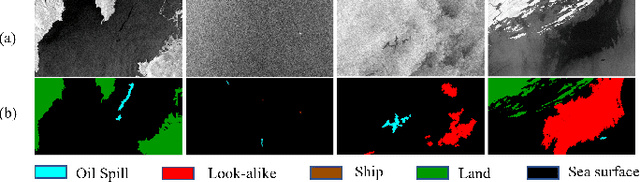


Semantic segmentation-based methods have attracted extensive attention in oil spill detection from SAR images. However, the existing approaches require a large number of finely annotated segmentation samples in the training stage. To alleviate this issue, we propose a composite oil spill detection framework, SAM-OIL, comprising an object detector (e.g., YOLOv8), an adapted Segment Anything Model (SAM), and an Ordered Mask Fusion (OMF) module. SAM-OIL is the first application of the powerful SAM in oil spill detection. Specifically, the SAM-OIL strategy uses YOLOv8 to obtain the categories and bounding boxes of oil spill-related objects, then inputs bounding boxes into the adapted SAM to retrieve category-agnostic masks, and finally adopts the Ordered Mask Fusion (OMF) module to fuse the masks and categories. The adapted SAM, combining a frozen SAM with a learnable Adapter module, can enhance SAM's ability to segment ambiguous objects. The OMF module, a parameter-free method, can effectively resolve pixel category conflicts within SAM. Experimental results demonstrate that SAM-OIL surpasses existing semantic segmentation-based oil spill detection methods, achieving mIoU of 69.52%. The results also indicated that both OMF and Adapter modules can effectively improve the accuracy in SAM-OIL.