 Add to Chrome
 Add to Firefox
 Add to Edge
Workflow-Localized Mechanism Learning: Attribution-Guided Repair and Knowledge Reuse for Structured Agent Skills
Jul 23, 2026
Agent Skills package reusable procedural knowledge as external artifacts for frozen language-model agents, yet existing optimizers do not jointly resolve where a failure occurs in a workflow, which mechanism caused it, and how relevant knowledge from third-party Skills should be reused locally. We introduce Workflow-Localized Mechanism Learning (WML). Its Node--Mechanism Attribution identifies the failed workflow node, implicated mechanisms, and smallest valid edit target, routing single-mechanism defects to L3 resources and relational defects across mechanisms to L2 composition protocols. A six-module Workflow-Guided Skill Optimization (WGSO) loop then selects provenance- and scope-aware third-party knowledge, applies bounded patches, evaluates candidates, and stores verified outcomes in optimizer-side memory. On SpreadsheetBench, WML reaches 90.33 +/- 1.53 and 74.67 +/- 3.51 Hard Accuracy with DeepSeek and Qwen3.6-Flash, respectively; without additional optimization, the learned Skills transfer to WikiTableQuestions with 84.00 +/- 2.00 and 83.00 +/- 2.00 Denotation Accuracy. On Compiler-Supported50, WML attains both the highest hard-PASS rate and the lowest cost per successful task; compiled execution sharply reduces tokens and calls relative to a direct SkillAgent while retaining most of its successful tasks. Code and artifacts are available at https://github.com/xiaolin9595/workflow-localized-mechanism-learning.

HunyuanOCR-1.5: Making Lightweight OCR VLMs Faster and Better
Jul 06, 2026We present HunyuanOCR-1.5, a lightweight end-to-end OCR-specialized vision-language model. HunyuanOCR unifies document parsing, text spotting, information extraction, text-image translation, and multi-image document understanding within a single end-to-end VLM. Building upon the lightweight architecture of HunyuanOCR-1.0, HunyuanOCR-1.5 does not redesign the backbone, but systematically improves both efficiency and capability. For efficiency, we adapt DFlash to OCR decoding, significantly reducing the latency of long structured outputs such as dense documents, tables, and formulas while preserving output distribution. Powered by DFlash, HunyuanOCR-1.5 achieves a 6.37x Transformer inference speedup and a 2.14x speedup under vLLM, delivering the fastest inference among lightweight OCR VLMs. For capability, we propose Agentic Data Flow, an agent-driven data construction system that transforms model weaknesses into executable data requirements and autonomously performs material search, quality verification, and pipeline development. It substantially improves long-tail capabilities in ancient-script OCR, fine-grained chart and table parsing, multi-image text-centric QA, low-resource multilingual parsing, and document hallucination evaluation. HunyuanOCR-1.5 ranks among the top-tier end-to-end OCR solutions on OmniDocBench v1.6 while achieving new performance milestones across these long-tail tasks. Combined with an upgraded pretraining and post-training recipe, HunyuanOCR-1.5 further extends its capability in high-resolution, long-context, and multi-task scenarios. Experiments demonstrate faster inference, broader OCR capability coverage, and the deployment advantages of a lightweight end-to-end model. We will release the model weights and training code to support future research and real-world OCR applications.
Distributed General-Purpose Agent Networks: Architecture, Key Mechanisms, and Prototypes
Jun 15, 2026Large language models have accelerated the transition from passive conversational assistants to autonomous agents that can understand goals, plan actions, invoke tools, and execute multi-step tasks. Yet the capability of a single agent remains constrained by its local data, tool permissions, runtime environment, and governance boundary. This paper studies distributed general-purpose agent networks: open peer-to-peer networks in which heterogeneous agents deployed on personal devices, edge nodes, or autonomous computing environments can discover one another, establish trust, negotiate cooperation rules, and execute open-ended tasks. We argue that such networks cannot be obtained by simply combining existing peer-to-peer overlays with conventional multi-agent systems. Unlike traditional P2P networks, agent networks must propagate semantic declarations about intentions, capabilities, states, and cooperation constraints. We therefore propose a layered architecture centered on a protocol adaptation layer that connects upper-level task semantics with lower-level network operations. Based on this architecture, the paper identifies three core mechanism problems: semantic announcement propagation for collaborator discovery, verifiable identity and multi-topic reputation for cooperation governance, and semantic-gradient mechanism design for open task execution. For each problem, we present a technical route, including bodyless gossip with sequential logs, BAID-based identity binding with MG-EigenTrust reputation, and a Stackelberg-style mechanism-generation loop driven by semantic attribution feedback. We further report prototype overhead results for BAID-style tiered verification and mechanism-level simulations of MG-EigenTrust under cross-topic disguise-collusion attacks. The resulting framework provides a system-level foundation for open, trustworthy, and scalable agent collaboration.
Ling and Ring 2.6 Technical Report: Efficient and Instant Agentic Intelligence at Trillion-Parameter Scale
Jun 13, 2026Efficient and scalable agentic intelligence requires models that can deliver both low-latency responses and strong reasoning capabilities while remaining practical to train, serve, and deploy. In this report, we present Ling-2.6 and Ring-2.6, a family of models designed to address this challenge at scale. Ling-2.6 is optimized for instant response generation and high capability per output token, whereas Ring-2.6 is tailored for deeper reasoning and more advanced agentic workflows. Instead of training from scratch, we upgrade the Ling-2.0 base model through architectural migration pre-training and large-scale post-training. This upgrade is guided by a unified co-design of model architecture, optimization objectives, serving systems, and agent training environments, enabling improvements in both model capability and deployment efficiency. At the architectural level, we introduce a hybrid linear attention design that integrates Lightning Attention with MLA, improving the efficiency of long-context training and decoding. To further enhance token efficiency, we optimize capability per output token through Evolutionary Chain-of-Thought, Linguistic Unit Policy Optimization, bidirectional preference alignment, and shortest-correct-response distillation. For agentic capabilities, we propose KPop, a reinforcement learning framework designed to support stable training of Ring-2.6-1T on large-scale environment-grounded data. KPop improves training efficiency through asynchronous scheduling across coding, search, tool use, and workflow execution, enabling scalable learning from complex agent-environment interactions. Together, Ling-2.6 and Ring-2.6 provide a practical pathway toward efficient, scalable, and open agentic systems. We open-source all checkpoints in the 2.6 family to support further research and development in practical agentic intelligence.
A Survey of Zero-Knowledge Proof Based Verifiable Machine Learning
Feb 25, 2025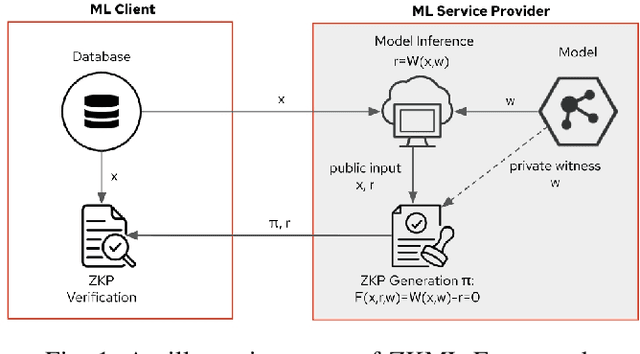
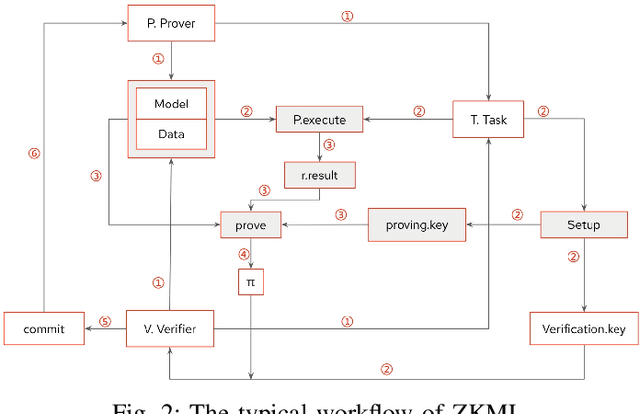
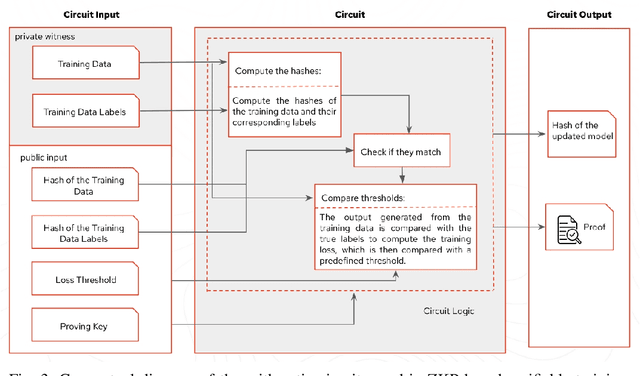
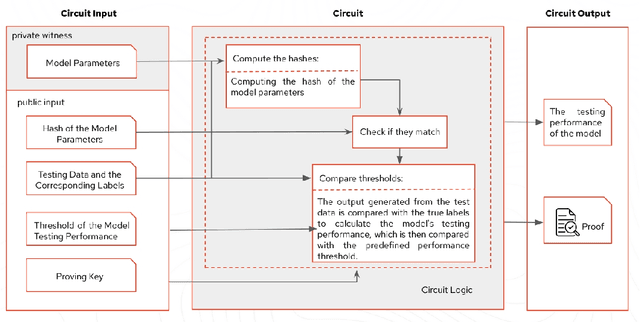
As machine learning technologies advance rapidly across various domains, concerns over data privacy and model security have grown significantly. These challenges are particularly pronounced when models are trained and deployed on cloud platforms or third-party servers due to the computational resource limitations of users' end devices. In response, zero-knowledge proof (ZKP) technology has emerged as a promising solution, enabling effective validation of model performance and authenticity in both training and inference processes without disclosing sensitive data. Thus, ZKP ensures the verifiability and security of machine learning models, making it a valuable tool for privacy-preserving AI. Although some research has explored the verifiable machine learning solutions that exploit ZKP, a comprehensive survey and summary of these efforts remain absent. This survey paper aims to bridge this gap by reviewing and analyzing all the existing Zero-Knowledge Machine Learning (ZKML) research from June 2017 to December 2024. We begin by introducing the concept of ZKML and outlining its ZKP algorithmic setups under three key categories: verifiable training, verifiable inference, and verifiable testing. Next, we provide a comprehensive categorization of existing ZKML research within these categories and analyze the works in detail. Furthermore, we explore the implementation challenges faced in this field and discuss the improvement works to address these obstacles. Additionally, we highlight several commercial applications of ZKML technology. Finally, we propose promising directions for future advancements in this domain.
Personalized Behavior-Aware Transformer for Multi-Behavior Sequential Recommendation
Feb 22, 2024
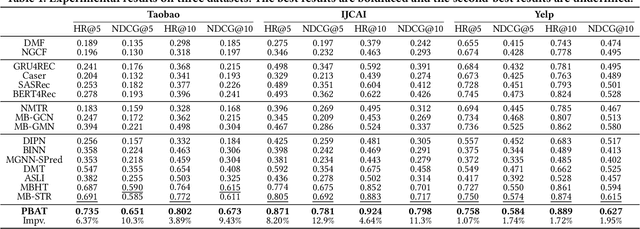

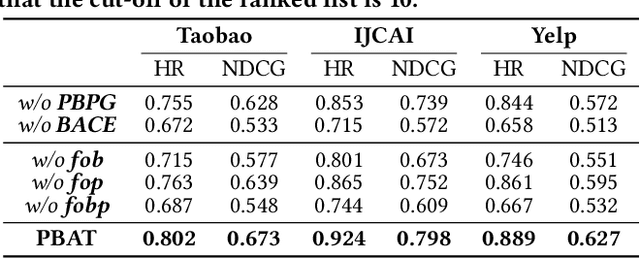
Sequential Recommendation (SR) captures users' dynamic preferences by modeling how users transit among items. However, SR models that utilize only single type of behavior interaction data encounter performance degradation when the sequences are short. To tackle this problem, we focus on Multi-Behavior Sequential Recommendation (MBSR) in this paper, which aims to leverage time-evolving heterogeneous behavioral dependencies for better exploring users' potential intents on the target behavior. Solving MBSR is challenging. On the one hand, users exhibit diverse multi-behavior patterns due to personal characteristics. On the other hand, there exists comprehensive co-influence between behavior correlations and item collaborations, the intensity of which is deeply affected by temporal factors. To tackle these challenges, we propose a Personalized Behavior-Aware Transformer framework (PBAT) for MBSR problem, which models personalized patterns and multifaceted sequential collaborations in a novel way to boost recommendation performance. First, PBAT develops a personalized behavior pattern generator in the representation layer, which extracts dynamic and discriminative behavior patterns for sequential learning. Second, PBAT reforms the self-attention layer with a behavior-aware collaboration extractor, which introduces a fused behavior-aware attention mechanism for incorporating both behavioral and temporal impacts into collaborative transitions. We conduct experiments on three benchmark datasets and the results demonstrate the effectiveness and interpretability of our framework. Our implementation code is released at https://github.com/TiliaceaeSU/PBAT.