 Add to Chrome
 Add to Firefox
 Add to Edge
Workflow-Localized Mechanism Learning: Attribution-Guided Repair and Knowledge Reuse for Structured Agent Skills
Jul 23, 2026
Agent Skills package reusable procedural knowledge as external artifacts for frozen language-model agents, yet existing optimizers do not jointly resolve where a failure occurs in a workflow, which mechanism caused it, and how relevant knowledge from third-party Skills should be reused locally. We introduce Workflow-Localized Mechanism Learning (WML). Its Node--Mechanism Attribution identifies the failed workflow node, implicated mechanisms, and smallest valid edit target, routing single-mechanism defects to L3 resources and relational defects across mechanisms to L2 composition protocols. A six-module Workflow-Guided Skill Optimization (WGSO) loop then selects provenance- and scope-aware third-party knowledge, applies bounded patches, evaluates candidates, and stores verified outcomes in optimizer-side memory. On SpreadsheetBench, WML reaches 90.33 +/- 1.53 and 74.67 +/- 3.51 Hard Accuracy with DeepSeek and Qwen3.6-Flash, respectively; without additional optimization, the learned Skills transfer to WikiTableQuestions with 84.00 +/- 2.00 and 83.00 +/- 2.00 Denotation Accuracy. On Compiler-Supported50, WML attains both the highest hard-PASS rate and the lowest cost per successful task; compiled execution sharply reduces tokens and calls relative to a direct SkillAgent while retaining most of its successful tasks. Code and artifacts are available at https://github.com/xiaolin9595/workflow-localized-mechanism-learning.

Distributed General-Purpose Agent Networks: Architecture, Key Mechanisms, and Prototypes
Jun 15, 2026Large language models have accelerated the transition from passive conversational assistants to autonomous agents that can understand goals, plan actions, invoke tools, and execute multi-step tasks. Yet the capability of a single agent remains constrained by its local data, tool permissions, runtime environment, and governance boundary. This paper studies distributed general-purpose agent networks: open peer-to-peer networks in which heterogeneous agents deployed on personal devices, edge nodes, or autonomous computing environments can discover one another, establish trust, negotiate cooperation rules, and execute open-ended tasks. We argue that such networks cannot be obtained by simply combining existing peer-to-peer overlays with conventional multi-agent systems. Unlike traditional P2P networks, agent networks must propagate semantic declarations about intentions, capabilities, states, and cooperation constraints. We therefore propose a layered architecture centered on a protocol adaptation layer that connects upper-level task semantics with lower-level network operations. Based on this architecture, the paper identifies three core mechanism problems: semantic announcement propagation for collaborator discovery, verifiable identity and multi-topic reputation for cooperation governance, and semantic-gradient mechanism design for open task execution. For each problem, we present a technical route, including bodyless gossip with sequential logs, BAID-based identity binding with MG-EigenTrust reputation, and a Stackelberg-style mechanism-generation loop driven by semantic attribution feedback. We further report prototype overhead results for BAID-style tiered verification and mechanism-level simulations of MG-EigenTrust under cross-topic disguise-collusion attacks. The resulting framework provides a system-level foundation for open, trustworthy, and scalable agent collaboration.
When Should Agent Trust Be Conditional? Characterizing and Attacking Skill-Conditional Reputation in Agent Swarms
Jun 12, 2026Open platforms increasingly route tasks among heterogeneous LLM agents--differing in base model, scaffold, and tool stack--whose competence varies sharply by skill: an agent excellent at one skill may be useless at another. The standard reputation approach summarizes each agent by a single global trust score, but that scalar is the wrong object here, because routing every task to the globally most-trusted agent leaves the value of specialization unclaimed. We study skill-conditional trust R(i | k)--the trust to place in agent i for a task requiring skill k, rather than one score per agent--and pose three falsifiable questions: when is conditioning worth it, how much cross-skill evidence should be borrowed, and whether that borrowing is safe. A controlled phase-diagram analysis answers the first two: conditional trust wins only in a specific regime--high agent heterogeneity, sparse per-skill evidence, and correlated skills--and the coupling strength beta that buys this data efficiency is dual-use, because the same cross-skill borrowing is also a laundering channel. On a public benchmark of 14 genuinely heterogeneous AppWorld agents, real pools land inside the beneficial regime--a small but genuine gain, with the per-skill best agent genuinely changing across skills. We then show that an attacker with cheap evidence in one skill and none in a target skill hijacks the conditional router, driving routing regret from 0 to 0.94 on a pool our zero-cost Conditional Information Value Test (CIVT) rates GREEN--while the ungated trust verdict it contaminates reads -0.06 instead of the honest +0.19. A zero-evidence gate bounds the attack but does not eliminate it; we characterize the residual cost under an explicit budget. We do not claim Sybil-resistance--we quantify the trade-off.
ResearchLoop: An Evidence-Gated Control Plane for AI-Assisted Research
May 27, 2026AI-assisted research compresses ideation, implementation, evaluation, and manuscript writing into a single interactive loop. This compression is useful, but it also creates a publication risk: paper claims can become easier to state than to audit. We present ResearchLoop, an evidence-gated control plane for AI-assisted computational research. ResearchLoop treats research questions, task contracts, evidence objects, claim ledgers, closeouts, and paper bindings as durable project state, realized here as a repository-backed runtime. This technical report provides the complete protocol specification, state model, transition rules, claim-admission algorithm, and insight-compounding mechanism. It also reports the full experimental record spanning nine versions (V0--V9), including a self-hosting case study, a controlled task-suite study with component ablations, a mathematical olympiad evaluation, and a supplementary SciCode boundary experiment evaluated with the official generated-code harness. All artifacts, manifests, and verification reports are preserved in the project repository.
Agentic Trading: When LLM Agents Meet Financial Markets
May 19, 2026A growing body of work explores how Large Language Models (LLMs) can be embedded in trading systems as agents that perceive market information, retrieve context, reason about decisions, emit tradable actions, and adapt under market feedback. This paper reframes LLM-based trading agents as expert-system decision pipelines and presents an audit-oriented evidence map of 77 included studies in a protocol-coded snapshot screened through 2026-03-09. A primary empirical subset (n=19) satisfies the minimum boundary of Action Output plus Closed-Loop Evaluation; the remaining 58 included studies are retained as background and design context. The central empirical finding is protocol incomparability: within the primary subset, only 2/19 studies report extractable time-consistent split protocols, 1/19 reports an explicit transaction-cost model, 1/19 documents universe or survivorship handling, 11/19 report execution timing or semantics, 15/19 are coded as R0, and no study reaches R3 reproducibility. We therefore use Architecture-Capability-Adaptation as a working analytical lens rather than a validated taxonomy, and we foreground the evidence ledger, reproducibility audit, and reporting checklist as the main contributions. The resulting survey shows that architectural experimentation is expanding rapidly, while comparable evaluation protocols, execution semantics, and reproducible artifacts remain the field's immediate bottlenecks.
TimberAgent: Gram-Guided Retrieval for Executable Music Effect Control
Mar 10, 2026Digital audio workstations expose rich effect chains, yet a semantic gap remains between perceptual user intent and low-level signal-processing parameters. We study retrieval-grounded audio effect control, where the output is an editable plugin configuration rather than a finalized waveform. Our focus is Texture Resonance Retrieval (TRR), an audio representation built from Gram matrices of projected mid-level Wav2Vec2 activations. This design preserves texture-relevant co-activation structure. We evaluate TRR on a guitar-effects benchmark with 1,063 candidate presets and 204 queries. The evaluation follows Protocol-A, a cross-validation scheme that prevents train-test leakage. We compare TRR against CLAP and internal retrieval baselines (Wav2Vec-RAG, Text-RAG, FeatureNN-RAG), using min-max normalized metrics grounded in physical DSP parameter ranges. Ablation studies validate TRR's core design choices: projection dimensionality, layer selection, and projection type. A near-duplicate sensitivity analysis confirms that results are robust to trivial knowledge-base matches. TRR achieves the lowest normalized parameter error among evaluated methods. A multiple-stimulus listening study with 26 participants provides complementary perceptual evidence. We interpret these results as benchmark evidence that texture-aware retrieval is useful for editable audio effect control, while broader personalization and real-audio robustness claims remain outside the verified evidence presented here.
Agentic Peer-to-Peer Networks: From Content Distribution to Capability and Action Sharing
Mar 04, 2026The ongoing shift of AI models from centralized cloud APIs to local AI agents on edge devices is enabling \textit{Client-Side Autonomous Agents (CSAAs)} -- persistent personal agents that can plan, access local context, and invoke tools on behalf of users. As these agents begin to collaborate by delegating subtasks directly between clients, they naturally form \emph{Agentic Peer-to-Peer (P2P) Networks}. Unlike classic file-sharing overlays where the exchanged object is static, hash-indexed content (e.g., files in BitTorrent), agentic overlays exchange \emph{capabilities and actions} that are heterogeneous, state-dependent, and potentially unsafe if delegated to untrusted peers. This article outlines the networking foundations needed to make such collaboration practical. We propose a plane-based reference architecture that decouples connectivity/identity, semantic discovery, and execution. Besides, we introduce signed, soft-state capability descriptors to support intent- and constraint-aware discovery. To cope with adversarial settings, we further present a \textit{tiered verification} spectrum: Tier~1 relies on reputation signals, Tier~2 applies lightweight canary challenge-response with fallback selection, and Tier~3 requires evidence packages such as signed tool receipts/traces (and, when applicable, attestation). Using a discrete-event simulator that models registry-based discovery, Sybil-style index poisoning, and capability drift, we show that tiered verification substantially improves end-to-end workflow success while keeping discovery latency near-constant and control-plane overhead modest.
TDC-Cache: A Trustworthy Decentralized Cooperative Caching Framework for Web3.0
Dec 10, 2025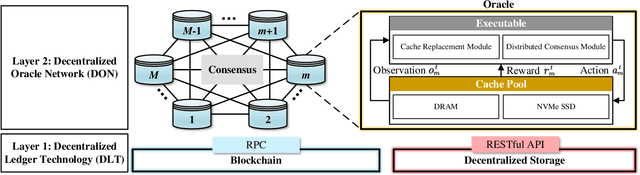
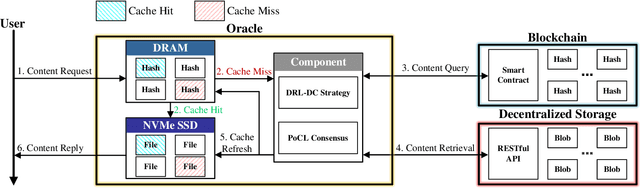
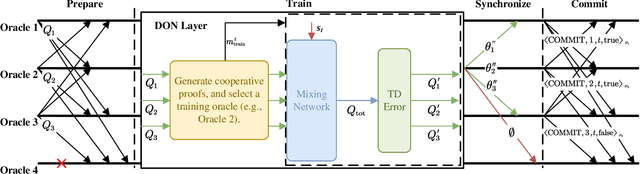
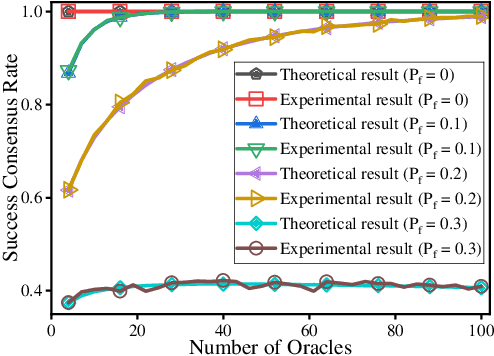
The rapid growth of Web3.0 is transforming the Internet from a centralized structure to decentralized, which empowers users with unprecedented self-sovereignty over their own data. However, in the context of decentralized data access within Web3.0, it is imperative to cope with efficiency concerns caused by the replication of redundant data, as well as security vulnerabilities caused by data inconsistency. To address these challenges, we develop a Trustworthy Decentralized Cooperative Caching (TDC-Cache) framework for Web3.0 to ensure efficient caching and enhance system resilience against adversarial threats. This framework features a two-layer architecture, wherein the Decentralized Oracle Network (DON) layer serves as a trusted intermediary platform for decentralized caching, bridging the contents from decentralized storage and the content requests from users. In light of the complexity of Web3.0 network topologies and data flows, we propose a Deep Reinforcement Learning-Based Decentralized Caching (DRL-DC) for TDC-Cache to dynamically optimize caching strategies of distributed oracles. Furthermore, we develop a Proof of Cooperative Learning (PoCL) consensus to maintain the consistency of decentralized caching decisions within DON. Experimental results show that, compared with existing approaches, the proposed framework reduces average access latency by 20%, increases the cache hit rate by at most 18%, and improves the average success consensus rate by 10%. Overall, this paper serves as a first foray into the investigation of decentralized caching framework and strategy for Web3.0.
Privacy-preserving Preselection for Face Identification Based on Packing
Jul 03, 2025Face identification systems operating in the ciphertext domain have garnered significant attention due to increasing privacy concerns and the potential recovery of original facial data. However, as the size of ciphertext template libraries grows, the face retrieval process becomes progressively more time-intensive. To address this challenge, we propose a novel and efficient scheme for face retrieval in the ciphertext domain, termed Privacy-Preserving Preselection for Face Identification Based on Packing (PFIP). PFIP incorporates an innovative preselection mechanism to reduce computational overhead and a packing module to enhance the flexibility of biometric systems during the enrollment stage. Extensive experiments conducted on the LFW and CASIA datasets demonstrate that PFIP preserves the accuracy of the original face recognition model, achieving a 100% hit rate while retrieving 1,000 ciphertext face templates within 300 milliseconds. Compared to existing approaches, PFIP achieves a nearly 50x improvement in retrieval efficiency.
Semi-supervised Node Importance Estimation with Informative Distribution Modeling for Uncertainty Regularization
Mar 26, 2025Node importance estimation, a classical problem in network analysis, underpins various web applications. Previous methods either exploit intrinsic topological characteristics, e.g., graph centrality, or leverage additional information, e.g., data heterogeneity, for node feature enhancement. However, these methods follow the supervised learning setting, overlooking the fact that ground-truth node-importance data are usually partially labeled in practice. In this work, we propose the first semi-supervised node importance estimation framework, i.e., EASING, to improve learning quality for unlabeled data in heterogeneous graphs. Different from previous approaches, EASING explicitly captures uncertainty to reflect the confidence of model predictions. To jointly estimate the importance values and uncertainties, EASING incorporates DJE, a deep encoder-decoder neural architecture. DJE introduces distribution modeling for graph nodes, where the distribution representations derive both importance and uncertainty estimates. Additionally, DJE facilitates effective pseudo-label generation for the unlabeled data to enrich the training samples. Based on labeled and pseudo-labeled data, EASING develops effective semi-supervised heteroscedastic learning with varying node uncertainty regularization. Extensive experiments on three real-world datasets highlight the superior performance of EASING compared to competing methods. Codes are available via https://github.com/yankai-chen/EASING.