 Add to Chrome
 Add to Firefox
 Add to Edge
Workflow-Localized Mechanism Learning: Attribution-Guided Repair and Knowledge Reuse for Structured Agent Skills
Jul 23, 2026
Agent Skills package reusable procedural knowledge as external artifacts for frozen language-model agents, yet existing optimizers do not jointly resolve where a failure occurs in a workflow, which mechanism caused it, and how relevant knowledge from third-party Skills should be reused locally. We introduce Workflow-Localized Mechanism Learning (WML). Its Node--Mechanism Attribution identifies the failed workflow node, implicated mechanisms, and smallest valid edit target, routing single-mechanism defects to L3 resources and relational defects across mechanisms to L2 composition protocols. A six-module Workflow-Guided Skill Optimization (WGSO) loop then selects provenance- and scope-aware third-party knowledge, applies bounded patches, evaluates candidates, and stores verified outcomes in optimizer-side memory. On SpreadsheetBench, WML reaches 90.33 +/- 1.53 and 74.67 +/- 3.51 Hard Accuracy with DeepSeek and Qwen3.6-Flash, respectively; without additional optimization, the learned Skills transfer to WikiTableQuestions with 84.00 +/- 2.00 and 83.00 +/- 2.00 Denotation Accuracy. On Compiler-Supported50, WML attains both the highest hard-PASS rate and the lowest cost per successful task; compiled execution sharply reduces tokens and calls relative to a direct SkillAgent while retaining most of its successful tasks. Code and artifacts are available at https://github.com/xiaolin9595/workflow-localized-mechanism-learning.

Distributed General-Purpose Agent Networks: Architecture, Key Mechanisms, and Prototypes
Jun 15, 2026Large language models have accelerated the transition from passive conversational assistants to autonomous agents that can understand goals, plan actions, invoke tools, and execute multi-step tasks. Yet the capability of a single agent remains constrained by its local data, tool permissions, runtime environment, and governance boundary. This paper studies distributed general-purpose agent networks: open peer-to-peer networks in which heterogeneous agents deployed on personal devices, edge nodes, or autonomous computing environments can discover one another, establish trust, negotiate cooperation rules, and execute open-ended tasks. We argue that such networks cannot be obtained by simply combining existing peer-to-peer overlays with conventional multi-agent systems. Unlike traditional P2P networks, agent networks must propagate semantic declarations about intentions, capabilities, states, and cooperation constraints. We therefore propose a layered architecture centered on a protocol adaptation layer that connects upper-level task semantics with lower-level network operations. Based on this architecture, the paper identifies three core mechanism problems: semantic announcement propagation for collaborator discovery, verifiable identity and multi-topic reputation for cooperation governance, and semantic-gradient mechanism design for open task execution. For each problem, we present a technical route, including bodyless gossip with sequential logs, BAID-based identity binding with MG-EigenTrust reputation, and a Stackelberg-style mechanism-generation loop driven by semantic attribution feedback. We further report prototype overhead results for BAID-style tiered verification and mechanism-level simulations of MG-EigenTrust under cross-topic disguise-collusion attacks. The resulting framework provides a system-level foundation for open, trustworthy, and scalable agent collaboration.
LLMCount: Enhancing Stationary mmWave Detection with Multimodal-LLM
Sep 24, 2024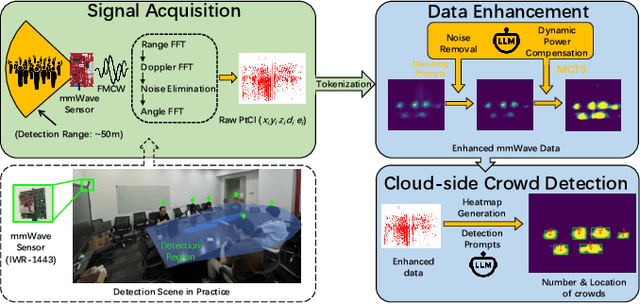
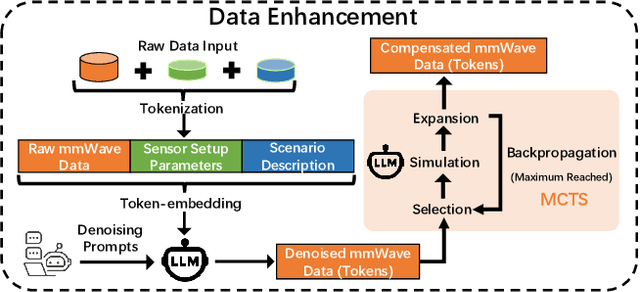
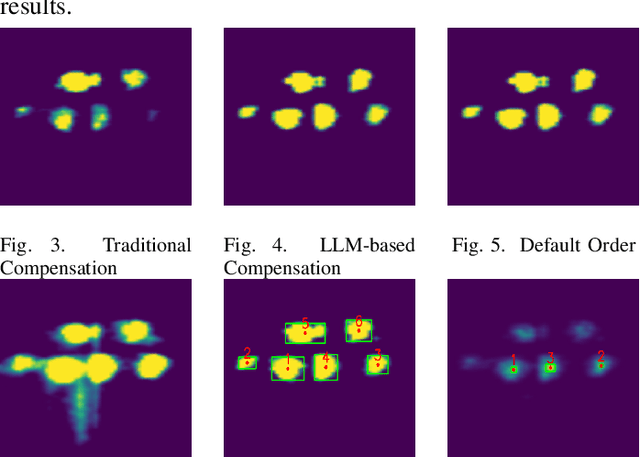
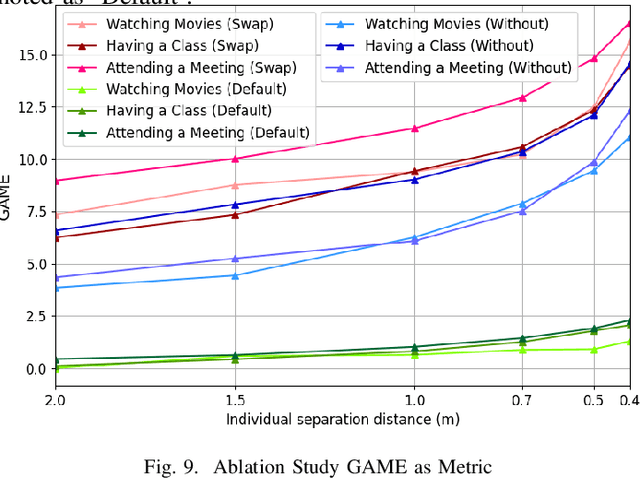
Millimeter wave sensing provides people with the capability of sensing the surrounding crowds in a non-invasive and privacy-preserving manner, which holds huge application potential. However, detecting stationary crowds remains challenging due to several factors such as minimal movements (like breathing or casual fidgets), which can be easily treated as noise clusters during data collection and consequently filtered in the following processing procedures. Additionally, the uneven distribution of signal power due to signal power attenuation and interferences resulting from external reflectors or absorbers further complicates accurate detection. To address these challenges and enable stationary crowd detection across various application scenarios requiring specialized domain adaption, we introduce LLMCount, the first system to harness the capabilities of large-language models (LLMs) to enhance crowd detection performance. By exploiting the decision-making capability of LLM, we can successfully compensate the signal power to acquire a uniform distribution and thereby achieve a detection with higher accuracy. To assess the system's performance, comprehensive evaluations are conducted under diversified scenarios like hall, meeting room, and cinema. The evaluation results show that our proposed approach reaches high detection accuracy with lower overall latency compared with previous methods.