 Add to Chrome
 Add to Firefox
 Add to Edge
Latent Dynamics for Full Body Avatar Animation
May 20, 2026
Pose-driven full-body avatars built on neural rendering produce high-quality novel views of a captured subject. Yet loose clothing and other dynamic elements deform in ways pose alone cannot explain: the same pose can correspond to many different states, because their motion depends on history, inertia, and contact. Explicit simulation and layered-garment methods can model such dynamics, but they require either a dedicated garment template, which raw multi-view capture does not naturally provide, or a test-time physics simulator with non-trivial runtime cost. A parallel line of work learns data-driven clothing avatars that avoid explicit garment layers. These methods add an auxiliary latent for variation beyond pose; at inference, they fix it, regress it from pose, or retrieve it from training data, without explicitly modeling how the latent evolves with its own dynamics. Additionally, even in everyday motion with loose clothing, existing architectures often struggle to capture fine-grained detail, producing blurry renderings and temporal artifacts. We augment a pose-conditioned 3D Gaussian avatar with a transformer-based decoder and a dynamics residual latent that captures temporal appearance and geometry variation beyond the driving signals. At inference, a learned latent dynamics model evolves the residual latent from a short pose history and the previous latent state. The model decomposes each update into driving, restoring, and dissipative forces, producing temporally coherent, history-dependent rollouts with negligible added cost. Different initial conditions yield diverse yet plausible motion trajectories, and the force decomposition exposes controls such as stiffness. Across nine captured sequences of everyday motion with diverse loose garments, quantitative metrics and a perceptual user study show improved animation quality over recent data-driven baselines.

HyperBones: Realtime Bone-driven Neural Garment Simulation with Hypernetwork Conditioning
May 19, 2026Recent advances in garment simulation have brought high-quality results closer to real-time performance. Physics-based simulators can produce accurate motion, but remain too computationally expensive for interactive applications. In contrast, linear blend skinning is efficient, but cannot capture the complex dynamics of loose-fitting garments, often leading to unrealistic motion and visual artifacts. Neural methods offer a promising alternative, yet they still struggle to animate loose clothing plausibly under strict runtime constraints. We present a fast and physically plausible approach for dynamic garment simulation. Our method trains a reduced-space neural dynamics simulator composed of independent coarse- and fine-level components. At the coarse level, the garment is driven by a set of virtual bones integrated with a lightweight neural network. Fine-scale wrinkle details are then recovered using a trained convolutional neural map. By decoupling identity-specific computation from real-time neural integration, our architecture maintains high performance while supporting diverse body shapes and motions. We further introduce an effective physics-supervision scheme that enables accurate results without relying on an external simulator. Experiments show that our method produces physically plausible garment dynamics, generalizes across a range of motions and body shapes, and supports a fixed set of garments. Our simulator runs at 300+ FPS on a commodity GPU, making it suitable for real-time applications.
Large-scale Codec Avatars: The Unreasonable Effectiveness of Large-scale Avatar Pretraining
Apr 02, 2026High-quality 3D avatar modeling faces a critical trade-off between fidelity and generalization. On the one hand, multi-view studio data enables high-fidelity modeling of humans with precise control over expressions and poses, but it struggles to generalize to real-world data due to limited scale and the domain gap between the studio environment and the real world. On the other hand, recent large-scale avatar models trained on millions of in-the-wild samples show promise for generalization across a wide range of identities, yet the resulting avatars are often of low-quality due to inherent 3D ambiguities. To address this, we present Large-Scale Codec Avatars (LCA), a high-fidelity, full-body 3D avatar model that generalizes to world-scale populations in a feedforward manner, enabling efficient inference. Inspired by the success of large language models and vision foundation models, we present, for the first time, a pre/post-training paradigm for 3D avatar modeling at scale: we pretrain on 1M in-the-wild videos to learn broad priors over appearance and geometry, then post-train on high-quality curated data to enhance expressivity and fidelity. LCA generalizes across hair styles, clothing, and demographics while providing precise, fine-grained facial expressions and finger-level articulation control, with strong identity preservation. Notably, we observe emergent generalization to relightability and loose garment support to unconstrained inputs, and zero-shot robustness to stylized imagery, despite the absence of direct supervision.
MHR: Momentum Human Rig
Nov 19, 2025We present MHR, a parametric human body model that combines the decoupled skeleton/shape paradigm of ATLAS with a flexible, modern rig and pose corrective system inspired by the Momentum library. Our model enables expressive, anatomically plausible human animation, supporting non-linear pose correctives, and is designed for robust integration in AR/VR and graphics pipelines.
FRESA:Feedforward Reconstruction of Personalized Skinned Avatars from Few Images
Mar 24, 2025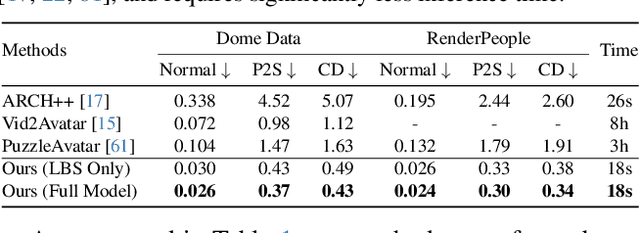
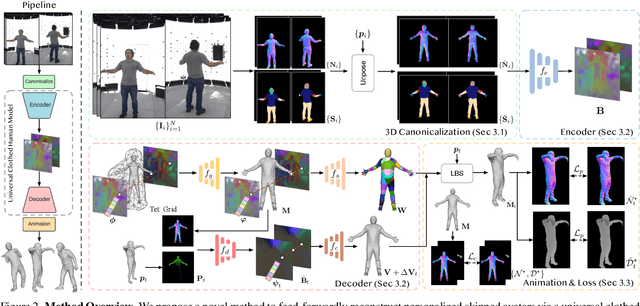
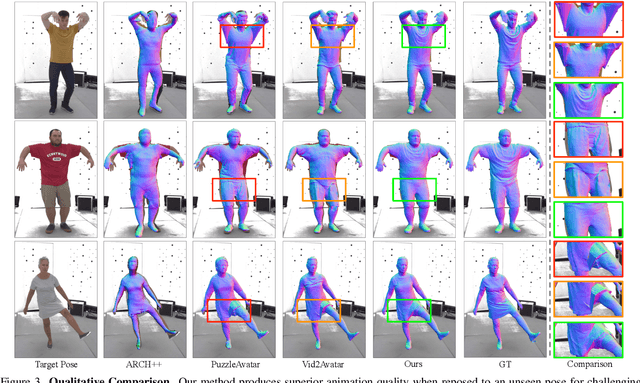
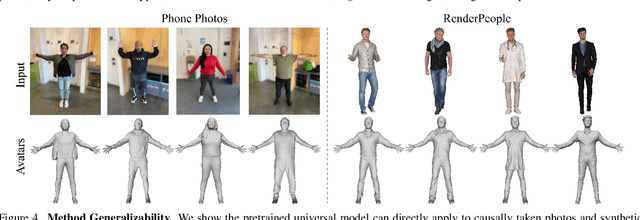
We present a novel method for reconstructing personalized 3D human avatars with realistic animation from only a few images. Due to the large variations in body shapes, poses, and cloth types, existing methods mostly require hours of per-subject optimization during inference, which limits their practical applications. In contrast, we learn a universal prior from over a thousand clothed humans to achieve instant feedforward generation and zero-shot generalization. Specifically, instead of rigging the avatar with shared skinning weights, we jointly infer personalized avatar shape, skinning weights, and pose-dependent deformations, which effectively improves overall geometric fidelity and reduces deformation artifacts. Moreover, to normalize pose variations and resolve coupled ambiguity between canonical shapes and skinning weights, we design a 3D canonicalization process to produce pixel-aligned initial conditions, which helps to reconstruct fine-grained geometric details. We then propose a multi-frame feature aggregation to robustly reduce artifacts introduced in canonicalization and fuse a plausible avatar preserving person-specific identities. Finally, we train the model in an end-to-end framework on a large-scale capture dataset, which contains diverse human subjects paired with high-quality 3D scans. Extensive experiments show that our method generates more authentic reconstruction and animation than state-of-the-arts, and can be directly generalized to inputs from casually taken phone photos. Project page and code is available at https://github.com/rongakowang/FRESA.
Rethinking Video-Text Understanding: Retrieval from Counterfactually Augmented Data
Jul 18, 2024Recent video-text foundation models have demonstrated strong performance on a wide variety of downstream video understanding tasks. Can these video-text models genuinely understand the contents of natural videos? Standard video-text evaluations could be misleading as many questions can be inferred merely from the objects and contexts in a single frame or biases inherent in the datasets. In this paper, we aim to better assess the capabilities of current video-text models and understand their limitations. We propose a novel evaluation task for video-text understanding, namely retrieval from counterfactually augmented data (RCAD), and a new Feint6K dataset. To succeed on our new evaluation task, models must derive a comprehensive understanding of the video from cross-frame reasoning. Analyses show that previous video-text foundation models can be easily fooled by counterfactually augmented data and are far behind human-level performance. In order to narrow the gap between video-text models and human performance on RCAD, we identify a key limitation of current contrastive approaches on video-text data and introduce LLM-teacher, a more effective approach to learn action semantics by leveraging knowledge obtained from a pretrained large language model. Experiments and analyses show that our approach successfully learn more discriminative action embeddings and improves results on Feint6K when applied to multiple video-text models. Our Feint6K dataset and project page is available at https://feint6k.github.io.
ABC: A Big CAD Model Dataset For Geometric Deep Learning
Dec 15, 2018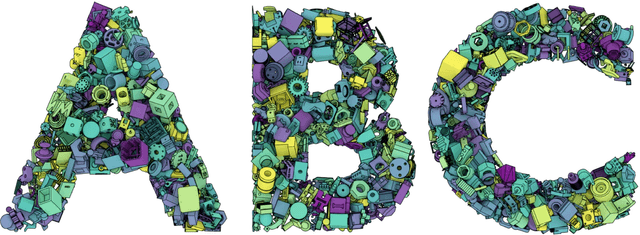
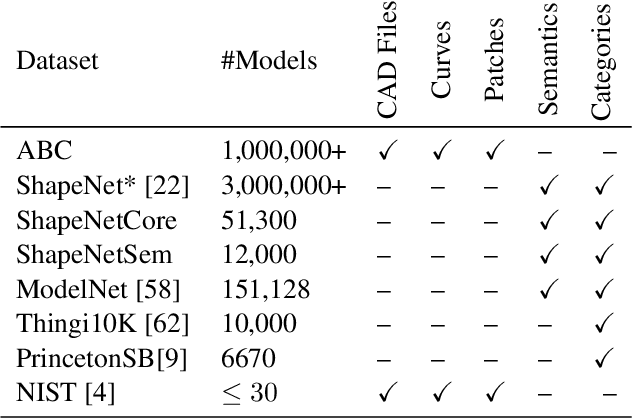

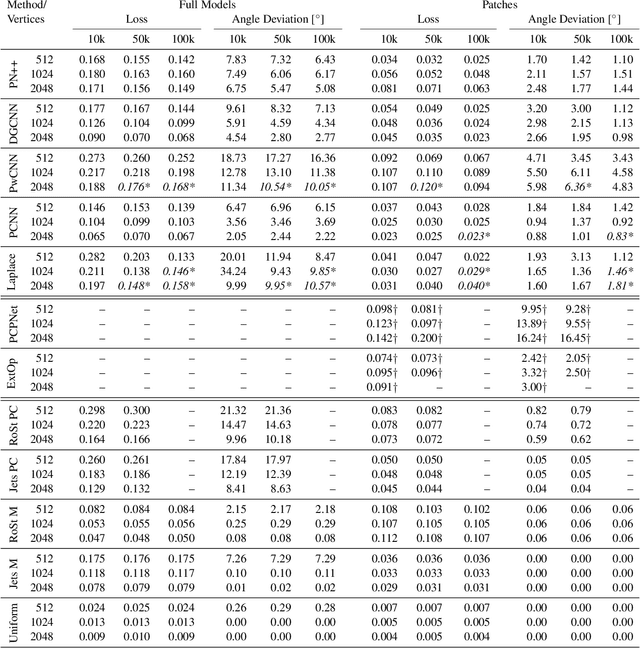
We introduce ABC-Dataset, a collection of one million Computer-Aided Design (CAD) models for research of geometric deep learning methods and applications. Each model is a collection of explicitly parametrized curves and surfaces, providing ground truth for differential quantities, patch segmentation, geometric feature detection, and shape reconstruction. Sampling the parametric descriptions of surfaces and curves allows generating data in different formats and resolutions, enabling fair comparisons for a wide range of geometric learning algorithms. As a use case for our dataset, we perform a large-scale benchmark for estimation of surface normals, comparing existing data driven methods and evaluating their performance against both the ground truth and traditional normal estimation methods.
Surface Networks
Jun 18, 2018
We study data-driven representations for three-dimensional triangle meshes, which are one of the prevalent objects used to represent 3D geometry. Recent works have developed models that exploit the intrinsic geometry of manifolds and graphs, namely the Graph Neural Networks (GNNs) and its spectral variants, which learn from the local metric tensor via the Laplacian operator. Despite offering excellent sample complexity and built-in invariances, intrinsic geometry alone is invariant to isometric deformations, making it unsuitable for many applications. To overcome this limitation, we propose several upgrades to GNNs to leverage extrinsic differential geometry properties of three-dimensional surfaces, increasing its modeling power. In particular, we propose to exploit the Dirac operator, whose spectrum detects principal curvature directions --- this is in stark contrast with the classical Laplace operator, which directly measures mean curvature. We coin the resulting models \emph{Surface Networks (SN)}. We prove that these models define shape representations that are stable to deformation and to discretization, and we demonstrate the efficiency and versatility of SNs on two challenging tasks: temporal prediction of mesh deformations under non-linear dynamics and generative models using a variational autoencoder framework with encoders/decoders given by SNs.