 Add to Chrome
 Add to Firefox
 Add to Edge
OmniFaceRig: Fully Automatic Inner-Mouth-Aware Face Rigging Across Diverse 3D Character Topologies
Jun 06, 2026
Facial rigging - creating FACS-based blendshapes together with inner-mouth geometry (teeth, gums, and tongue) - remains a major bottleneck in 3D character production. Existing pipelines still require substantial designer effort, especially for manual landmark annotation, per-character template adjustment, and inner-mouth placement. We present OmniFaceRig, a fully automatic end-to-end pipeline that converts a static surface-only 3D character mesh, with no pre-modeled oral cavity, into an inner-mouth-aware FACS rig with up to 155 blendshapes, procedurally fitted teeth, gums, and tongue, and re-packed UV/texture. OmniFaceRig supports diverse topologies - humans, humanoids, long-muzzled animals (e.g., dogs, wolves, foxes), and short-muzzled animals (e.g., cats, bears, rabbits, tigers) - with no manual landmarks, no user-provided templates, and no per-asset setup. The pipeline combines hybrid VLM+CV riggability checking, multi-model face parsing, dense keypoint-driven template registration, procedural inner-mouth construction, and collision-aware blendshape transfer. For non-human characters, OmniFaceRig selects topology-specific face and inner-mouth templates and uses collision-aware inner-mouth fitting to reduce teeth-face intersections without exposing users to category-specific tuning. We also publicly release Omni-Bench, a freely available benchmark dataset of 1,000 biped 3D characters with FACS facial blendshapes and inner-mouth geometry, spanning humans, humanoids, cats, dogs, and other animals. Experiments show high final rigging success on screened Omni-Bench inputs, nearly complete face detection recall from the segmentation ensemble and reliable inner-mouth placement with low penetration. Together, OmniFaceRig provides an automatic path from static generated characters to animation-ready facial rigs across both human and non-human topologies.

HyperBones: Realtime Bone-driven Neural Garment Simulation with Hypernetwork Conditioning
May 19, 2026Recent advances in garment simulation have brought high-quality results closer to real-time performance. Physics-based simulators can produce accurate motion, but remain too computationally expensive for interactive applications. In contrast, linear blend skinning is efficient, but cannot capture the complex dynamics of loose-fitting garments, often leading to unrealistic motion and visual artifacts. Neural methods offer a promising alternative, yet they still struggle to animate loose clothing plausibly under strict runtime constraints. We present a fast and physically plausible approach for dynamic garment simulation. Our method trains a reduced-space neural dynamics simulator composed of independent coarse- and fine-level components. At the coarse level, the garment is driven by a set of virtual bones integrated with a lightweight neural network. Fine-scale wrinkle details are then recovered using a trained convolutional neural map. By decoupling identity-specific computation from real-time neural integration, our architecture maintains high performance while supporting diverse body shapes and motions. We further introduce an effective physics-supervision scheme that enables accurate results without relying on an external simulator. Experiments show that our method produces physically plausible garment dynamics, generalizes across a range of motions and body shapes, and supports a fixed set of garments. Our simulator runs at 300+ FPS on a commodity GPU, making it suitable for real-time applications.
RigidFormer: Learning Rigid Dynamics using Transformers
May 09, 2026Learning-based simulation of multi-object rigid-body dynamics remains difficult because contact is discontinuous and errors compound over long horizons. Most existing methods remain tied to mesh connectivity and vertex-level message passing, which limits their applicability to mesh-free inputs such as point clouds and leads to high computational cost. Efficiently modeling high-fidelity rigid-body dynamics from mesh-free representations, therefore, remains challenging. We introduce RigidFormer, an object-centric Transformer-based model that learns mesh-free rigid-body dynamics with controllable integration step sizes. RigidFormer reasons at the object level and advances each object through compact anchors; Anchor-Vertex Pooling enriches these anchors with local vertex features, retaining contact-relevant geometry without dense vertex-level interaction. We propose Anchor-based RoPE to inject anchor geometry into attention while respecting the unordered nature of objects and anchors: object-token processing is permutation-equivariant, and the mean-pooled anchor descriptor is invariant to anchor reindexing while preserving shape extent. RigidFormer further enforces rigidity by projecting updates onto the rigid-body manifold using differentiable Kabsch alignment. On standard benchmarks, RigidFormer outperforms or matches mesh-based baselines using point inputs, runs faster, generalizes to unseen point resolutions and across datasets, and scales to 200+ objects; we also show a preliminary extension to command-conditioned articulated bodies by treating body parts as interacting object-level components.
HairWeaver: Few-Shot Photorealistic Hair Motion Synthesis with Sim-to-Real Guided Video Diffusion
Feb 11, 2026We present HairWeaver, a diffusion-based pipeline that animates a single human image with realistic and expressive hair dynamics. While existing methods successfully control body pose, they lack specific control over hair, and as a result, fail to capture the intricate hair motions, resulting in stiff and unrealistic animations. HairWeaver overcomes this limitation using two specialized modules: a Motion-Context-LoRA to integrate motion conditions and a Sim2Real-Domain-LoRA to preserve the subject's photoreal appearance across different data domains. These lightweight components are designed to guide a video diffusion backbone while maintaining its core generative capabilities. By training on a specialized dataset of dynamic human motion generated from a CG simulator, HairWeaver affords fine control over hair motion and ultimately learns to produce highly realistic hair that responds naturally to movement. Comprehensive evaluations demonstrate that our approach sets a new state of the art, producing lifelike human hair animations with dynamic details.
Quaffure: Real-Time Quasi-Static Neural Hair Simulation
Dec 13, 2024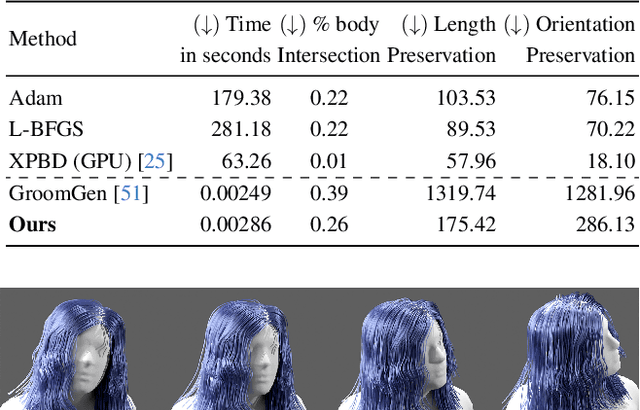
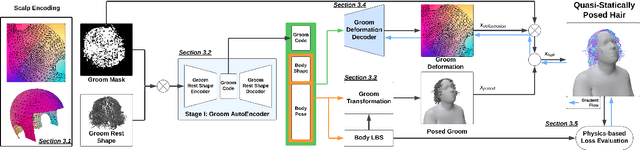
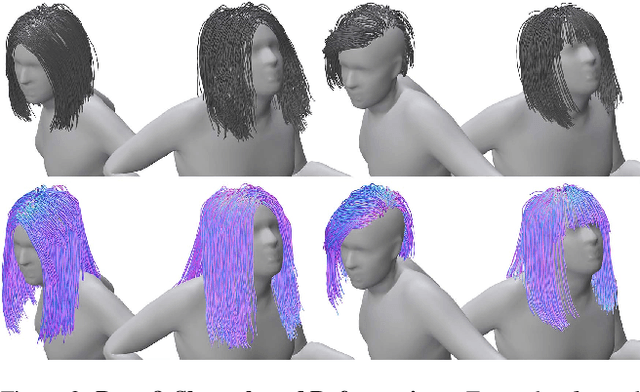
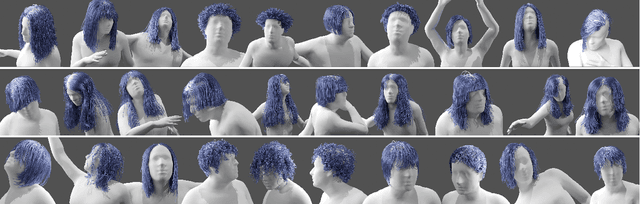
Realistic hair motion is crucial for high-quality avatars, but it is often limited by the computational resources available for real-time applications. To address this challenge, we propose a novel neural approach to predict physically plausible hair deformations that generalizes to various body poses, shapes, and hairstyles. Our model is trained using a self-supervised loss, eliminating the need for expensive data generation and storage. We demonstrate our method's effectiveness through numerous results across a wide range of pose and shape variations, showcasing its robust generalization capabilities and temporally smooth results. Our approach is highly suitable for real-time applications with an inference time of only a few milliseconds on consumer hardware and its ability to scale to predicting the drape of 1000 grooms in 0.3 seconds.