 Add to Chrome
 Add to Firefox
 Add to Edge
SR-Agent: An Experience-Driven Agentic Framework for Post-Ranking Strategy Refinement in E-Commerce Recommendation
Jul 21, 2026
User experience is a first-class objective in industrial e-commerce recommender systems (RS). Post-ranking strategies, which govern diversity, similarity, and exposure over a ranked list, are widely deployed in industrial RS for their simplicity and low serving cost. However, as the online recommendation environment evolves continuously, these statically configured strategies gradually become stale, thereby degrading the user experience. Refining them typically relies on manual inspection, diagnosis, and updates, making it slow, costly, and difficult to scale or reuse. Although recent LLM-based agents (e.g., RecUserSim, SimUSER, and Self-EvolveRec) offer promising directions, none of them close the full loop of automated, self-evolving strategy refinement. To bridge this gap, we introduce SR-Agent, which, to the best of our knowledge, is the first agentic framework deployed to refine post-ranking strategies in industrial RS. SR-Agent unifies three components: (i) a UserSim agent that applies inspection skills to surface user-perceived bad cases; (ii) an Analysis agent that consolidates recurring bad cases into structured, reusable diagnoses; and (iii) a constrained Strategy Refinement Harness that maps diagnoses to typed and bounded actions, gated by a four-stage reward pipeline with reversible rollback. Deployed on the Kuaishou e-commerce platform, SR-Agent continuously runs this refinement loop and, in a one-month online A/B test, increases order volume by 0.71%, browsing depth by 0.34%, and clicked-category diversity by 0.48%, while markedly shortening the refinement cycle and lowering operational cost.

Awakening Dormant Users: Generative Recommendation with Counterfactual Functional Role Reasoning
Feb 13, 2026Awakening dormant users, who remain engaged but exhibit low conversion, is a pivotal driver for incremental GMV growth in large-scale e-commerce platforms. However, existing approaches often yield suboptimal results since they typically rely on single-step estimation of an item's intrinsic value (e.g., immediate click probability). This mechanism overlooks the instrumental effect of items, where specific interactions act as triggers to shape latent intent and drive subsequent decisions along a conversion trajectory. To bridge this gap, we propose RoleGen, a novel framework that synergizes a Conversion Trajectory Reasoner with a Generative Behavioral Backbone. Specifically, the LLM-based Reasoner explicitly models the context-dependent Functional Role of items to reconstruct intent evolution. It further employs counterfactual inference to simulate diverse conversion paths, effectively mitigating interest collapse. These reasoned candidate items are integrated into the generative backbone, which is optimized via a collaborative "Reasoning-Execution-Feedback-Reflection" closed-loop strategy to ensure grounded execution. Extensive offline experiments and online A/B testing on the Kuaishou e-commerce platform demonstrate that RoleGen achieves a 6.2% gain in Recall@1 and a 7.3% increase in online order volume, confirming its effectiveness in activating the dormant user base.
QARM V2: Quantitative Alignment Multi-Modal Recommendation for Reasoning User Sequence Modeling
Feb 09, 2026With the evolution of large language models (LLMs), there is growing interest in leveraging their rich semantic understanding to enhance industrial recommendation systems (RecSys). Traditional RecSys relies on ID-based embeddings for user sequence modeling in the General Search Unit (GSU) and Exact Search Unit (ESU) paradigm, which suffers from low information density, knowledge isolation, and weak generalization ability. While LLMs offer complementary strengths with dense semantic representations and strong generalization, directly applying LLM embeddings to RecSys faces critical challenges: representation unmatch with business objectives and representation unlearning end-to-end with downstream tasks. In this paper, we present QARM V2, a unified framework that bridges LLM semantic understanding with RecSys business requirements for user sequence modeling.
SMILE: SeMantic Ids Enhanced CoLd Item Representation for Click-through Rate Prediction in E-commerce SEarch
Oct 14, 2025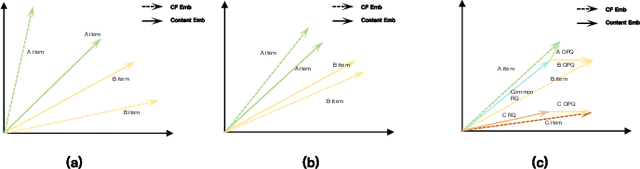
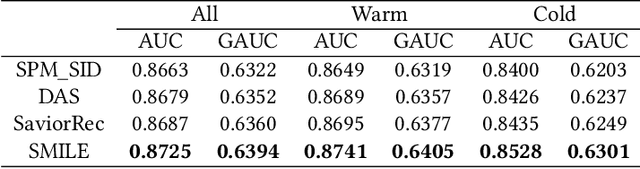
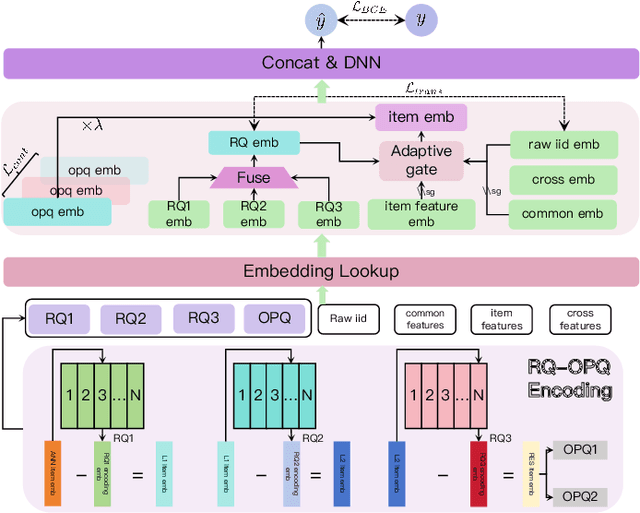
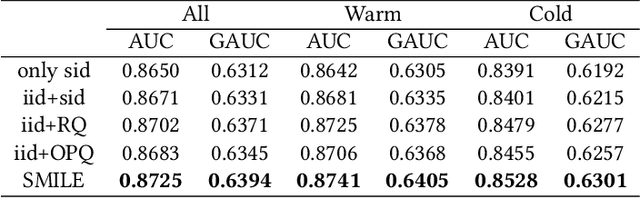
With the rise of modern search and recommendation platforms, insufficient collaborative information of cold-start items exacerbates the Matthew effect of existing platform items, challenging platform diversity and becoming a longstanding issue. Existing methods align items' side content with collaborative information to transfer collaborative signals from high-popularity items to cold-start items. However, these methods fail to account for the asymmetry between collaboration and content, nor the fine-grained differences among items. To address these issues, we propose SMILE, an item representation enhancement approach based on fused alignment of semantic IDs. Specifically, we use RQ-OPQ encoding to quantize item content and collaborative information, followed by a two-step alignment: RQ encoding transfers shared collaborative signals across items, while OPQ encoding learns differentiated information of items. Comprehensive offline experiments on large-scale industrial datasets demonstrate superiority of SMILE, and rigorous online A/B tests confirm statistically significant improvements: item CTR +1.66%, buyers +1.57%, and order volume +2.17%.
DiffusionGS: Generative Search with Query Conditioned Diffusion in Kuaishou
Aug 25, 2025
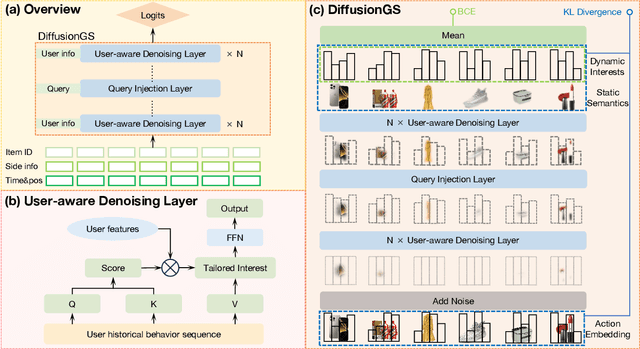
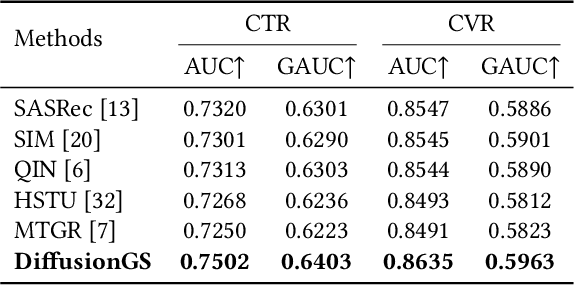
Personalized search ranking systems are critical for driving engagement and revenue in modern e-commerce and short-video platforms. While existing methods excel at estimating users' broad interests based on the filtered historical behaviors, they typically under-exploit explicit alignment between a user's real-time intent (represented by the user query) and their past actions. In this paper, we propose DiffusionGS, a novel and scalable approach powered by generative models. Our key insight is that user queries can serve as explicit intent anchors to facilitate the extraction of users' immediate interests from long-term, noisy historical behaviors. Specifically, we formulate interest extraction as a conditional denoising task, where the user's query guides a conditional diffusion process to produce a robust, user intent-aware representation from their behavioral sequence. We propose the User-aware Denoising Layer (UDL) to incorporate user-specific profiles into the optimization of attention distribution on the user's past actions. By reframing queries as intent priors and leveraging diffusion-based denoising, our method provides a powerful mechanism for capturing dynamic user interest shifts. Extensive offline and online experiments demonstrate the superiority of DiffusionGS over state-of-the-art methods.