 Add to Chrome
 Add to Firefox
 Add to Edge
Back to Blackwell: Closing the Loop on Intransitivity in Multi-Objective Preference Fine-Tuning
Feb 22, 2026
A recurring challenge in preference fine-tuning (PFT) is handling $\textit{intransitive}$ (i.e., cyclic) preferences. Intransitive preferences often stem from either $\textit{(i)}$ inconsistent rankings along a single objective or $\textit{(ii)}$ scalarizing multiple objectives into a single metric. Regardless of their source, the downstream implication of intransitive preferences is the same: there is no well-defined optimal policy, breaking a core assumption of the standard PFT pipeline. In response, we propose a novel, game-theoretic solution concept -- the $\textit{Maximum Entropy Blackwell Winner}$ ($\textit{MaxEntBW}$) -- that is well-defined under multi-objective intransitive preferences. To enable computing MaxEntBWs at scale, we derive $\texttt{PROSPER}$: a provably efficient PFT algorithm. Unlike prior self-play techniques, $\texttt{PROSPER}$ directly handles multiple objectives without requiring scalarization. We then apply $\texttt{PROSPER}$ to the problem of fine-tuning large language models (LLMs) from multi-objective LLM-as-a-Judge feedback (e.g., rubric-based judges), a setting where both sources of intransitivity arise. We find that $\texttt{PROSPER}$ outperforms all baselines considered across both instruction following and general chat benchmarks, releasing trained model checkpoints at the 7B and 3B parameter scales.

Rubrics as an Attack Surface: Stealthy Preference Drift in LLM Judges
Feb 14, 2026Evaluation and alignment pipelines for large language models increasingly rely on LLM-based judges, whose behavior is guided by natural-language rubrics and validated on benchmarks. We identify a previously under-recognized vulnerability in this workflow, which we term Rubric-Induced Preference Drift (RIPD). Even when rubric edits pass benchmark validation, they can still produce systematic and directional shifts in a judge's preferences on target domains. Because rubrics serve as a high-level decision interface, such drift can emerge from seemingly natural, criterion-preserving edits and remain difficult to detect through aggregate benchmark metrics or limited spot-checking. We further show this vulnerability can be exploited through rubric-based preference attacks, in which benchmark-compliant rubric edits steer judgments away from a fixed human or trusted reference on target domains, systematically inducing RIPD and reducing target-domain accuracy up to 9.5% (helpfulness) and 27.9% (harmlessness). When these judgments are used to generate preference labels for downstream post-training, the induced bias propagates through alignment pipelines and becomes internalized in trained policies. This leads to persistent and systematic drift in model behavior. Overall, our findings highlight evaluation rubrics as a sensitive and manipulable control interface, revealing a system-level alignment risk that extends beyond evaluator reliability alone. The code is available at: https://github.com/ZDCSlab/Rubrics-as-an-Attack-Surface. Warning: Certain sections may contain potentially harmful content that may not be appropriate for all readers.
Gained in Translation: Privileged Pairwise Judges Enhance Multilingual Reasoning
Jan 26, 2026When asked a question in a language less seen in its training data, current reasoning large language models (RLMs) often exhibit dramatically lower performance than when asked the same question in English. In response, we introduce \texttt{SP3F} (Self-Play with Privileged Pairwise Feedback), a two-stage framework for enhancing multilingual reasoning without \textit{any} data in the target language(s). First, we supervise fine-tune (SFT) on translated versions of English question-answer pairs to raise base model correctness. Second, we perform RL with feedback from a pairwise judge in a self-play fashion, with the judge receiving the English reference response as \textit{privileged information}. Thus, even when none of the model's responses are completely correct, the privileged pairwise judge can still tell which response is better. End-to-end, \texttt{SP3F} greatly improves base model performance, even outperforming fully post-trained models on multiple math and non-math tasks with less than of the training data across the single-language, multilingual, and generalization to unseen language settings.
Persona-Augmented Benchmarking: Evaluating LLMs Across Diverse Writing Styles
Jul 29, 2025Current benchmarks for evaluating Large Language Models (LLMs) often do not exhibit enough writing style diversity, with many adhering primarily to standardized conventions. Such benchmarks do not fully capture the rich variety of communication patterns exhibited by humans. Thus, it is possible that LLMs, which are optimized on these benchmarks, may demonstrate brittle performance when faced with "non-standard" input. In this work, we test this hypothesis by rewriting evaluation prompts using persona-based LLM prompting, a low-cost method to emulate diverse writing styles. Our results show that, even with identical semantic content, variations in writing style and prompt formatting significantly impact the estimated performance of the LLM under evaluation. Notably, we identify distinct writing styles that consistently trigger either low or high performance across a range of models and tasks, irrespective of model family, size, and recency. Our work offers a scalable approach to augment existing benchmarks, improving the external validity of the assessments they provide for measuring LLM performance across linguistic variations.
Measurement as Bricolage: Examining How Data Scientists Construct Target Variables for Predictive Modeling Tasks
Jul 03, 2025Data scientists often formulate predictive modeling tasks involving fuzzy, hard-to-define concepts, such as the "authenticity" of student writing or the "healthcare need" of a patient. Yet the process by which data scientists translate fuzzy concepts into a concrete, proxy target variable remains poorly understood. We interview fifteen data scientists in education (N=8) and healthcare (N=7) to understand how they construct target variables for predictive modeling tasks. Our findings suggest that data scientists construct target variables through a bricolage process, involving iterative negotiation between high-level measurement objectives and low-level practical constraints. Data scientists attempt to satisfy five major criteria for a target variable through bricolage: validity, simplicity, predictability, portability, and resource requirements. To achieve this, data scientists adaptively use problem (re)formulation strategies, such as swapping out one candidate target variable for another when the first fails to meet certain criteria (e.g., predictability), or composing multiple outcomes into a single target variable to capture a more holistic set of modeling objectives. Based on our findings, we present opportunities for future HCI, CSCW, and ML research to better support the art and science of target variable construction.
Enhancing One-run Privacy Auditing with Quantile Regression-Based Membership Inference
Jun 18, 2025Differential privacy (DP) auditing aims to provide empirical lower bounds on the privacy guarantees of DP mechanisms like DP-SGD. While some existing techniques require many training runs that are prohibitively costly, recent work introduces one-run auditing approaches that effectively audit DP-SGD in white-box settings while still being computationally efficient. However, in the more practical black-box setting where gradients cannot be manipulated during training and only the last model iterate is observed, prior work shows that there is still a large gap between the empirical lower bounds and theoretical upper bounds. Consequently, in this work, we study how incorporating approaches for stronger membership inference attacks (MIA) can improve one-run auditing in the black-box setting. Evaluating on image classification models trained on CIFAR-10 with DP-SGD, we demonstrate that our proposed approach, which utilizes quantile regression for MIA, achieves tighter bounds while crucially maintaining the computational efficiency of one-run methods.
Membership Inference Attacks for Unseen Classes
Jun 06, 2025Shadow model attacks are the state-of-the-art approach for membership inference attacks on machine learning models. However, these attacks typically assume an adversary has access to a background (nonmember) data distribution that matches the distribution the target model was trained on. We initiate a study of membership inference attacks where the adversary or auditor cannot access an entire subclass from the distribution -- a more extreme but realistic version of distribution shift than has been studied previously. In this setting, we first show that the performance of shadow model attacks degrades catastrophically, and then demonstrate the promise of another approach, quantile regression, that does not have the same limitations. We show that quantile regression attacks consistently outperform shadow model attacks in the class dropout setting -- for example, quantile regression attacks achieve up to 11$\times$ the TPR of shadow models on the unseen class on CIFAR-100, and achieve nontrivial TPR on ImageNet even with 90% of training classes removed. We also provide a theoretical model that illustrates the potential and limitations of this approach.
Breaking the Gold Standard: Extracting Forgotten Data under Exact Unlearning in Large Language Models
May 30, 2025Large language models are typically trained on datasets collected from the web, which may inadvertently contain harmful or sensitive personal information. To address growing privacy concerns, unlearning methods have been proposed to remove the influence of specific data from trained models. Of these, exact unlearning -- which retrains the model from scratch without the target data -- is widely regarded the gold standard, believed to be robust against privacy-related attacks. In this paper, we challenge this assumption by introducing a novel data extraction attack that compromises even exact unlearning. Our method leverages both the pre- and post-unlearning models: by guiding the post-unlearning model using signals from the pre-unlearning model, we uncover patterns that reflect the removed data distribution. Combining model guidance with a token filtering strategy, our attack significantly improves extraction success rates -- doubling performance in some cases -- across common benchmarks such as MUSE, TOFU, and WMDP. Furthermore, we demonstrate our attack's effectiveness on a simulated medical diagnosis dataset to highlight real-world privacy risks associated with exact unlearning. In light of our findings, which suggest that unlearning may, in a contradictory way, increase the risk of privacy leakage, we advocate for evaluation of unlearning methods to consider broader threat models that account not only for post-unlearning models but also for adversarial access to prior checkpoints.
Discretization-free Multicalibration through Loss Minimization over Tree Ensembles
May 23, 2025In recent years, multicalibration has emerged as a desirable learning objective for ensuring that a predictor is calibrated across a rich collection of overlapping subpopulations. Existing approaches typically achieve multicalibration by discretizing the predictor's output space and iteratively adjusting its output values. However, this discretization approach departs from the standard empirical risk minimization (ERM) pipeline, introduces rounding error and additional sensitive hyperparameter, and may distort the predictor's outputs in ways that hinder downstream decision-making. In this work, we propose a discretization-free multicalibration method that directly optimizes an empirical risk objective over an ensemble of depth-two decision trees. Our ERM approach can be implemented using off-the-shelf tree ensemble learning methods such as LightGBM. Our algorithm provably achieves multicalibration, provided that the data distribution satisfies a technical condition we term as loss saturation. Across multiple datasets, our empirical evaluation shows that this condition is always met in practice. Our discretization-free algorithm consistently matches or outperforms existing multicalibration approaches--even when evaluated using a discretization-based multicalibration metric that shares its discretization granularity with the baselines.
Generate-then-Verify: Reconstructing Data from Limited Published Statistics
Apr 29, 2025
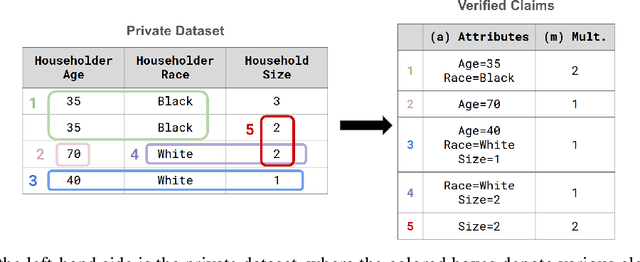
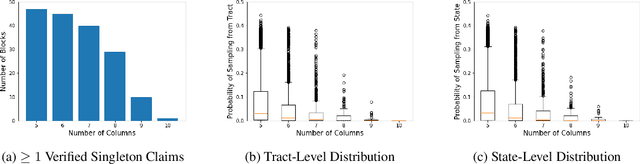
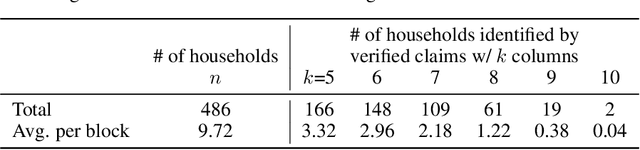
We study the problem of reconstructing tabular data from aggregate statistics, in which the attacker aims to identify interesting claims about the sensitive data that can be verified with 100% certainty given the aggregates. Successful attempts in prior work have conducted studies in settings where the set of published statistics is rich enough that entire datasets can be reconstructed with certainty. In our work, we instead focus on the regime where many possible datasets match the published statistics, making it impossible to reconstruct the entire private dataset perfectly (i.e., when approaches in prior work fail). We propose the problem of partial data reconstruction, in which the goal of the adversary is to instead output a $\textit{subset}$ of rows and/or columns that are $\textit{guaranteed to be correct}$. We introduce a novel integer programming approach that first $\textbf{generates}$ a set of claims and then $\textbf{verifies}$ whether each claim holds for all possible datasets consistent with the published aggregates. We evaluate our approach on the housing-level microdata from the U.S. Decennial Census release, demonstrating that privacy violations can still persist even when information published about such data is relatively sparse.