 Add to Chrome
 Add to Firefox
 Add to Edge
Reasoning Quality Emerges Early: Data Curation for Reasoning Models
Jun 25, 2026
Supervised fine-tuning (SFT) on a small, high-quality set of long reasoning traces is an effective approach for eliciting strong reasoning capabilities in Large Language Models (LLMs). However, existing methods for curating high-quality SFT data rely heavily on strong reasoning models to filter examples based on diversity and difficulty, making the curation process costly while often yielding suboptimal data quality. In this work, we show that diverse and challenging reasoning examples can be identified using only the initial reasoning tokens. Specifically, we demonstrate that difficult problems can be reliably detected based on the loss of the first 100 reasoning tokens evaluated at a randomly perturbed checkpoint of the pretrained model. We further show that examples exhibiting similar loss patterns over their first 1k reasoning tokens across a small number of perturbed checkpoints extrapolating along the fine-tuning trajectory provably induce similar gradients. We validate our approach through extensive experiments on fine-tuning Qwen2.5-7B and Llama3.1-8B models on the M23K medical reasoning and OpenThoughts-Math datasets. Our method outperforms existing baselines by up to 1.7% while being 91% more token efficient.

Discretization-free Multicalibration through Loss Minimization over Tree Ensembles
May 23, 2025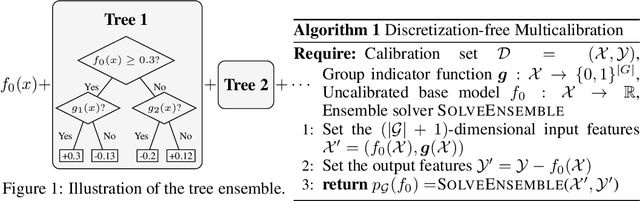
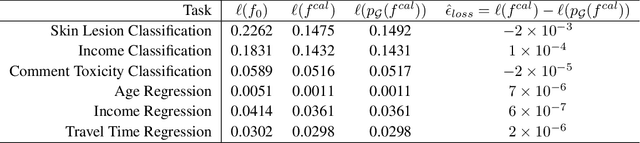
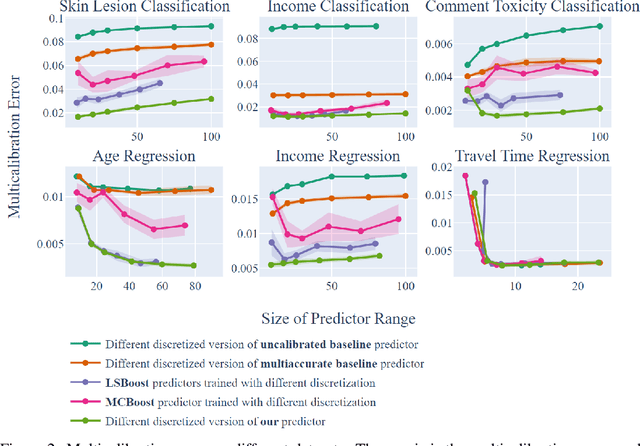
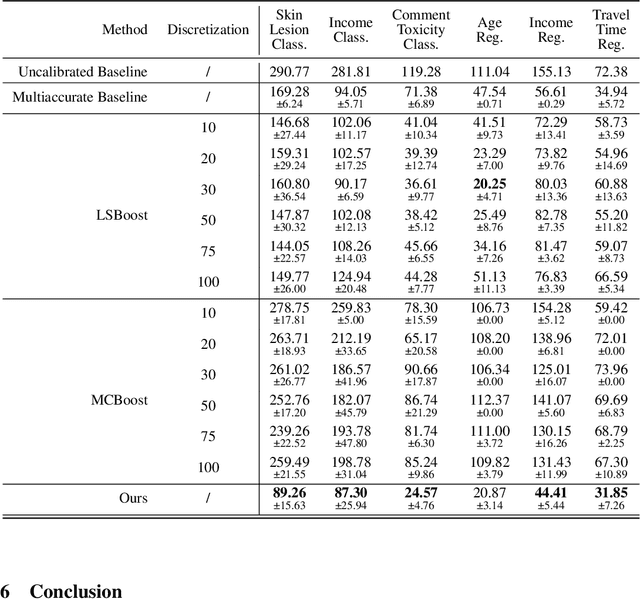
In recent years, multicalibration has emerged as a desirable learning objective for ensuring that a predictor is calibrated across a rich collection of overlapping subpopulations. Existing approaches typically achieve multicalibration by discretizing the predictor's output space and iteratively adjusting its output values. However, this discretization approach departs from the standard empirical risk minimization (ERM) pipeline, introduces rounding error and additional sensitive hyperparameter, and may distort the predictor's outputs in ways that hinder downstream decision-making. In this work, we propose a discretization-free multicalibration method that directly optimizes an empirical risk objective over an ensemble of depth-two decision trees. Our ERM approach can be implemented using off-the-shelf tree ensemble learning methods such as LightGBM. Our algorithm provably achieves multicalibration, provided that the data distribution satisfies a technical condition we term as loss saturation. Across multiple datasets, our empirical evaluation shows that this condition is always met in practice. Our discretization-free algorithm consistently matches or outperforms existing multicalibration approaches--even when evaluated using a discretization-based multicalibration metric that shares its discretization granularity with the baselines.