 Add to Chrome
 Add to Firefox
 Add to Edge
HorizonDrive: Self-Corrective Autoregressive World Model for Long-horizon Driving Simulation
May 12, 2026
Closed-loop driving simulation requires real-time interaction beyond short offline clips, pushing current driving world models toward autoregressive (AR) rollout. Existing AR distillation approaches typically rely on frame sinks or student-side degradation training. The former transfers poorly to driving due to fast ego-motion and rapid scene changes, while the latter remains bounded by the teacher's single-pass output length and thus provides only a limited supervision horizon. A natural question is: can the teacher itself be extended via AR rollout to provide unbounded-horizon supervision at bounded memory cost? The key difficulty is that a standard teacher drifts under its own predictions, contaminating the supervision it provides. Our key insight is to make the teacher rollout-capable, ensuring reliable supervision from its own AR rollouts. This is instantiated as HorizonDrive, an anti-drifting training-and-distillation framework for AR driving simulation. First, scheduled rollout recovery (SRR) trains the base model to reconstruct ground-truth future clips from prediction-corrupted histories, yielding a teacher that remains stable across long AR rollouts. Second, the rollout-capable teacher is extended via AR rollout, providing long-horizon distribution-matching supervision under bounded memory, while a short-window student aligns to it with teacher rollout DMD (TRD) for efficient real-time deployment. HorizonDrive natively supports minute-scale AR rollout under bounded memory; on nuScenes, HorizonDrive reduces FID by 52% and FVD by 37%, and lowers ARE and DTW by 21% and 9% relative to the strongest long-horizon streaming baselines, while remaining competitive with single-pass driving video generators.

OpenGV 2.0: Motion prior-assisted calibration and SLAM with vehicle-mounted surround-view systems
Mar 05, 2025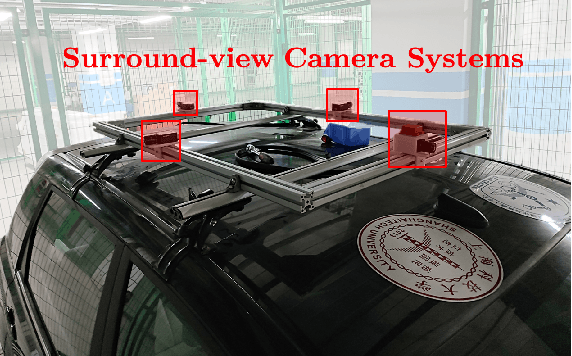
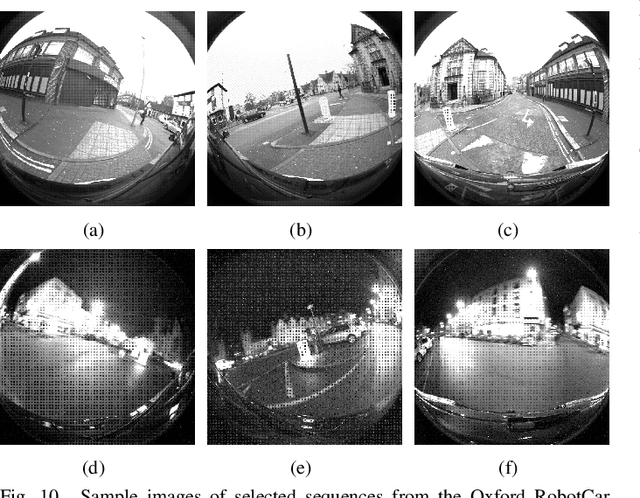
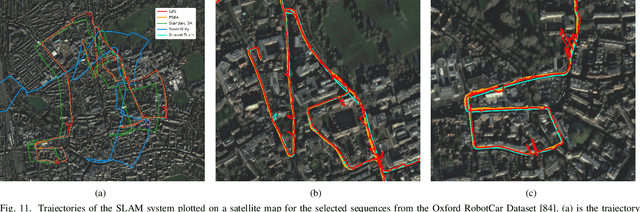
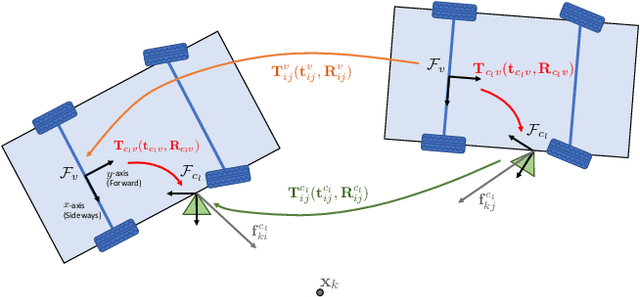
The present paper proposes optimization-based solutions to visual SLAM with a vehicle-mounted surround-view camera system. Owing to their original use-case, such systems often only contain a single camera facing into either direction and very limited overlap between fields of view. Our novelty consist of three optimization modules targeting at practical online calibration of exterior orientations from simple two-view geometry, reliable front-end initialization of relative displacements, and accurate back-end optimization using a continuous-time trajectory model. The commonality between the proposed modules is given by the fact that all three of them exploit motion priors that are related to the inherent non-holonomic characteristics of passenger vehicle motion. In contrast to prior related art, the proposed modules furthermore excel in terms of bypassing partial unobservabilities in the transformation variables that commonly occur for Ackermann-motion. As a further contribution, the modules are built into a novel surround-view camera SLAM system that specifically targets deployment on Ackermann vehicles operating in urban environments. All modules are studied in the context of in-depth ablation studies, and the practical validity of the entire framework is supported by a successful application to challenging, large-scale publicly available online datasets. Note that upon acceptance, the entire framework is scheduled for open-source release as part of an extension of the OpenGV library.