 Add to Chrome
 Add to Firefox
 Add to Edge
Action Chunk Scheduling for Batched Robot Policy Serving
Jul 31, 2026
Deploying robot foundation models at scale is the next step towards realizing the potential of general-purpose robots. However, Vision-Language-Action (VLA) and other foundation models are computationally demanding, and on-device compute is constrained by power and space. In this paper, we introduce the problem of serving a robot policy to multiple robots from a remote GPU and formulate it as a scheduling problem. We build Armory, a serving system validated on fleets of both simulated and real robots. Our experiments show that naive scheduling heuristics perform well when all robots are the same, but fall short when robots consume action chunks at different rates, uncovering a mismatch between conventional batching methods and the closed-loop requirements of robot policy execution. To address this, we propose a scheduling algorithm that accounts for this heterogeneity and improves overall system throughput by up to $18\%$ in real-world experiments. Additional details are available at https://gatech-rl2.github.io/actionchunkscheduling.

Static In, Dynamic Out: Counterfactual Action Augmentation for Moving Object Manipulation
Jul 30, 2026Visuomotor policies have advanced on manipulation tasks where the target object stays static during execution, but real deployments break this assumption: parts drift on conveyors and fruits sway in the wind. We introduce Static In, Dynamic Out (SIDO), a counterfactual action augmentation that enables a policy trained only on static object demonstrations to adapt to unseen object motion at test time. Our key idea is to factorize moving object manipulation into two sub-problems: predicting where the object will be, and reaching that predicted pose. SIDO displaces the object to a counterfactual future position and morphs the demonstrated action chunk to preserve the hand-object relative pose, yielding a goal-conditioned policy. At deployment an object pose predictor supplies the future position. Across three simulated tasks (Mug, Square, Stack) under five object motion patterns and two real-world tasks (Gantry, Peachtree), SIDO improves moving object success over the baselines while preserving static object performance. Project website: https://sido-staticindynamicout.github.io/.
WARP: Whole-Body Retargeting for Learning from Offline Human Demonstrations
Jun 29, 2026Direct transfer from human demonstration to learnable robot action is a crucial step towards scalable whole-body mobile manipulation. While human data scales better than mobile teleoperation, it requires overcoming significant embodiment gaps. Existing retargeting methods yield imprecise or inconsistent solutions, causing action multi-modality that prevents supervised policies from reliably converging. We present Whole-body-Aware Retargeting from human Pose (WARP), an offline pipeline that explicitly models embodiment differences to extract precise, unique whole-body actions. WARP leverages a closed-form Shoulder-Elbow-Wrist (SEW) geometric solver for exact end-effector tracking while preserving whole-body structural intent. Paired with lazy mobile-base control, it extracts accurate, consistent robot trajectories. Evaluations show WARP provides highly reliable data for open-loop real-world replay. To our knowledge, WARP is the first framework to achieve zero-shot whole-body mobile manipulation directly from offline human demonstrations, eliminating the need for human-in-the-loop teleoperation action data. More details on https://warp-retarget.github.io/
EgoEngine: From Egocentric Human Videos to High-Fidelity Dexterous Robot Demonstrations
Jun 10, 2026Dexterous manipulation is limited by the cost of collecting large-scale robot demonstrations. Egocentric human videos offer a scalable source of diverse manipulation behaviors, but directly using them for robot learning requires bridging two gaps: the visual gap between human and robot observations, and the action gap between human motion and robot-executable action. We propose EgoEngine, a scalable framework for transforming egocentric human manipulation videos into high-fidelity robot data. Given an egocentric RGB video, EgoEngine produces: (i) a high-fidelity robot observation video replacing human with robot while preserving scene context and temporal alignment, and (ii) a task-aligned, executable robot action trajectory under feasibility constraints. Experiments in simulation and on real robots show that EgoEngine enables scalable conversion of human videos into robot data and, to our knowledge, demonstrates the first zero-shot visuomotor dexterous policy learning from egocentric human videos without real-robot demonstrations. Project website: https://egoengine.github.io.
From Inference Efficiency to Embodied Efficiency: Revisiting Efficiency Metrics for Vision-Language-Action Models
Mar 19, 2026Vision-Language-Action (VLA) models have recently enabled embodied agents to perform increasingly complex tasks by jointly reasoning over visual, linguistic, and motor modalities. However, we find that the prevailing notion of ``efficiency'' in current VLA research, characterized by parameters, FLOPs, or token decoding throughput, does not reflect actual performance on robotic platforms. In real-world execution, efficiency is determined by system-level embodied behaviors such as task completion time, trajectory smoothness, cumulative joint rotation, and motion energy. Through controlled studies across model compression, token sparsification, and action sequence compression, we make several observations that challenge common assumptions. (1) Methods that reduce computation under conventional metrics often increase end-to-end execution cost or degrade motion quality, despite maintaining task success rates. (2) System-level embodied efficiency metrics reveal performance differences in the learned action policies that remain hidden under conventional evaluations. (3) Common adaptation methods such as in-context prompting or supervised fine-tuning show only mild and metric-specific improvements in embodied efficiency. While these methods can reduce targeted embodied-efficiency metrics such as jerk or action rate, the resulting gains may come with trade-offs in other metrics, such as longer completion time. Taken together, our results suggest that conventional inference efficiency metrics can overlook important aspects of embodied execution. Incorporating embodied efficiency provides a more complete view of policy behavior and practical performance, enabling fairer and more comprehensive comparisons of VLA models.
ReSteer: Quantifying and Refining the Steerability of Multitask Robot Policies
Mar 18, 2026Despite strong multi-task pretraining, existing policies often exhibit poor task steerability. For example, a robot may fail to respond to a new instruction ``put the bowl in the sink" when moving towards the oven, executing ``close the oven", even though it can complete both tasks when executed separately. We propose ReSteer, a framework to quantify and improve task steerability in multitask robot policies. We conduct an exhaustive evaluation of state-of-the-art policies, revealing a common lack of steerability. We find that steerability is associated with limited overlap among training task trajectory distributions, and introduce a proxy metric to measure this overlap from policy behavior. Building on this insight, ReSteer improves steerability via three components: (i) a steerability estimator that identifies low-steerability states without full-rollout evaluation, (ii) a steerable data generator that synthesizes motion segments from these states, and (iii) a self-refinement pipeline that improves policy steerability using the generated data. In simulation on LIBERO, ReSteer improves steerability by 11\% over 18k rollouts. In real-world experiments, we show that improved steerability is critical for interactive use, enabling users to instruct robots to perform any task at any time. We hope this work motivates further study on quantifying steerability and data collection strategies for large robot policies.
A Closed-Form Geometric Retargeting Solver for Upper Body Humanoid Robot Teleoperation
Feb 02, 2026Retargeting human motion to robot poses is a practical approach for teleoperating bimanual humanoid robot arms, but existing methods can be suboptimal and slow, often causing undesirable motion or latency. This is due to optimizing to match robot end-effector to human hand position and orientation, which can also limit the robot's workspace to that of the human. Instead, this paper reframes retargeting as an orientation alignment problem, enabling a closed-form, geometric solution algorithm with an optimality guarantee. The key idea is to align a robot arm to a human's upper and lower arm orientations, as identified from shoulder, elbow, and wrist (SEW) keypoints; hence, the method is called SEW-Mimic. The method has fast inference (3 kHz) on standard commercial CPUs, leaving computational overhead for downstream applications; an example in this paper is a safety filter to avoid bimanual self-collision. The method suits most 7-degree-of-freedom robot arms and humanoids, and is agnostic to input keypoint source. Experiments show that SEW-Mimic outperforms other retargeting methods in computation time and accuracy. A pilot user study suggests that the method improves teleoperation task success. Preliminary analysis indicates that data collected with SEW-Mimic improves policy learning due to being smoother. SEW-Mimic is also shown to be a drop-in way to accelerate full-body humanoid retargeting. Finally, hardware demonstrations illustrate SEW-Mimic's practicality. The results emphasize the utility of SEW-Mimic as a fundamental building block for bimanual robot manipulation and humanoid robot teleoperation.
SAIL: Faster-than-Demonstration Execution of Imitation Learning Policies
Jun 13, 2025Offline Imitation Learning (IL) methods such as Behavior Cloning are effective at acquiring complex robotic manipulation skills. However, existing IL-trained policies are confined to executing the task at the same speed as shown in demonstration data. This limits the task throughput of a robotic system, a critical requirement for applications such as industrial automation. In this paper, we introduce and formalize the novel problem of enabling faster-than-demonstration execution of visuomotor policies and identify fundamental challenges in robot dynamics and state-action distribution shifts. We instantiate the key insights as SAIL (Speed Adaptation for Imitation Learning), a full-stack system integrating four tightly-connected components: (1) a consistency-preserving action inference algorithm for smooth motion at high speed, (2) high-fidelity tracking of controller-invariant motion targets, (3) adaptive speed modulation that dynamically adjusts execution speed based on motion complexity, and (4) action scheduling to handle real-world system latencies. Experiments on 12 tasks across simulation and two real, distinct robot platforms show that SAIL achieves up to a 4x speedup over demonstration speed in simulation and up to 3.2x speedup in the real world. Additional detail is available at https://nadunranawaka1.github.io/sail-policy
DemoGen: Synthetic Demonstration Generation for Data-Efficient Visuomotor Policy Learning
Feb 24, 2025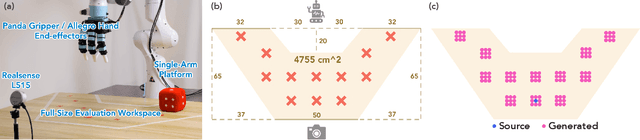
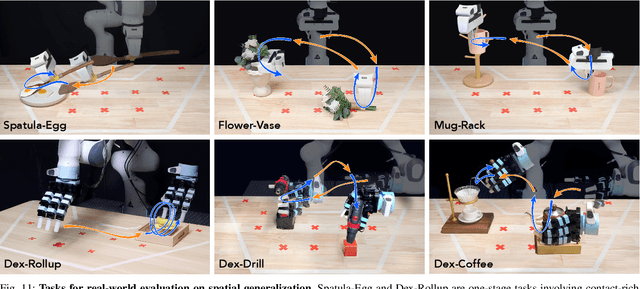
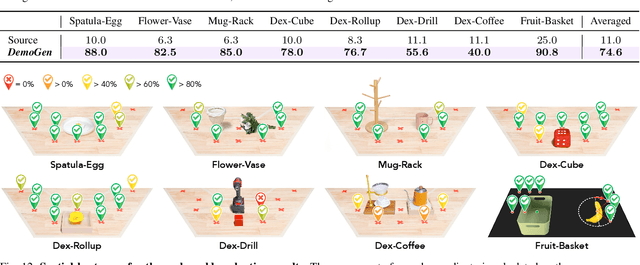
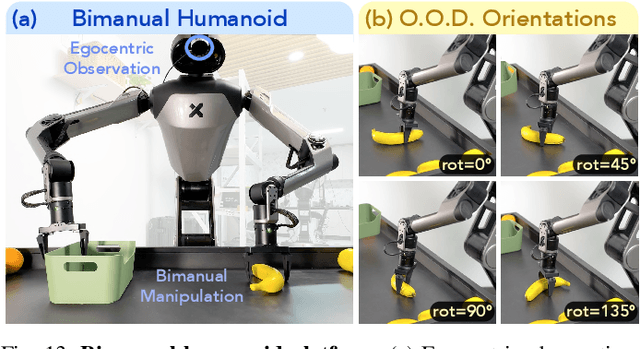
Visuomotor policies have shown great promise in robotic manipulation but often require substantial amounts of human-collected data for effective performance. A key reason underlying the data demands is their limited spatial generalization capability, which necessitates extensive data collection across different object configurations. In this work, we present DemoGen, a low-cost, fully synthetic approach for automatic demonstration generation. Using only one human-collected demonstration per task, DemoGen generates spatially augmented demonstrations by adapting the demonstrated action trajectory to novel object configurations. Visual observations are synthesized by leveraging 3D point clouds as the modality and rearranging the subjects in the scene via 3D editing. Empirically, DemoGen significantly enhances policy performance across a diverse range of real-world manipulation tasks, showing its applicability even in challenging scenarios involving deformable objects, dexterous hand end-effectors, and bimanual platforms. Furthermore, DemoGen can be extended to enable additional out-of-distribution capabilities, including disturbance resistance and obstacle avoidance.
Catch It! Learning to Catch in Flight with Mobile Dexterous Hands
Sep 16, 2024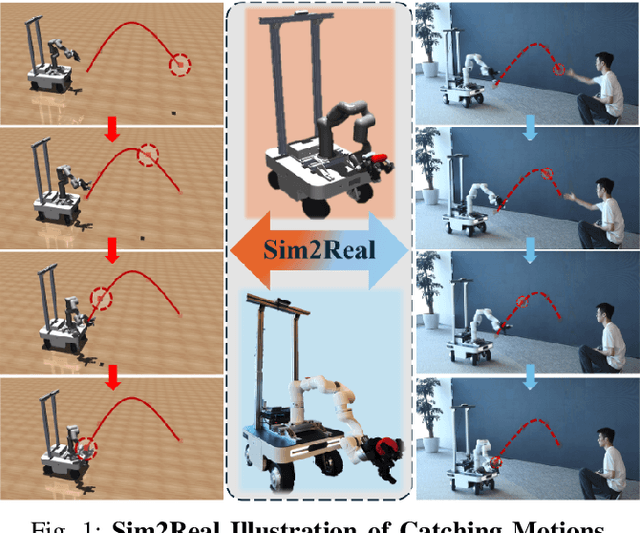
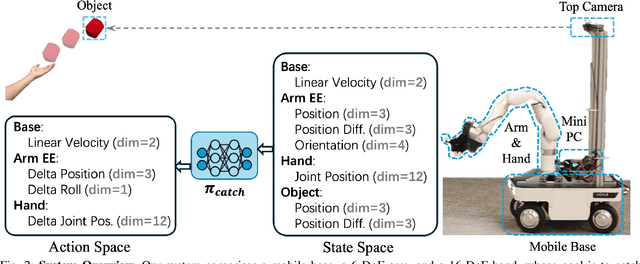
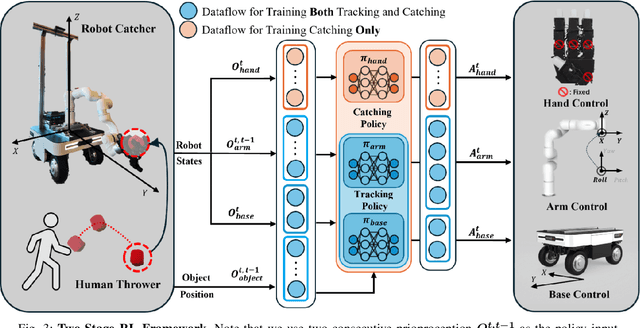
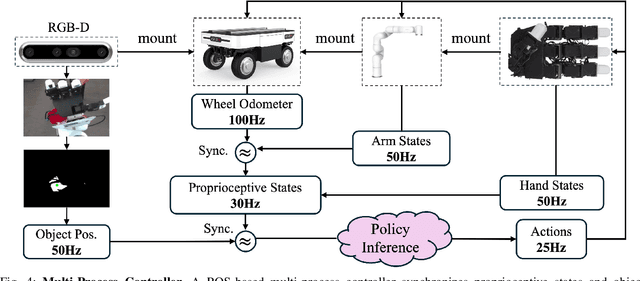
Catching objects in flight (i.e., thrown objects) is a common daily skill for humans, yet it presents a significant challenge for robots. This task requires a robot with agile and accurate motion, a large spatial workspace, and the ability to interact with diverse objects. In this paper, we build a mobile manipulator composed of a mobile base, a 6-DoF arm, and a 12-DoF dexterous hand to tackle such a challenging task. We propose a two-stage reinforcement learning framework to efficiently train a whole-body-control catching policy for this high-DoF system in simulation. The objects' throwing configurations, shapes, and sizes are randomized during training to enhance policy adaptivity to various trajectories and object characteristics in flight. The results show that our trained policy catches diverse objects with randomly thrown trajectories, at a high success rate of about 80\% in simulation, with a significant improvement over the baselines. The policy trained in simulation can be directly deployed in the real world with onboard sensing and computation, which achieves catching sandbags in various shapes, randomly thrown by humans. Our project page is available at https://mobile-dex-catch.github.io/.