 Add to Chrome
 Add to Firefox
 Add to Edge
Dual-Hop Joint Visible Light and Backscatter Communication Relaying under Finite Blocklength
Feb 25, 2026
This paper investigates a dual-hop joint visible light communication (VLC) and backscatter communication (BC) relaying framework under the finite blocklength (FBL) constraint, aiming at energy-neutral Ambient Internet of Things (A-IoT) deployments. In the proposed system, indoor LED access points are used to simultaneously provide illumination and transmit information over light to a backscatter device (BD), which harvests optical energy and backscatters the received messages to user equipments (UEs) equipped with radio frequency (RF) front ends. This forwarding of the information from VLC to RF channels is implemented without the need for carrier synthesizers and power amplifiers at the IoT node. By modeling the end-to-end communication link with short-packet IoT traffic and realistic levels of interference between adjacent VLC coverage areas, we analyze the outage performance and achievable data rate of the proposed system. Simulation results demonstrate that key factors, such as placement and orientation of the BD, as well as the selected code rate of the system affect reliability and data rate that can be achieved for communication purposes. The insights gained from this study pave the way for ambient power-enabled IoT solutions and future hybrid VLC/RF network designs.

Joint Visible Light and Backscatter Communications for Proximity-Based Indoor Asset Tracking Enabled by Energy-Neutral Devices
Oct 31, 2025In next-generation wireless systems, providing location-based mobile computing services for energy-neutral devices has become a crucial objective for the provision of sustainable Internet of Things (IoT). Visible light positioning (VLP) has gained great research attention as a complementary method to radio frequency (RF) solutions since it can leverage ubiquitous lighting infrastructure. However, conventional VLP receivers often rely on photodetectors or cameras that are power-hungry, complex, and expensive. To address this challenge, we propose a hybrid indoor asset tracking system that integrates visible light communication (VLC) and backscatter communication (BC) within a simultaneous lightwave information and power transfer (SLIPT) framework. We design a low-complexity and energy-neutral IoT node, namely backscatter device (BD) which harvests energy from light-emitting diode (LED) access points, and then modulates and reflects ambient RF carriers to indicate its location within particular VLC cells. We present a multi-cell VLC deployment with frequency division multiplexing (FDM) method that mitigates interference among LED access points by assigning them distinct frequency pairs based on a four-color map scheduling principle. We develop a lightweight particle filter (PF) tracking algorithm at an edge RF reader, where the fusion of proximity reports and the received backscatter signal strength are employed to track the BD. Experimental results show that this approach achieves the positioning error of 0.318 m at 50th percentile and 0.634 m at 90th percentile, while avoiding the use of complex photodetectors and active RF synthesizing components at the energy-neutral IoT node. By demonstrating robust performance in multiple indoor trajectories, the proposed solution enables scalable, cost-effective, and energy-neutral indoor tracking for pervasive and edge-assisted IoT applications.
Movable Antenna-Equipped UAV for Data Collection in Backscatter Sensor Networks: A Deep Reinforcement Learning-based Approach
Nov 21, 2024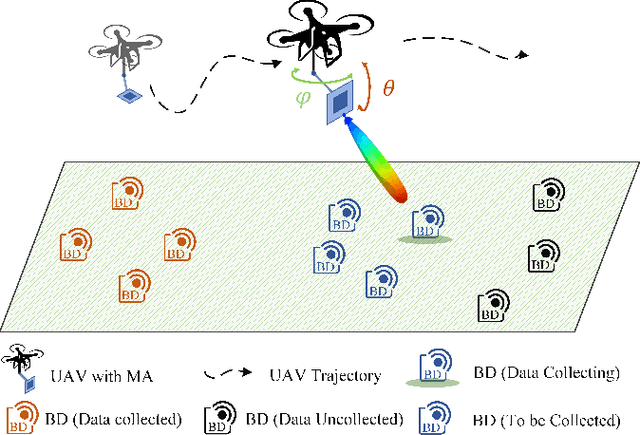
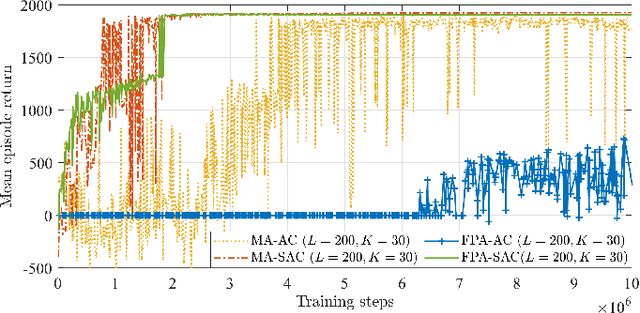
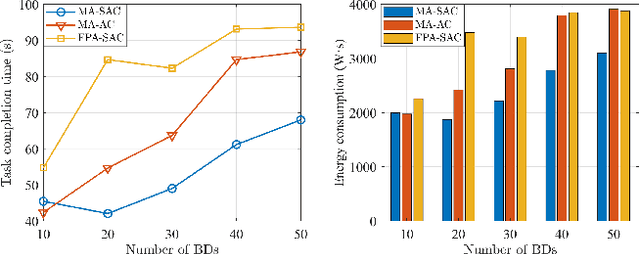

Backscatter communication (BC) becomes a promising energy-efficient solution for future wireless sensor networks (WSNs). Unmanned aerial vehicles (UAVs) enable flexible data collection from remote backscatter devices (BDs), yet conventional UAVs rely on omni-directional fixed-position antennas (FPAs), limiting channel gain and prolonging data collection time. To address this issue, we consider equipping a UAV with a directional movable antenna (MA) with high directivity and flexibility. The MA enhances channel gain by precisely aiming its main lobe at each BD, focusing transmission power for efficient communication. Our goal is to minimize the total data collection time by jointly optimizing the UAV's trajectory and the MA's orientation. We develop a deep reinforcement learning (DRL)-based strategy using the azimuth angle and distance between the UAV and each BD to simplify the agent's observation space. To ensure stability during training, we adopt Soft Actor-Critic (SAC) algorithm that balances exploration with reward maximization for efficient and reliable learning. Simulation results demonstrate that our proposed MA-equipped UAV with SAC outperforms both FPA-equipped UAVs and other RL methods, achieving significant reductions in both data collection time and energy consumption.
Thin Film Reconfigurable Intelligent Surface for Harmonic Beam Steering
Jun 10, 2024This letter explores the development and implementation of a novel thin film 1-by-4 reconfigurable intelligent surface (RIS) designed for future communication and sensing scenarios. Utilizing cost-effective inkjet printing methods and additive manufacturing, our approach significantly simplifies the RIS construction process and reduces production costs. The RIS, fabricated on a flexible and lightweight polyethylene terephthalate (PET) substrate, integrates antennas, switching circuitry, and a microcontroller unit (MCU). This setup enables individual and simultaneous control of each RIS element, manipulating the captured carrier signal by steering its dominant harmonics toward multiple desired directions. Measurement results of the beam steering show the manufactured RIS has the potential to enable RIS-aided communication and sensing applications.