 Add to Chrome
 Add to Firefox
 Add to Edge
Lighting-grounded Video Generation with Renderer-based Agent Reasoning
Apr 09, 2026
Diffusion models have achieved remarkable progress in video generation, but their controllability remains a major limitation. Key scene factors such as layout, lighting, and camera trajectory are often entangled or only weakly modeled, restricting their applicability in domains like filmmaking and virtual production where explicit scene control is essential. We present LiVER, a diffusion-based framework for scene-controllable video generation. To achieve this, we introduce a novel framework that conditions video synthesis on explicit 3D scene properties, supported by a new large-scale dataset with dense annotations of object layout, lighting, and camera parameters. Our method disentangles these properties by rendering control signals from a unified 3D representation. We propose a lightweight conditioning module and a progressive training strategy to integrate these signals into a foundational video diffusion model, ensuring stable convergence and high fidelity. Our framework enables a wide range of applications, including image-to-video and video-to-video synthesis where the underlying 3D scene is fully editable. To further enhance usability, we develop a scene agent that automatically translates high-level user instructions into the required 3D control signals. Experiments show that LiVER achieves state-of-the-art photorealism and temporal consistency while enabling precise, disentangled control over scene factors, setting a new standard for controllable video generation.

GraspVLA: a Grasping Foundation Model Pre-trained on Billion-scale Synthetic Action Data
May 06, 2025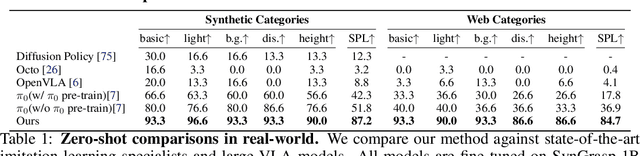
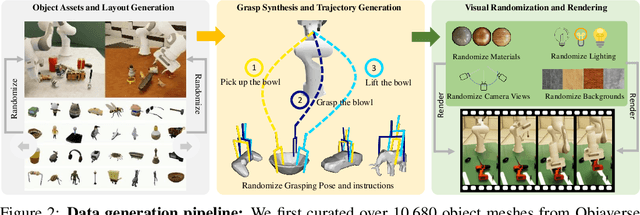
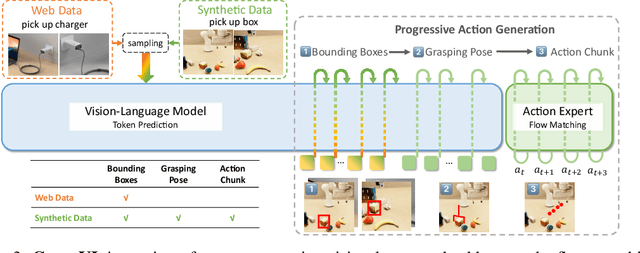
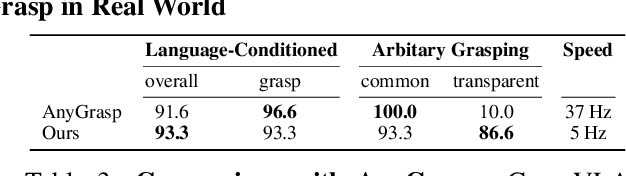
Embodied foundation models are gaining increasing attention for their zero-shot generalization, scalability, and adaptability to new tasks through few-shot post-training. However, existing models rely heavily on real-world data, which is costly and labor-intensive to collect. Synthetic data offers a cost-effective alternative, yet its potential remains largely underexplored. To bridge this gap, we explore the feasibility of training Vision-Language-Action models entirely with large-scale synthetic action data. We curate SynGrasp-1B, a billion-frame robotic grasping dataset generated in simulation with photorealistic rendering and extensive domain randomization. Building on this, we present GraspVLA, a VLA model pretrained on large-scale synthetic action data as a foundational model for grasping tasks. GraspVLA integrates autoregressive perception tasks and flow-matching-based action generation into a unified Chain-of-Thought process, enabling joint training on synthetic action data and Internet semantics data. This design helps mitigate sim-to-real gaps and facilitates the transfer of learned actions to a broader range of Internet-covered objects, achieving open-vocabulary generalization in grasping. Extensive evaluations across real-world and simulation benchmarks demonstrate GraspVLA's advanced zero-shot generalizability and few-shot adaptability to specific human preferences. We will release SynGrasp-1B dataset and pre-trained weights to benefit the community.