 Add to Chrome
 Add to Firefox
 Add to Edge
MASS: Multiplayer World Models with Authoritative Shared State
Aug 06, 2026
Current video world models struggle in multiplayer environments because they entangle world state with view-dependent visual latents, leading to redundant compute, view inconsistencies, and poor scalability. We propose MAS (Multiplayer world models with Authoritative Shared State) to resolve this limitation. Inspired by multiplayer game architectures, MAS disentangles world dynamics and view rendering. A learned Logic Engine advances a global, authoritative typed state from joint actions without any hand-written transition function, acting as the sole recurrent memory and synchronization reference. From this shared state, a learned Rendering Engine generates independent and consistent views for any requested camera on demand. This explicit disentangling allows MAS to achieve superior state accuracy and lower cross-view inconsistency compared to state-of-the-art multi-view baselines on a matched multiplayer Snake benchmark. It advances predicted worlds with 1,024 concurrent players for 10,000 recurrent steps. Our results show that explicit, authoritative state modeling provides a practical foundation for scalable and consistent multi-agent world simulation.

Video Generation Models Are Inherent Lighting Estimators
Jul 06, 2026Recovering dynamic environment maps from a single in-the-wild video is crucial for photorealistic rendering, yet remains a challenge. Recent video generation models can produce photorealistic scenes with complex lighting, possessing an inherent understanding of lighting. In this paper, we introduce V-LITE (Video generation models are inherent lighting estimators), a framework that unlocks this internal knowledge by reframing lighting estimation as a guided video inpainting task. Inspired by VFX industry practices, we insert a synthetic chrome ball into the scene to compel the model to generate physically plausible reflections from the surrounding spatio-temporal context. To bridge the gap from LDR-native models to the HDR domain, we design an HDR-aware VAE and employ an efficient LoRA-based fine-tuning strategy. We then construct a mixed dataset comprising high-fidelity HDR images to provide realistic HDR priors, and in-the-wild HDR videos to provide dynamic spatio-temporal context. Extensive experiments demonstrate that V-LITE produces temporally coherent HDR environment maps, revealing that modern video diffusion models are not merely synthesizers but also powerful, inherently capable estimators of physical scene lighting.
MAVIN: Multi-Shot Audio-Visual Generation with Narrative Control
Jun 28, 2026While recent generative models produce high-fidelity videos, they struggle with the complex narrative control required for coherent multi-shot audio-visual generation. Existing methods suffer from temporal misalignment, limited controllability, and incomplete scripting. In this paper, we propose MAVIN, the first framework for multi-shot audio-visual generation with customized narrative control. To resolve temporal misalignment, we propose boundary-aware attention, which leverages hierarchical captions and boundary-aware token routing to render audio-visual elements within their respective temporal boundaries. To improve the controllability for multi-subject scenarios, we propose ID-aware propagation, utilizing identity embeddings and an identity-aware mask to bind specific identities to consistent visual appearances and vocal timbres. To provide comprehensive audio-visual narratives, we present a multi-agent scripting pipeline to transform free-form user inputs into hierarchical captions. Furthermore, we construct MAVINSet, a multi-shot audio-visual dataset for robust training and evaluation. Extensive experiments demonstrate that MAVIN achieves state-of-the-art performance, opening up a new avenue for integrating generative models into professional filmmaking workflows.
ReContraster: Making Your Posters Stand Out with Regional Contrast
Apr 12, 2026Effective poster design requires rapidly capturing attention and clearly conveying messages. Inspired by the ``contrast effects'' principle, we propose ReContraster, the first training-free model to leverage regional contrast to make posters stand out. By emulating the cognitive behaviors of a poster designer, ReContraster introduces the compositional multi-agent system to identify elements, organize layout, and evaluate generated poster candidates. To further ensure harmonious transitions across region boundaries, ReContraster integrates the hybrid denoising strategy during the diffusion process. We additionally contribute a new benchmark dataset for comprehensive evaluation. Seven quantitative metrics and four user studies confirm its superiority over relevant state-of-the-art methods, producing visually striking and aesthetically appealing posters.
Lighting-grounded Video Generation with Renderer-based Agent Reasoning
Apr 09, 2026Diffusion models have achieved remarkable progress in video generation, but their controllability remains a major limitation. Key scene factors such as layout, lighting, and camera trajectory are often entangled or only weakly modeled, restricting their applicability in domains like filmmaking and virtual production where explicit scene control is essential. We present LiVER, a diffusion-based framework for scene-controllable video generation. To achieve this, we introduce a novel framework that conditions video synthesis on explicit 3D scene properties, supported by a new large-scale dataset with dense annotations of object layout, lighting, and camera parameters. Our method disentangles these properties by rendering control signals from a unified 3D representation. We propose a lightweight conditioning module and a progressive training strategy to integrate these signals into a foundational video diffusion model, ensuring stable convergence and high fidelity. Our framework enables a wide range of applications, including image-to-video and video-to-video synthesis where the underlying 3D scene is fully editable. To further enhance usability, we develop a scene agent that automatically translates high-level user instructions into the required 3D control signals. Experiments show that LiVER achieves state-of-the-art photorealism and temporal consistency while enabling precise, disentangled control over scene factors, setting a new standard for controllable video generation.
DreamPolish: Domain Score Distillation With Progressive Geometry Generation
Nov 03, 2024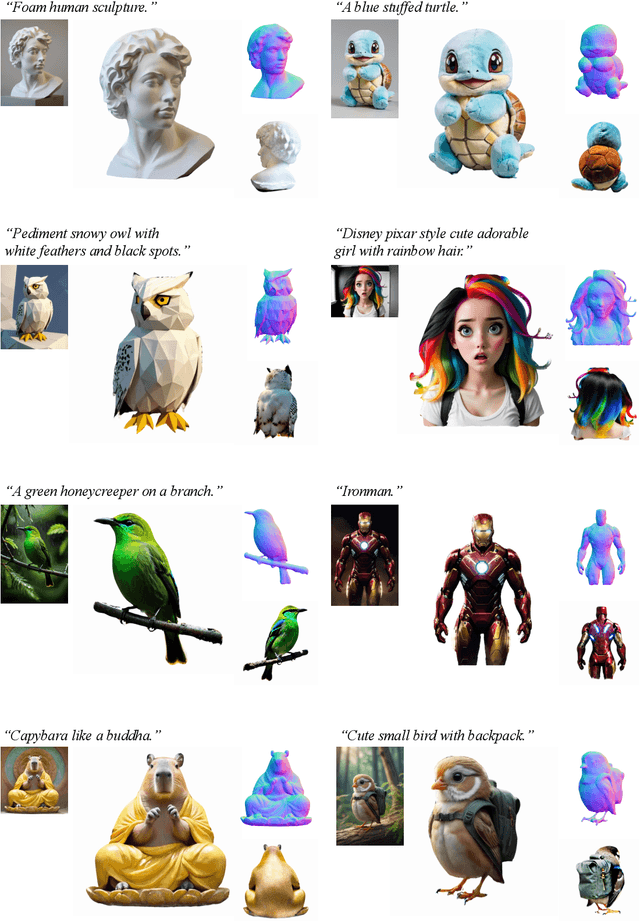
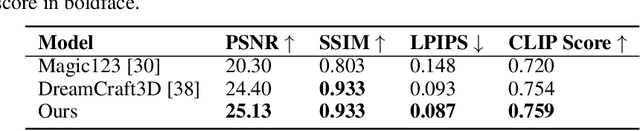
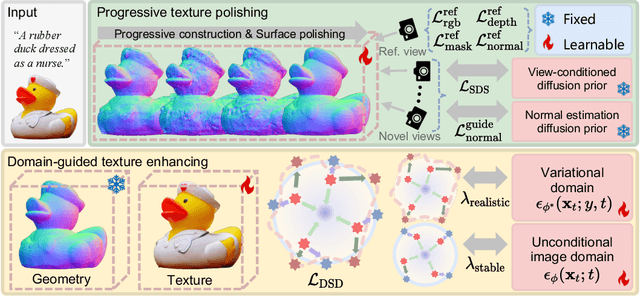
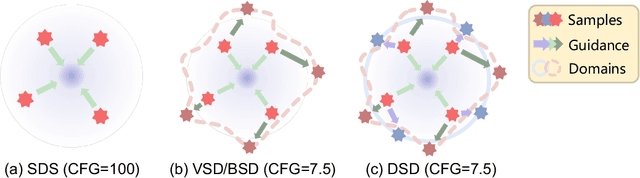
We introduce DreamPolish, a text-to-3D generation model that excels in producing refined geometry and high-quality textures. In the geometry construction phase, our approach leverages multiple neural representations to enhance the stability of the synthesis process. Instead of relying solely on a view-conditioned diffusion prior in the novel sampled views, which often leads to undesired artifacts in the geometric surface, we incorporate an additional normal estimator to polish the geometry details, conditioned on viewpoints with varying field-of-views. We propose to add a surface polishing stage with only a few training steps, which can effectively refine the artifacts attributed to limited guidance from previous stages and produce 3D objects with more desirable geometry. The key topic of texture generation using pretrained text-to-image models is to find a suitable domain in the vast latent distribution of these models that contains photorealistic and consistent renderings. In the texture generation phase, we introduce a novel score distillation objective, namely domain score distillation (DSD), to guide neural representations toward such a domain. We draw inspiration from the classifier-free guidance (CFG) in textconditioned image generation tasks and show that CFG and variational distribution guidance represent distinct aspects in gradient guidance and are both imperative domains for the enhancement of texture quality. Extensive experiments show our proposed model can produce 3D assets with polished surfaces and photorealistic textures, outperforming existing state-of-the-art methods.
Real-time 3D-aware Portrait Video Relighting
Oct 24, 2024Synthesizing realistic videos of talking faces under custom lighting conditions and viewing angles benefits various downstream applications like video conferencing. However, most existing relighting methods are either time-consuming or unable to adjust the viewpoints. In this paper, we present the first real-time 3D-aware method for relighting in-the-wild videos of talking faces based on Neural Radiance Fields (NeRF). Given an input portrait video, our method can synthesize talking faces under both novel views and novel lighting conditions with a photo-realistic and disentangled 3D representation. Specifically, we infer an albedo tri-plane, as well as a shading tri-plane based on a desired lighting condition for each video frame with fast dual-encoders. We also leverage a temporal consistency network to ensure smooth transitions and reduce flickering artifacts. Our method runs at 32.98 fps on consumer-level hardware and achieves state-of-the-art results in terms of reconstruction quality, lighting error, lighting instability, temporal consistency and inference speed. We demonstrate the effectiveness and interactivity of our method on various portrait videos with diverse lighting and viewing conditions.