 Add to Chrome
 Add to Firefox
 Add to Edge
Gradient Compression May Hurt Generalization: A Remedy by Synthetic Data Guided Sharpness Aware Minimization
Feb 12, 2026
It is commonly believed that gradient compression in federated learning (FL) enjoys significant improvement in communication efficiency with negligible performance degradation. In this paper, we find that gradient compression induces sharper loss landscapes in federated learning, particularly under non-IID data distributions, which suggests hindered generalization capability. The recently emerging Sharpness Aware Minimization (SAM) effectively searches for a flat minima by incorporating a gradient ascent step (i.e., perturbing the model with gradients) before the celebrated stochastic gradient descent. Nonetheless, the direct application of SAM in FL suffers from inaccurate estimation of the global perturbation due to data heterogeneity. Existing approaches propose to utilize the model update from the previous communication round as a rough estimate. However, its effectiveness is hindered when model update compression is incorporated. In this paper, we propose FedSynSAM, which leverages the global model trajectory to construct synthetic data and facilitates an accurate estimation of the global perturbation. The convergence of the proposed algorithm is established, and extensive experiments are conducted to validate its effectiveness.

Binary Flow Matching: Prediction-Loss Space Alignment for Robust Learning
Feb 11, 2026Flow matching has emerged as a powerful framework for generative modeling, with recent empirical successes highlighting the effectiveness of signal-space prediction ($x$-prediction). In this work, we investigate the transfer of this paradigm to binary manifolds, a fundamental setting for generative modeling of discrete data. While $x$-prediction remains effective, we identify a latent structural mismatch that arises when it is coupled with velocity-based objectives ($v$-loss), leading to a time-dependent singular weighting that amplifies gradient sensitivity to approximation errors. Motivated by this observation, we formalize prediction-loss alignment as a necessary condition for flow matching training. We prove that re-aligning the objective to the signal space ($x$-loss) eliminates the singular weighting, yielding uniformly bounded gradients and enabling robust training under uniform timestep sampling without reliance on heuristic schedules. Finally, with alignment secured, we examine design choices specific to binary data, revealing a topology-dependent distinction between probabilistic objectives (e.g., cross-entropy) and geometric losses (e.g., mean squared error). Together, these results provide theoretical foundations and practical guidelines for robust flow matching on binary -- and related discrete -- domains, positioning signal-space alignment as a key principle for robust diffusion learning.
Physics-Inspired Target Shape Detection and Reconstruction in mmWave Communication Systems
Feb 05, 2026The integration of sensing and communication (ISAC) is an essential function of future wireless systems. Due to its large available bandwidth, millimeter-wave (mmWave) ISAC systems are able to achieve high sensing accuracy. In this paper, we consider the multiple base-station (BS) collaborative sensing problem in a multi-input multi-output (MIMO) orthogonal frequency division multiplexing (OFDM) mmWave communication system. Our aim is to sense a remote target shape with the collected signals which consist of both the reflection and scattering signals. We first characterize the mmWave's scattering and reflection effects based on the Lambertian scattering model. Then we apply the periodogram technique to obtain rough scattering point detection, and further incorporate the subspace method to achieve more precise scattering and reflection point detection. Based on these, a reconstruction algorithm based on Hough Transform and principal component analysis (PCA) is designed for a single convex polygon target scenario. To improve the accuracy and completeness of the reconstruction results, we propose a method to further fuse the scattering and reflection points. Extensive simulation results validate the effectiveness of the proposed algorithms.
Toward a Sustainable Federated Learning Ecosystem: A Practical Least Core Mechanism for Payoff Allocation
Feb 03, 2026Emerging network paradigms and applications increasingly rely on federated learning (FL) to enable collaborative intelligence while preserving privacy. However, the sustainability of such collaborative environments hinges on a fair and stable payoff allocation mechanism. Focusing on coalition stability, this paper introduces a payoff allocation framework based on the least core (LC) concept. Unlike traditional methods, the LC prioritizes the cohesion of the federation by minimizing the maximum dissatisfaction among all potential subgroups, ensuring that no participant has an incentive to break away. To adapt this game-theoretic concept to practical, large-scale networks, we propose a streamlined implementation with a stack-based pruning algorithm, effectively balancing computational efficiency with allocation precision. Case studies in federated intrusion detection demonstrate that our mechanism correctly identifies pivotal contributors and strategic alliances. The results confirm that the practical LC framework promotes stable collaboration and fosters a sustainable FL ecosystem.
Talk2Move: Reinforcement Learning for Text-Instructed Object-Level Geometric Transformation in Scenes
Jan 08, 2026We introduce Talk2Move, a reinforcement learning (RL) based diffusion framework for text-instructed spatial transformation of objects within scenes. Spatially manipulating objects in a scene through natural language poses a challenge for multimodal generation systems. While existing text-based manipulation methods can adjust appearance or style, they struggle to perform object-level geometric transformations-such as translating, rotating, or resizing objects-due to scarce paired supervision and pixel-level optimization limits. Talk2Move employs Group Relative Policy Optimization (GRPO) to explore geometric actions through diverse rollouts generated from input images and lightweight textual variations, removing the need for costly paired data. A spatial reward guided model aligns geometric transformations with linguistic description, while off-policy step evaluation and active step sampling improve learning efficiency by focusing on informative transformation stages. Furthermore, we design object-centric spatial rewards that evaluate displacement, rotation, and scaling behaviors directly, enabling interpretable and coherent transformations. Experiments on curated benchmarks demonstrate that Talk2Move achieves precise, consistent, and semantically faithful object transformations, outperforming existing text-guided editing approaches in both spatial accuracy and scene coherence.
Random Multiplexing
Dec 30, 2025As wireless communication applications evolve from traditional multipath environments to high-mobility scenarios like unmanned aerial vehicles, multiplexing techniques have advanced accordingly. Traditional single-carrier frequency-domain equalization (SC-FDE) and orthogonal frequency-division multiplexing (OFDM) have given way to emerging orthogonal time-frequency space (OTFS) and affine frequency-division multiplexing (AFDM). These approaches exploit specific channel structures to diagonalize or sparsify the effective channel, thereby enabling low-complexity detection. However, their reliance on these structures significantly limits their robustness in dynamic, real-world environments. To address these challenges, this paper studies a random multiplexing technique that is decoupled from the physical channels, enabling its application to arbitrary norm-bounded and spectrally convergent channel matrices. Random multiplexing achieves statistical fading-channel ergodicity for transmitted signals by constructing an equivalent input-isotropic channel matrix in the random transform domain. It guarantees the asymptotic replica MAP bit-error rate (BER) optimality of AMP-type detectors for linear systems with arbitrary norm-bounded, spectrally convergent channel matrices and signaling configurations, under the unique fixed point assumption. A low-complexity cross-domain memory AMP (CD-MAMP) detector is considered, leveraging the sparsity of the time-domain channel and the randomness of the equivalent channel. Optimal power allocations are derived to minimize the replica MAP BER and maximize the replica constrained capacity of random multiplexing systems. The optimal coding principle and replica constrained-capacity optimality of CD-MAMP detector are investigated for random multiplexing systems. Additionally, the versatility of random multiplexing in diverse wireless applications is explored.
Rate Maximization for UAV-assisted ISAC System with Fluid Antennas
Oct 09, 2025This letter investigates the joint sensing problem between unmanned aerial vehicles (UAV) and base stations (BS) in integrated sensing and communication (ISAC) systems with fluid antennas (FA). In this system, the BS enhances its sensing performance through the UAV's perception system. We aim to maximize the communication rate between the BS and UAV while guaranteeing the joint system's sensing capability. By establishing a communication-sensing model with convex optimization properties, we decompose the problem and apply convex optimization to progressively solve key variables. An iterative algorithm employing an alternating optimization approach is subsequently developed to determine the optimal solution, significantly reducing the solution complexity. Simulation results validate the algorithm's effectiveness in balancing system performance.
Soft Graph Transformer for MIMO Detection
Sep 16, 2025

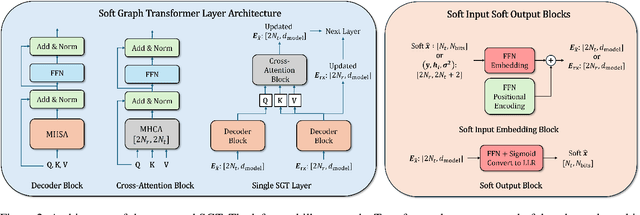
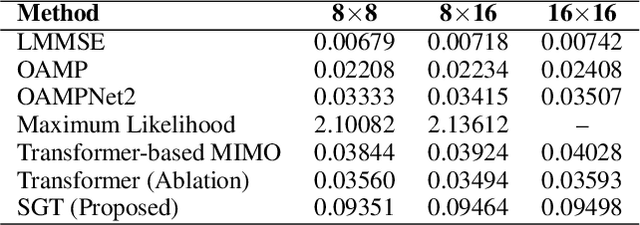
We propose the Soft Graph Transformer (SGT), a Soft-Input-Soft-Output neural architecture tailored for MIMO detection. While Maximum Likelihood (ML) detection achieves optimal accuracy, its prohibitive exponential complexity renders it impractical for real-world systems. Conventional message passing algorithms offer tractable alternatives but rely on large-system asymptotics and random matrix assumptions, both of which break down under practical implementations. Prior Transformer-based detectors, on the other hand, fail to incorporate the MIMO factor graph structure and cannot utilize decoder-side soft information, limiting their standalone performance and their applicability in iterative detection-decoding (IDD). To overcome these limitations, SGT integrates message passing directly into a graph-aware attention mechanism and supports decoder-informed updates through soft-input embeddings. This design enables effective soft-output generation while preserving computational efficiency. As a standalone detector, SGT closely approaches ML performance and surpasses prior Transformer-based approaches.
ToonComposer: Streamlining Cartoon Production with Generative Post-Keyframing
Aug 14, 2025
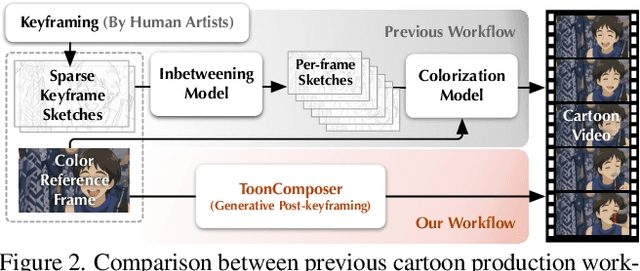
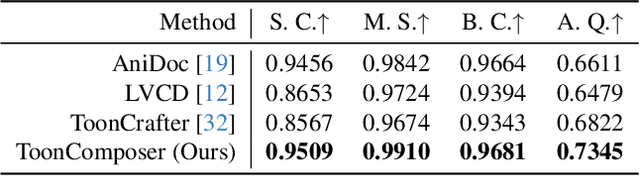
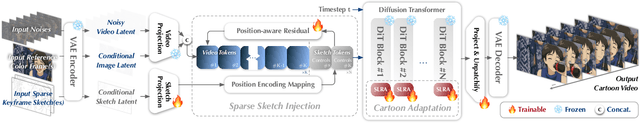
Traditional cartoon and anime production involves keyframing, inbetweening, and colorization stages, which require intensive manual effort. Despite recent advances in AI, existing methods often handle these stages separately, leading to error accumulation and artifacts. For instance, inbetweening approaches struggle with large motions, while colorization methods require dense per-frame sketches. To address this, we introduce ToonComposer, a generative model that unifies inbetweening and colorization into a single post-keyframing stage. ToonComposer employs a sparse sketch injection mechanism to provide precise control using keyframe sketches. Additionally, it uses a cartoon adaptation method with the spatial low-rank adapter to tailor a modern video foundation model to the cartoon domain while keeping its temporal prior intact. Requiring as few as a single sketch and a colored reference frame, ToonComposer excels with sparse inputs, while also supporting multiple sketches at any temporal location for more precise motion control. This dual capability reduces manual workload and improves flexibility, empowering artists in real-world scenarios. To evaluate our model, we further created PKBench, a benchmark featuring human-drawn sketches that simulate real-world use cases. Our evaluation demonstrates that ToonComposer outperforms existing methods in visual quality, motion consistency, and production efficiency, offering a superior and more flexible solution for AI-assisted cartoon production.
Integrated Communication and Remote Sensing in LEO Satellite Systems: Protocol, Architecture and Prototype
Aug 14, 2025In this paper, we explore the integration of communication and synthetic aperture radar (SAR)-based remote sensing in low Earth orbit (LEO) satellite systems to provide real-time SAR imaging and information transmission. Considering the high-mobility characteristics of satellite channels and limited processing capabilities of satellite payloads, we propose an integrated communication and remote sensing architecture based on an orthogonal delay-Doppler division multiplexing (ODDM) signal waveform. Both communication and SAR imaging functionalities are achieved with an integrated transceiver onboard the LEO satellite, utilizing the same waveform and radio frequency (RF) front-end. Based on such an architecture, we propose a transmission protocol compatible with the 5G NR standard using downlink pilots for joint channel estimation and SAR imaging. Furthermore, we design a unified signal processing framework for the integrated satellite receiver to simultaneously achieve high-performance channel sensing, low-complexity channel equalization and interference-free SAR imaging. Finally, the performance of the proposed integrated system is demonstrated through comprehensive analysis and extensive simulations in the sub-6 GHz band. Moreover, a software-defined radio (SDR) prototype is presented to validate its effectiveness for real-time SAR imaging and information transmission in satellite direct-connect user equipment (UE) scenarios within the millimeter-wave (mmWave) band.