 Add to Chrome
 Add to Firefox
 Add to Edge
Energy Efficiency Maximization for FAS-Assisted Downlink Communication in Mobile Embodied AI Networks (MEAN) over Interference Channels
Aug 13, 2026
In this paper, we investigate a fluid antenna system (FAS)-assisted downlink mobile embodied AI network (MEAN) over interference channels, where multiple base station (BS)-agent pairs reuse the same spectrum. The BSs employ FASs to improve the communication quality, while the mobile embodied artificial intelligence (AI) agents can adjust their positions according to environment-aware channel information, such as a channel-to-interference-plus-noise map (CINM). Considering both co-channel interference and the energy consumption caused by communication and agent movement, we formulate an energy efficiency (EE) maximization problem by jointly optimizing the agent positions, FAS port selections, and transmit powers. To solve this mixed-integer non-convex problem, we first derive the optimal transmit power in closed form for given agent positions and FAS ports. We then develop an iterative algorithm with adaptive FAS-port optimization and sequential agent-position optimization, together with a low-complexity power-update method. Simulation results demonstrate that the proposed design outperforms the considered benchmark schemes and provides improved feasibility under severe noise conditions.

Joint Communication and Computation Design for Mobile Embodied AI Network (MEAN)
May 14, 2026This letter investigates the problem of energy efficient collaborative strategy for mobile embodied artificial intelligence network (MEAN) over wireless communication. In the considered model, the agents execute the tasks through collaboration, and they can switch between two operating modes based on the signal-to-noise ratio (SNR) and global collaboration. The dual-mode comprises the base station (BS)-assisted collaborative mode, in which agents make decisions through semantic communication with BS and then collaborate on tasks, and the local computing mode, in which the agents make decisions and execute tasks independently. Due to the dynamic wireless communication and flexible collaboration strategy, we jointly consider computation energy, communication energy, and task-execution energy with specific collaborative gains into a mixed-integer nonlinear programming (MINLP) optimization problem whose goal is to minimize the total system energy consumption. To solve it, we propose a lower-complexity enumeration algorithm: first, we get the optimal closed-form solution for semantic compression ratio and transmit power by proving the strict convexity. Second, we determine the scale of collaboration and the operating mode of each agent by a greedy sorting algorithm based on individual energy-saving potentials. Simulation results show that the proposed algorithm can significantly reduce the total energy consumption compared to benchmark schemes.
On Performance of Fluid Antenna Relay (FAR)-Assisted AAV-NOMA Wireless Network
Mar 26, 2026In this paper, we investigate the performance of a fluid antenna relay (FAR)-assisted downlink communication system utilizing non-orthogonal multiple access (NOMA). The FAR, which integrates a fluid antenna system (FAS), is equipped on an autonomous aerial vehicle (AAV), and introduces extra degrees of freedom to improve the performance of the system. The transmission is divided into a first phase from the base station (BS) to the users and the FAR, and a second phase where the FAR forwards the signal using amplify-and-forward (AF) or decode-and-forward (DF) relaying to reduce the outage probability (OP) for the user maintaining weaker channel conditions. To analyze the OP performance of the weak user, Copula theory and the Gaussian copula function are employed to model the statistical distribution of the FAS channels. Analytical expressions for weak user's OP are derived for both the AF and the DF schemes. Simulation results validate the effectiveness of the proposed scheme, showing that it consistently outperforms benchmark schemes without the FAR. In addition, numerical simulations also demonstrate the values of the relaying scheme selection parameter under different FAR positions and communication outage thresholds.
Resource Allocation for Green Probabilistic Semantic Communication with Rate Splitting
Mar 31, 2024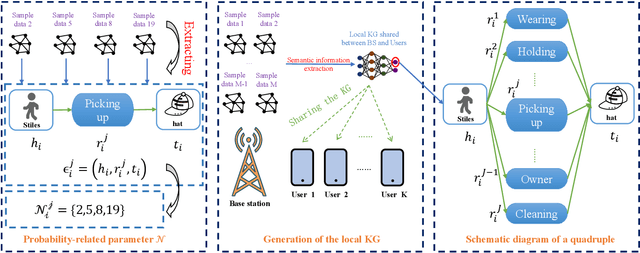
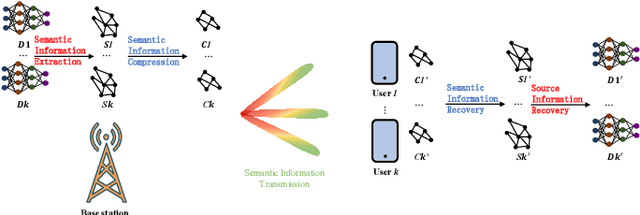
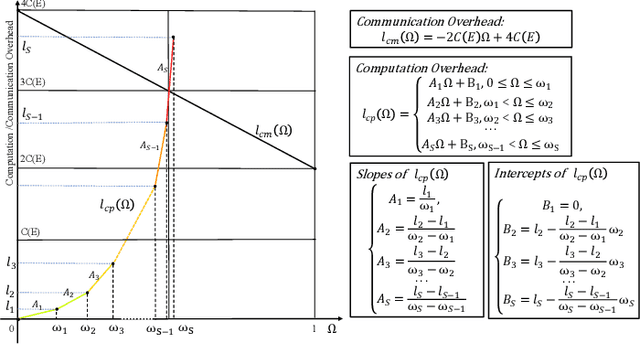
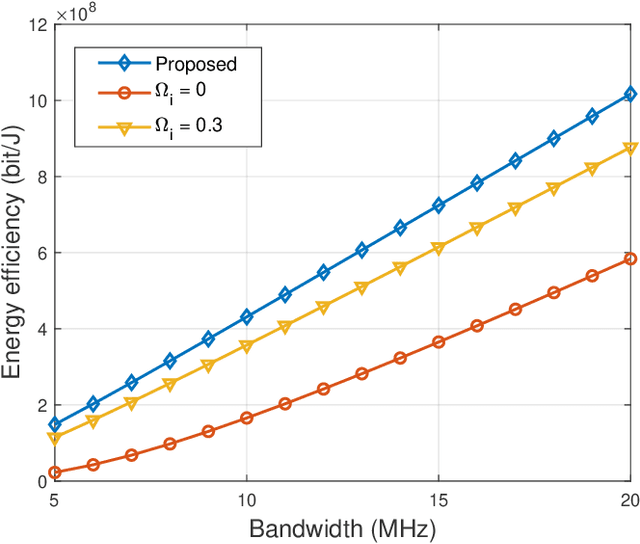
In this paper, the energy efficient design for probabilistic semantic communication (PSC) system with rate splitting multiple access (RSMA) is investigated. Basic principles are first reviewed to show how the PSC system works to extract, compress and transmit the semantic information in a task-oriented transmission. Subsequently, the process of how multiuser semantic information can be represented, compressed and transmitted with RSMA is presented, during which the semantic compression ratio (SCR) is introduced to directly measure the computation overhead in a transmission task, and communication overhead is indirectly described as well. Hence, the problem of wireless resource allocation jointly considering the computation and communication consumption for the PSC system with RSMA is investigated. Both conventional wireless resource constraints and unique constraints on semantic communication are considered to maximize the energy efficiency (EE). Simulation results verify the effectiveness of the proposed scheme.
Fluid Antenna Relay Assisted Communication Systems Through Antenna Location Optimization
Mar 31, 2024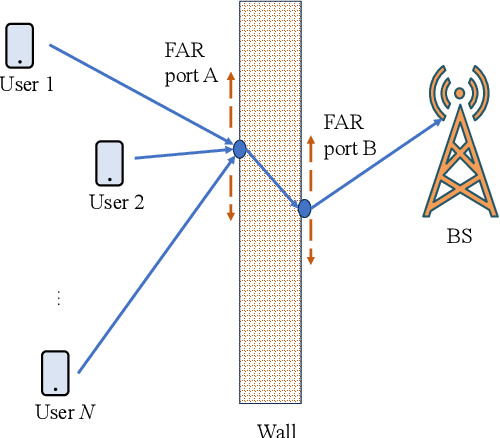
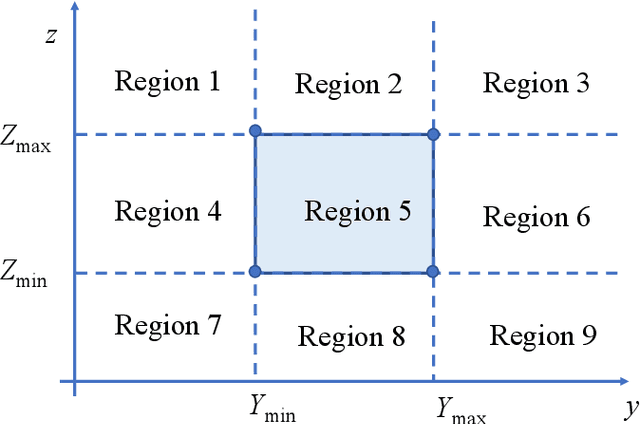
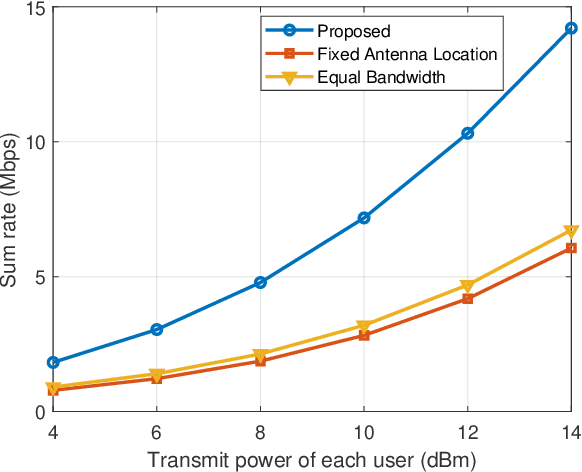
In this paper, we investigate the problem of resource allocation for fluid antenna relay (FAR) system with antenna location optimization. In the considered model, each user transmits information to a base station (BS) with help of FAR. The antenna location of the FAR is flexible and can be adapted to dynamic location distribution of the users. We formulate a sum rate maximization problem through jointly optimizing the antenna location and bandwidth allocation with meeting the minimum rate requirements, total bandwidth budget, and feasible antenna region constraints. To solve this problem, we obtain the optimal bandwidth in closed form. Based on the optimal bandwidth, the original problem is reduced to the antenna location optimization problem and an alternating algorithm is proposed. Simulation results verify the effectiveness of the proposed algorithm and the sum rate can be increased by up to 125% compared to the conventional schemes.